
If your CMMC evidence package is a spreadsheet full of screenshots, policy filenames, and uncertain notes, you do not have audit readiness. You have an evidence problem waiting to become an assessment problem.
Defense suppliers struggle with CMMC not because they do not care about cybersecurity. They struggle because they cannot consistently prove that their controls operate as described.
A screenshot may show that a setting was enabled once. A policy may describe what should happen without proving that it does happen. A log may exist but cover only part of the environment. A configuration may have changed six months ago with no documented history.
CMMC assessors do not evaluate intentions. They evaluate implemented, repeatable, and supportable practices.
That is where CPE Level 2 changes the operating model. Instead of treating evidence as a last-minute paperwork exercise, the enclave makes evidence collection, monitoring, and operational maintenance routine.
The Real Evidence Problems Defense Suppliers Face
Most organizations begin with a familiar checklist:
- “We have a policy for that.”
- “We took a screenshot.”
- “The setting should still be enabled.”
- “Our IT provider probably has the logs.”
- “We will gather the evidence before the assessment.”
- “We can put the remaining items in a POA&M.”
That approach creates anxiety because it depends on memory, manual effort, and assumptions.
1. Screenshots are snapshots, not operational proof
A screenshot can show a configuration at a specific moment. It generally does not show:
- Who changed the setting
- When the setting changed
- Whether the setting remained enabled
- Which systems were covered
- Whether exceptions existed
- Whether the configuration was reviewed afterward
Screenshots can be useful evidence, but they are not a substitute for continuous technical verification.
2. Policies can become stale
A policy may say that multi-factor authentication is required. That does not prove that every in-scope account uses it.
A procedure may require quarterly access reviews. That does not prove the reviews occurred, that findings were addressed, or that the review covered every applicable system.
CMMC evidence must connect the written requirement to actual implementation and ongoing execution.
3. Logs are often incomplete
Organizations frequently discover that:
- Critical systems are not forwarding logs
- Log retention periods are too short
- Time synchronization is inconsistent
- Administrative activity is not captured
- Alerts are generated but never reviewed
- SIEM data is not mapped to the relevant controls
An assessor may ask for a period of record. If the record does not exist, cannot be trusted, or cannot be explained, the spreadsheet will not save you.
4. Configuration history is missing
CMMC readiness is not just about the current state. You need confidence that the control has operated consistently.
Without configuration history, it becomes difficult to prove:
- Baselines were established
- Changes were approved
- Patches were applied
- Vulnerabilities were remediated
- Access rights were reviewed
- Security settings were not silently weakened
5. POA&M anxiety never goes away
A POA&M can document a legitimate remediation plan, but it is not a strategy for avoiding implementation. If too many requirements depend on future work, the organization may face a low SPRS score, contract risk, and difficult conversations with an assessor or customer.
The goal should be simple: reduce the number of open gaps and continuously prove that the implemented controls are operating.
CMMC 2.0 Level 2 Requires More Than a Completed Checklist
CMMC 2.0 Level 2 is aligned with NIST SP 800-171 Rev. 2 and includes:
- 110 CMMC requirements
- 320 assessment objectives
- Evidence evaluated through examination, interview, and testing
- Documentation tied to the defined system scope
- Technical and procedural proof that controls operate as required
The CMMC Level 2 Assessment Guide makes the practical expectation clear: organizations must be able to demonstrate implementation, not merely state that a control exists.
One missing objective can affect an entire requirement. One undocumented exception can create questions about scope. One inconsistent process can undermine confidence in related evidence.
The evidence package must tell one consistent story:
- This is our defined scope.
- This is how the control is implemented.
- This is how the control is monitored.
- This is what happened over time.
- This is who is responsible.
- This is the evidence that proves it.
How CPE Level 2 Makes Evidence Routine
CPE Level 2 is designed as an integrated environment of hardware, software, security configuration, policies, procedures, training, and managed operations.
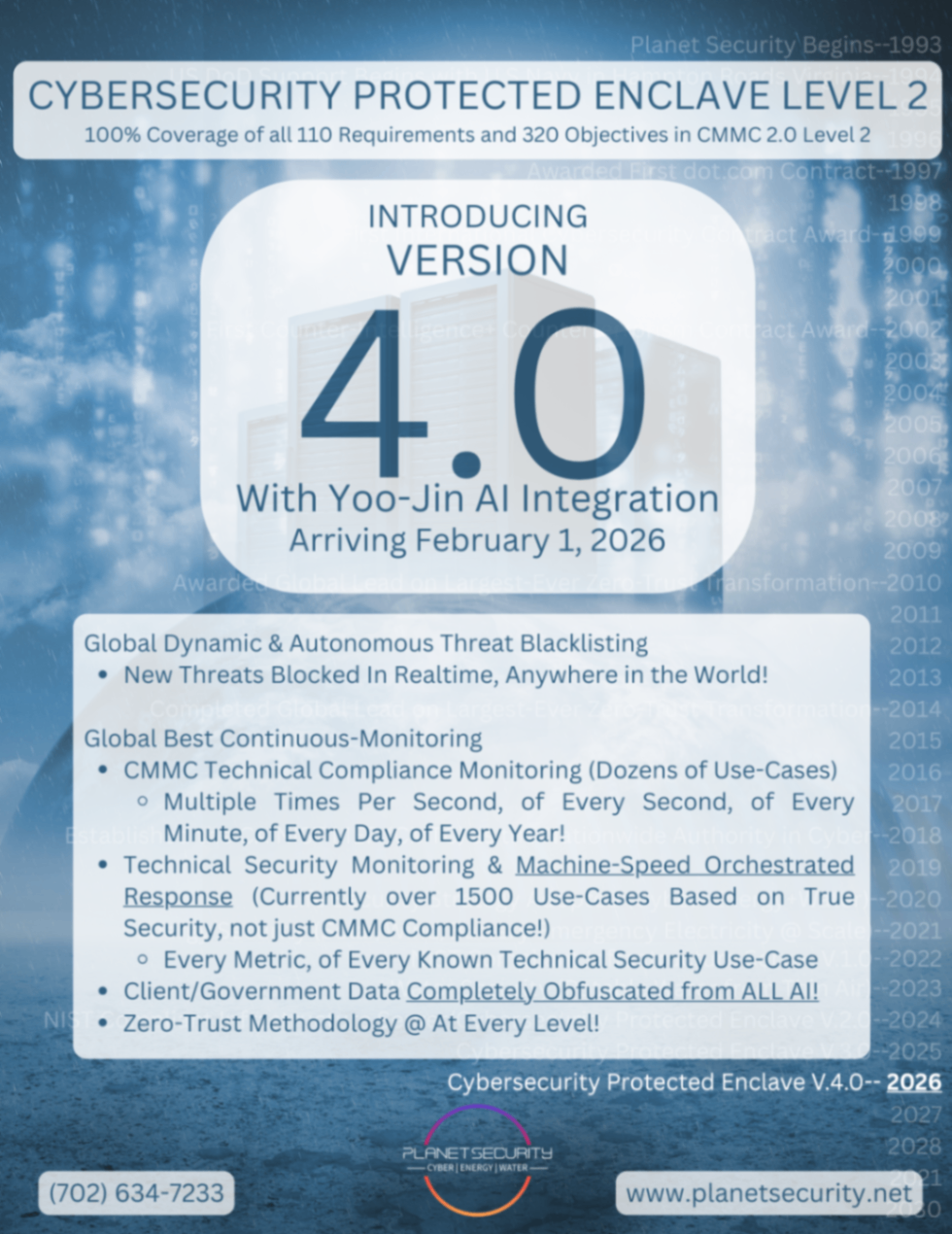
It provides 100% coverage of the 110 CMMC requirements and 320 objectives applicable to CMMC 2.0 Level 2 through a controlled architecture and ongoing operational support.
That means evidence is not created only when an assessment is approaching. It is produced as part of normal security operations.
Automated evidence collection
The enclave automates the collection and organization of evidence from the systems inside the defined boundary, including:
- Security configuration status
- Access control and authentication data
- Patch and update records
- Audit and event logs
- Backup and recovery activity
- Vulnerability and remediation records
- Encryption status
- Security review activity
- Incident response documentation
- Training and awareness records
The result is a living evidence trail instead of a spreadsheet assembled under pressure.
Continuous monitoring
Continuous monitoring helps identify when a control drifts from its intended state.
Instead of waiting for a quarterly review to discover that a system is misconfigured, managed monitoring can identify issues closer to the time they occur. This improves both security and audit readiness.
Monitoring supports practical questions such as:
- Is the required configuration still active?
- Are logs being collected from all in-scope systems?
- Are privileged accounts behaving as expected?
- Are patches and security updates current?
- Are backup jobs completing successfully?
- Has a control exception been documented and approved?
Audit readiness becomes a byproduct of security operations.
Managed operations and maintenance
Technology alone does not maintain compliance. People, processes, and accountability matter.
CPE Level 2 includes ongoing managed operations, maintenance, security monitoring, patching, training support, and compliance reporting. It also provides access to experienced guidance through virtual security leadership and audit support.
This addresses a major pain point for small and midsize defense suppliers: you may not have the staff to operate a complete compliance program every day, but your obligations still require daily discipline.
Hardened segmentation
A well-defined enclave limits where CUI resides, who can access it, and how it moves.
The environment uses hardened segmentation and a security reference architecture to separate protected systems from the broader business network. That reduces scope, limits unnecessary access, and makes the evidence story easier to defend.
A smaller, controlled boundary is easier to monitor than an entire corporate environment with unclear CUI flows.
Privacy-First AI: Why Generic AI Tools Cannot Be Trusted With Client Data
AI can help with security operations, but generic AI tools cannot be trusted with client data, intellectual property, financial information, personal information, or CUI.
Sending sensitive content into a public or broadly shared AI service creates questions about:
- Data retention
- Training use
- Third-party access
- Data residency
- Administrative visibility
- Contractual confidentiality
- Incident response responsibility
Yoo-Jin, integrated into CPE Level 2, uses AI-obfuscated data for privacy-first workflows. The AI does not need direct access to raw client data to support monitoring, analysis, and automation.
This is fundamentally different from the prevailing Big-Tech approach of ingesting sensitive information into systems with unclear governance.
Yoo-Jin is designed to help automate security and compliance workflows without exposing the client’s underlying data to the AI.
That distinction matters. In a CUI environment, convenience cannot come before data protection.

What About the Current CMMC Phase 2 Pause?
As of August 21, 2026, the Department of Defense has paused the CMMC Phase 2 rollout and related implementation milestones while a reform review proceeds.
That pause does not mean cybersecurity obligations disappeared.
Defense suppliers must continue to pay attention to applicable contractual and regulatory requirements, including:
- Protecting CUI under DFARS 252.204-7012
- Implementing applicable NIST SP 800-171 Rev. 2 requirements
- Maintaining accurate System Security Plan documentation
- Keeping SPRS information and annual affirmations accurate where required
- Completing required self-assessments
- Flowing down applicable obligations to subcontractors
- Maintaining evidence that supports compliance claims
The current pause may change the timing or verification mechanism for some organizations. It does not eliminate the need to protect CUI or prove that your security program is real.
In fact, this is a practical opportunity to replace fragile, manual evidence practices with a controlled environment that is ready for whatever requirements come next.
A Practical Readiness Test
Ask your team these five questions:
- Can we show evidence for every applicable objective, not just every requirement?
- Can we prove that our controls operated consistently over time?
- Can we explain every system, user, data flow, and service provider in scope?
- Can we identify who owns each control and who can answer assessor questions?
- Can we produce evidence without rebuilding our compliance program from scratch?
If the answer to any of these questions is “not yet,” your evidence process needs improvement.
CPE Level 2 is built to make that improvement operational. Full implementation can often be achieved in approximately 4 to 8 weeks, depending on scope and deployment requirements. The important outcome is not simply speed. It is the creation of a repeatable operating environment that supports security, compliance, and peace of mind.
Frequently Asked Questions
Is a spreadsheet useless for CMMC?
No. A spreadsheet can help track responsibilities, evidence references, and remediation tasks. But a spreadsheet cannot operate a control, collect reliable telemetry, or prove consistency by itself.
Does 100% coverage guarantee a passing assessment?
No technology can replace organizational accountability or an independent assessor’s judgment. However, CPE Level 2 is engineered to provide 100% coverage of the 110 requirements and 320 objectives, with the operational evidence and support needed to make those controls defensible.
Can CPE Level 2 help with POA&M concerns?
Yes. The objective is to address requirements systematically, reduce manual gaps, continuously identify drift, and keep remediation visible. That supports a more disciplined approach to POA&M management and reduces last-minute surprises.
Is AI safe to use in a CUI environment?
Generic AI tools cannot be trusted with client data. Yoo-Jin uses AI-obfuscated data so AI-enabled workflows can support security operations without exposing raw client information to the AI.
What should we do while Phase 2 is paused?
Continue protecting CUI, maintain accurate compliance records, monitor applicable contract language, keep required assessments and affirmations current, and build an environment that can withstand future changes.
planetsecurity.net 702.634.7233 QR code: contact Planet Security
We welcome a discussion on how we may assist in your CMMC success story!