Washington can pause, revise, or debate CMMC Phase II. Phishing campaigns do not wait for policy updates.
Attackers targeting defense suppliers are still sending convincing invoices, fake contract documents, credential-harvesting links, malicious attachments, and carefully researched social engineering messages. Their objective is simple: compromise one user, steal credentials, move laterally, and reach Controlled Unclassified Information (CUI).
The compliance calendar may change. Your obligation to protect CUI does not.
DFARS requirements and the security expectations established by NIST SP 800-171 remain central to defense contracting. The current CMMC Assessment Guide: Level 2 makes the point clearly: organizations must demonstrate that security requirements are implemented, operating as intended, and supported by evidence.
That is why CPE Level 2 is the pragmatic answer for protecting CUI now: not after the next rulemaking cycle.
A CMMC Pause Is Not a Security Holiday
A pause in third-party assessment activity does not make phishing less dangerous. It does not eliminate the need for security awareness training, incident response, access control, audit logging, or continuous monitoring.
It only changes the immediate oversight environment.
If your organization handles CUI, you still need to:
- Protect CUI from unauthorized access and disclosure.
- Maintain a defensible system security plan.
- Implement the applicable NIST SP 800-171 controls.
- Control remote access and use multifactor authentication.
- Train personnel to recognize and report suspicious activity.
- Monitor systems for attacks and indicators of compromise.
- Track incidents, vulnerabilities, remediation, and evidence.
- Maintain security controls as threats and technology change.
Attackers do not care whether your next assessment is self-assessed, third-party assessed, delayed, or rescheduled. They care whether an employee can be tricked into opening a malicious file.
Phishing Is a Human Problem: and a Technical Problem
A phishing email may begin with a human decision, but the consequences quickly become technical.
One successful click can expose:
- Credentials and multifactor authentication tokens.
- Email accounts and contact lists.
- Contract files and engineering documents.
- Shared drives containing CUI.
- Remote administration tools.
- Internal network pathways.
- Backups and recovery systems.
That is why CMMC 2.0 Level 2 treats security awareness and training as more than an annual checkbox. The Level 2 assessment guidance specifically addresses risk awareness, role-based training, insider threat awareness, malicious code protection, audit logging, incident handling, and system monitoring.
Your users need training. But training alone is not a complete defense. A serious CUI environment must assume that someone will eventually click the wrong link. The architecture must limit the damage, detect abnormal behavior, contain the incident, and preserve the evidence required to understand what happened.

Why CPE Level 2 Is Built for This Threat
CPE Level 2 is a hardened, turnkey environment designed around the complete scope of CMMC 2.0 Level 2.
It provides 100% coverage of all 110 CMMC requirements and 320 assessment objectives associated with NIST SP 800-171 Revision 2.
This is not a collection of disconnected cybersecurity products. It combines:
- Hardened enclave infrastructure built specifically for CUI.
- Security-focused network segmentation and controlled information flows.
- Least-privilege access controls to reduce the impact of compromised accounts.
- Multifactor authentication for privileged and network access.
- FIPS-validated cryptographic protections where required.
- Endpoint, server, and network hardening.
- Security patching and configuration maintenance.
- Integrated backup and recovery capabilities.
- Security awareness, role-based, and insider threat training.
- Continuous SIEM monitoring for suspicious activity.
- Incident response procedures and operational support.
- Automated evidence collection and audit preparation.
- Ongoing reporting and compliance verification.
- vCISO guidance and human client support.
The goal is direct: contain CUI, reduce the attack surface, detect threats quickly, and make compliance evidence available without forcing your team to reconstruct months of activity manually.
Automated Evidence Matters After a Phishing Incident
When phishing succeeds, leadership needs answers immediately:
- Which user interacted with the message?
- What device was involved?
- What credentials or sessions were used?
- Was CUI accessed, copied, or transmitted?
- Did the attacker move to another system?
- What controls blocked further activity?
- What evidence supports the incident report?
- What remediation steps were completed?
Without centralized logging and continuous monitoring, answering these questions can take days: or may be impossible.
CPE Level 2 is designed to automate evidence collection across the environment. Security events, configuration changes, access activity, training records, patching actions, and monitoring results become part of an ongoing compliance record.
That gives your team something far more valuable than a binder of policies: visibility into whether the controls are actually working.
Yoo-Jin AI: Privacy-First Automation for CUI Environments
Artificial intelligence can help security teams respond faster, but generic Big Tech AI tools cannot be trusted with client data by default. Sending CUI, intellectual property, financial information, or personal data into an external model creates governance, retention, and disclosure concerns that defense suppliers cannot ignore.
Yoo-Jin is different by design.
Planet Security’s privacy-first AI approach uses AI-obfuscated data in AI-enabled workflows. Yoo-Jin does not need access to raw client data to support security operations, monitoring, and compliance automation.
That distinction matters.
Yoo-Jin can help support:
- Continuous technical compliance monitoring.
- Threat intelligence and dynamic blacklisting.
- Security configuration verification.
- Compliance evidence organization.
- Alert prioritization.
- Audit preparation.
- Operational reporting.
At the same time, client data remains protected from the AI system itself. There is no reason to trade CUI confidentiality for automation.
Learn more about Yoo-Jin AI and its role inside CPE Level 2.
The Practical Path to Peace of Mind
Many defense suppliers are stuck between two bad choices:
- Continue operating a legacy environment that is difficult to scope, harden, and document.
- Attempt a massive enterprise-wide remediation project that takes months or years.
A purpose-built enclave changes the equation.
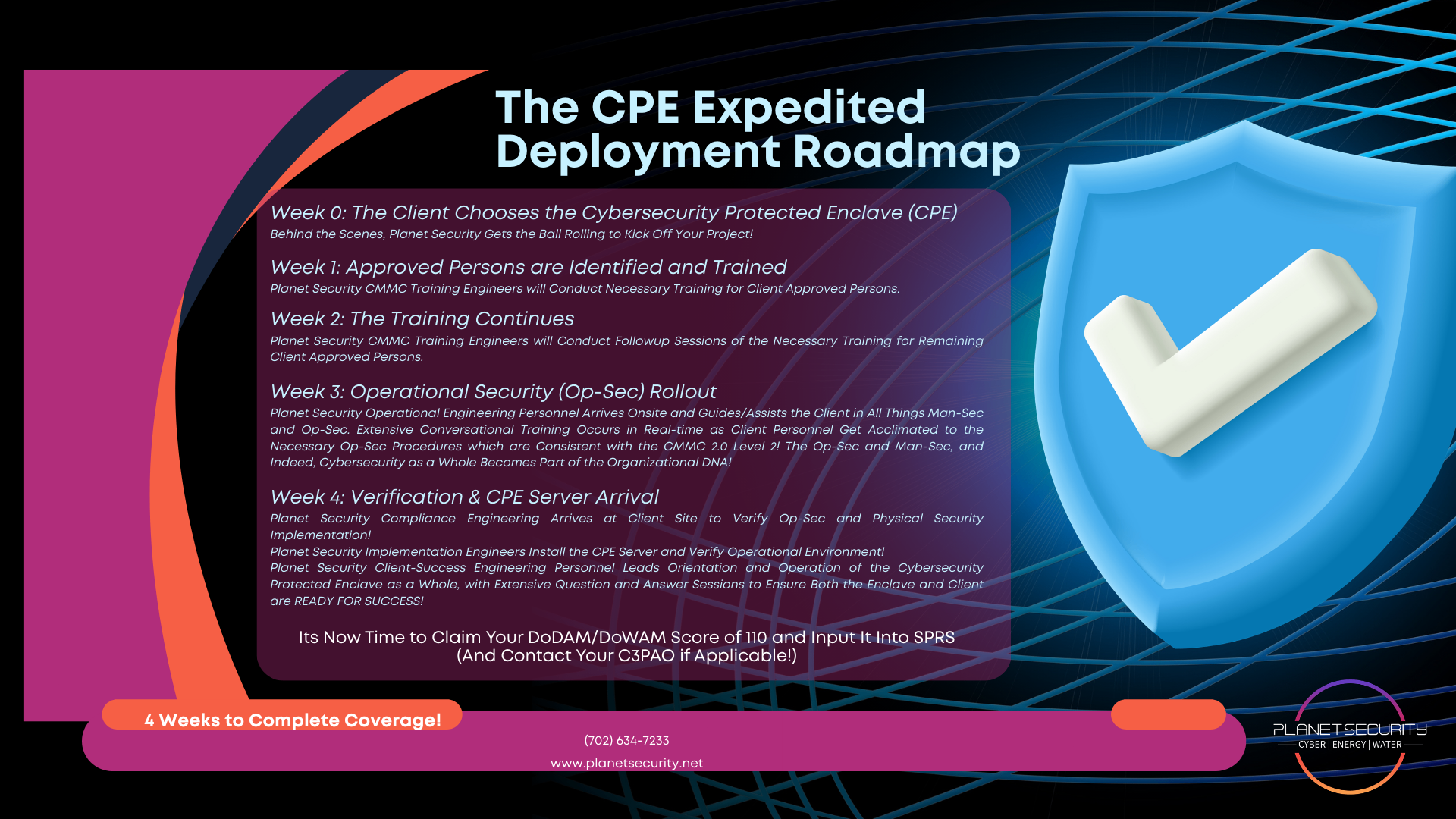
With CPE Level 2, your organization can isolate CUI operations inside a controlled environment while the rest of the business continues functioning. Full implementation is typically achieved in approximately 4–8 weeks, depending on deployment complexity and organizational readiness.
That means you can stop treating CMMC as an endless technology project and start treating it as an operational capability.
You know where CUI lives. You know who can access it. You know which controls protect it. You know what evidence exists.
That is peace of mind.
Frequently Asked Questions
Does a CMMC Phase II pause mean we can delay phishing defenses?
No. A pause in assessment timing does not eliminate your obligation to protect CUI or address the risks covered by NIST SP 800-171 and DFARS requirements. Phishing remains an active threat every day.
Does security awareness training satisfy the entire phishing risk?
No. Training is necessary, but it must be supported by technical controls. MFA, least privilege, segmentation, malware protection, SIEM monitoring, incident response, and controlled access all reduce the impact of a successful phishing attempt.
How many requirements does CPE Level 2 cover?
CPE Level 2 is engineered for 100% coverage of 110 CMMC requirements and 320 assessment objectives associated with CMMC 2.0 Level 2 and NIST SP 800-171 Revision 2.
Can AI be used safely around CUI?
Only with appropriate privacy controls. Generic AI tools cannot be trusted with client data simply because they are convenient. Yoo-Jin uses AI-obfuscated data so it can support automation without requiring access to raw CUI.
Is CPE Level 2 only for large defense contractors?
No. It is especially valuable for small and medium-sized defense suppliers that need a clean, controlled, and defensible way to protect CUI without rebuilding the entire enterprise.
Do Not Wait for Washington to Decide Your Security Posture
The next CMMC announcement may change an assessment deadline. It will not change the next phishing email.
Your CUI needs protection today. Your customers need confidence today. Your leadership team needs evidence today.
There is no substitute for a hardened enclave, complete control coverage, automated evidence, continuous SIEM monitoring, and privacy-first security operations. CPE Level 2 gives defense suppliers the pragmatic, 100% coverage answer.
| planetsecurity.net | 702.634.7233 |  |
|---|
We welcome a discussion on how we may assist in your CMMC success story!