If you are a defense supplier waiting for the CMMC Reform Task Force report, you are not alone. The RFI comment period closed on August 14, 2026, and final recommendations are expected around mid-September 2026.
That creates plenty of questions:
- Will third-party assessments remain part of the program?
- Will implementation timelines change?
- Will the Department of Defense modify the assessment model?
- Will more contractors be required to prove compliance before contract award?
Those questions matter. But they do not change what defense contractors must do today.
NIST SP 800-171 obligations remain active. Annual affirmations remain important. SPRS self-assessment scores still matter. Contracting officers still need visibility into a supplier’s cybersecurity posture.
The only practical way to stay ready for every possible CMMC outcome is to build a compliant, defensible environment now. For many defense suppliers, that means deploying CPE Level 2 instead of waiting for the policy environment to settle.
The Task Force Report Is Coming: But Your Obligations Have Not Disappeared
The closure of the RFI is a milestone in the review process. It is not a waiver, suspension, or replacement for current cybersecurity requirements.
While the Department evaluates potential reforms, contractors handling Controlled Unclassified Information should continue to:
- Implement NIST SP 800-171 protections.
- Maintain accurate system boundaries and asset inventories.
- Complete required self-assessments.
- Submit and maintain SPRS scores.
- Complete annual affirmations.
- Preserve evidence showing that controls operate continuously.
- Protect CUI across people, processes, technology, and third-party relationships.
For CMMC 2.0 Level 2, the scope remains substantial: 110 requirements and 320 assessment objectives based on NIST SP 800-171 Revision 2.
That is not a checklist you can complete once and forget. It is an operating model.
The task force may recommend changes to assessment timing, certification pathways, or program structure. However, a supplier that already has a hardened, monitored, documented environment is prepared for far more outcomes than a supplier that has only completed a spreadsheet.
Why Waiting Is the Riskier Strategy
Many contractors are taking a “wait and see” approach. That feels reasonable until you examine the consequences.
If the final recommendations preserve demanding assessment requirements, organizations that delayed will face a compressed remediation timeline. If the recommendations simplify one part of the process, they may still leave core NIST SP 800-171 security responsibilities intact.
Either way, the underlying risks remain:
- Ransomware can disrupt production and delay contract performance.
- Nation-state actors continue targeting the defense industrial base.
- Weak identity controls can expose CUI.
- Unmanaged endpoints can undermine otherwise strong network defenses.
- Incomplete documentation can create major problems during an assessment.
- An outdated SPRS score can weaken contract competitiveness.
- A missed annual affirmation can put an organization’s compliance status at risk.
Policy uncertainty does not create a security holiday. Threat actors are not waiting for the September report.
Deploying CPE Level 2 now converts uncertainty into preparation.
What CPE Level 2 Delivers
CPE Level 2 is a turnkey protected environment designed for organizations that need a practical path to CMMC 2.0 Level 2 readiness.
It brings the technical and operational pieces together instead of forcing a contractor to assemble a patchwork of consultants, cloud services, policies, security tools, and disconnected evidence repositories.
Core capabilities include:
- Coverage of all 110 CMMC requirements and 320 objectives
- Hardened infrastructure designed for CUI workloads
- Segmentation and controlled access
- Secure configuration and system hardening
- Encryption for data at rest and in transit
- Identity, authentication, and least-privilege controls
- Centralized logging and security event monitoring
- Vulnerability management and patching
- Backup and recovery procedures
- Incident response support
- Continuous compliance monitoring
- Evidence collection and reporting
- Security policies and operational procedures
- Training and documented responsibilities
- Managed maintenance and security operations
- Audit preparation and assessment support
- Virtual CISO-level guidance when needed
The result is not merely a compliance document set. It is an operating environment built to protect CUI and demonstrate that protection over time.

A 4–8 Week Path to a Defensible Environment
The deployment timeline is typically 4–8 weeks, depending on organizational readiness, user count, data migration requirements, policies, and coordination with the customer’s team.
A typical deployment may include:
Weeks 1–2: Scope and Foundation
- Confirm CUI boundaries
- Identify users, systems, and workflows
- Establish access requirements
- Configure the protected infrastructure
- Begin policy and procedure alignment
Weeks 3–4: Security Implementation
- Apply hardened configurations
- Implement identity and access controls
- Configure monitoring and logging
- Validate encryption and backup processes
- Begin evidence collection
Weeks 5–8: Validation and Operational Readiness
- Test procedures and response workflows
- Resolve outstanding configuration issues
- Review documentation
- Validate evidence against requirements
- Prepare for assessment and continuing operations
A faster four-week deployment is available when the organization can provide timely information, make decisions quickly, and limit unnecessary scope changes. An eight-week deployment provides additional time for planning, training, workflow refinement, and migration.
This flexibility matters because every defense supplier has a different starting point. The objective is not to force every company into an artificial schedule. The objective is to establish a secure, supportable, auditable environment before contract pressure makes every decision urgent.
Yoo-Jin AI: Automation Without Exposing Client Data
AI can improve security operations: but generic AI tools cannot be trusted with client data, intellectual property, financial information, personal information, or CUI.
That is why Planet Security uses AI-obfuscated data in AI-enabled workflows.
Yoo-Jin AI supports security monitoring, technical compliance workflows, threat intelligence, and response orchestration while never accessing client data. The architecture is intentionally different from Big-Tech approaches that may ingest sensitive information into systems with unclear governance, retention, or downstream use.
Yoo-Jin AI helps support:
- Continuous technical monitoring
- Configuration validation
- Security event analysis
- Threat intelligence updates
- Dynamic threat blacklisting
- Compliance evidence workflows
- Security alert prioritization
- Machine-speed response orchestration
- Zero-trust enforcement support
- Monitoring across more than 1,500 security use cases
The point is simple: use AI to strengthen the environment without handing AI the data you are obligated to protect.

What the Monthly Service Includes
CPE Level 2 is available at $1,299/month for up to 20 users.
That monthly service includes:
- Protected enclave infrastructure
- Hardware and software components
- Managed operations and maintenance
- Security monitoring
- Continuous compliance monitoring
- Patching and configuration management
- Backup and recovery capabilities
- SIEM and security event support
- Policy and procedure assistance
- Training support
- Audit preparation
- vCISO-level guidance
- Yoo-Jin AI integration using AI-obfuscated data
Deployment length can affect monthly pricing. Choosing an eight-week deployment instead of a four-week deployment reduces the monthly price by $100. The right deployment model depends on your CUI scope, personnel availability, migration needs, and desired implementation speed.
The pricing conversation should come after the risk conversation. The real question is whether your current environment can protect CUI, support your contract obligations, and produce credible evidence when an assessor or contracting officer asks for it.
FAQ for Defense Suppliers Waiting on the Report
Does the closed RFI change my current CMMC obligations?
No. The RFI closing date is a process milestone. It does not eliminate current NIST SP 800-171, SPRS, self-assessment, or annual affirmation responsibilities.
Should I wait until the final recommendations are published?
No. Waiting creates avoidable risk. A properly designed CPE Level 2 environment supports current requirements and positions your organization for potential future changes.
Does CPE Level 2 cover all CMMC 2.0 Level 2 requirements?
It is engineered to address 100% of the 110 requirements and 320 objectives associated with CMMC 2.0 Level 2 and NIST SP 800-171 Revision 2.
Can my organization use AI with CUI?
Generic AI tools should not receive CUI or other sensitive client information. Yoo-Jin AI uses AI-obfuscated data and is designed to never access client data.
How quickly can we deploy?
Most deployments fall within 4–8 weeks, with an accelerated four-week path available for organizations that are ready to move quickly.
Be Ready Before the Policy Becomes Final
The September report may clarify the direction of CMMC reform. It will not remove the need for disciplined cybersecurity.
Defense suppliers that act now will have:
- A stronger security posture
- Better protection for CUI
- More reliable evidence
- Greater confidence in SPRS reporting
- Less disruption when requirements evolve
- A clearer path to assessment readiness
- More peace of mind for leadership, customers, and contracting teams
There is no substitute for a secure environment that is already operating correctly.
Deploy CPE Level 2 now, continue meeting today’s obligations, and be prepared for tomorrow’s final recommendations.
We welcome a discussion on how we may assist in your CMMC success story!
Contact Planet Security or call 702.634.7233.
| planetsecurity.net | 702.634.7233 | 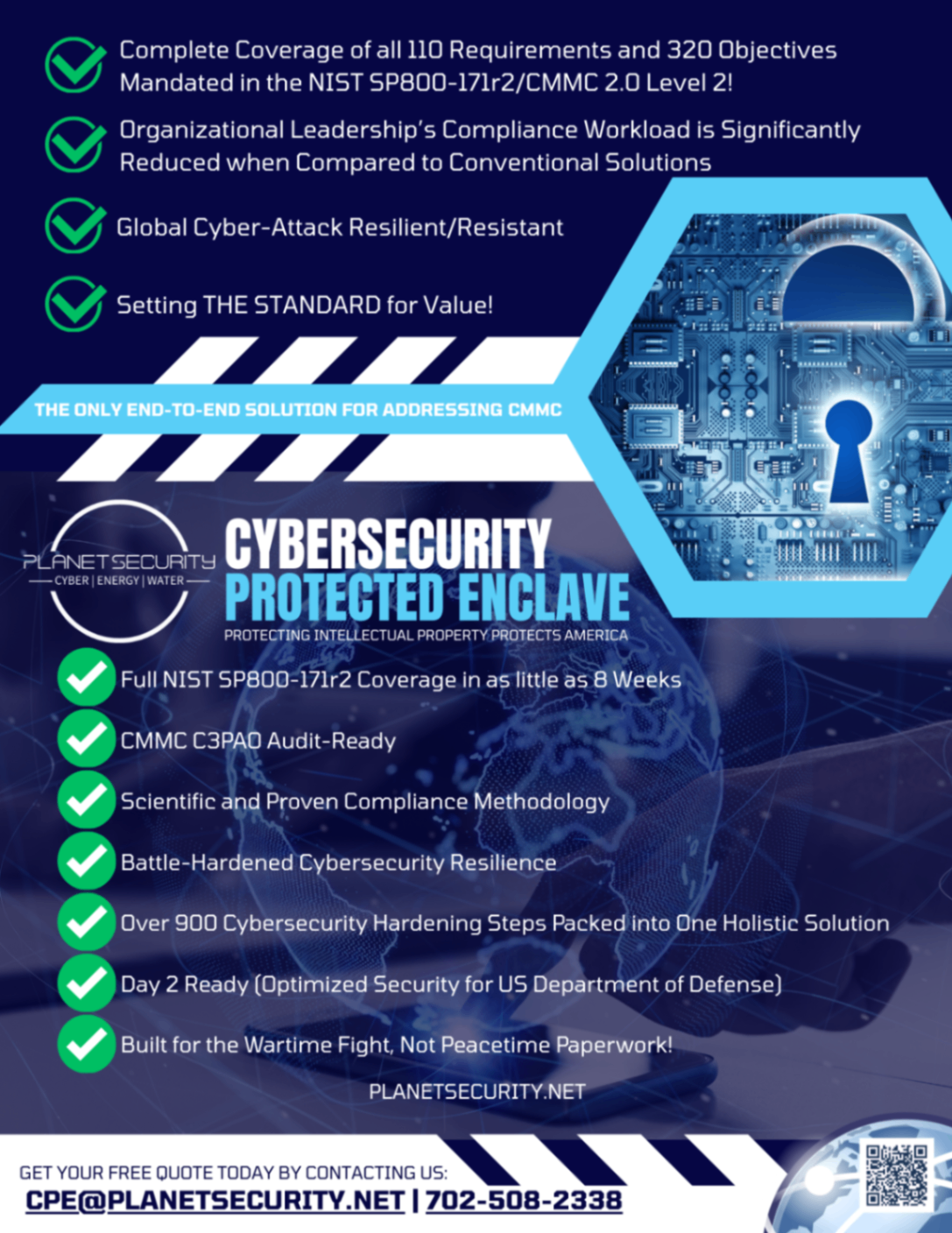 |
|---|