
If your organization is preparing for a CMMC 2.0 Level 2 certification assessment, your C3PAO is not evaluating your intentions. Assessors are evaluating whether your security requirements are implemented correctly, operating as intended, and supported by documented, verifiable evidence.
A policy that says “MFA is enabled” is not enough.
A screenshot showing a configuration window is not enough.
A verbal statement from an administrator is not enough.
Your evidence must demonstrate that the control exists, works, is maintained, and applies to the actual system boundary containing, processing, or transmitting Controlled Unclassified Information (CUI).
That is exactly why CPE Level 2 is built differently. It is designed to provide 100% coverage of the 110 CMMC requirements and 320 assessment objectives associated with NIST SP 800-171 Rev. 2: while continuously generating the operational evidence assessors need to verify implementation.
C3PAO Assessors Follow Evidence: Not Explanations
The official CMMC Level 2 Assessment Guide makes the standard clear. Assessors use three methods:
- Examine : Review policies, procedures, system configurations, logs, records, diagrams, reports, and other artifacts.
- Interview : Speak with personnel responsible for security, operations, access control, incident response, and system administration.
- Test : Validate that mechanisms and processes operate as documented.
A requirement is considered MET only when every applicable assessment objective is satisfied based on evidence. Evidence must be final, current, attributable, and relevant to the assessed environment.
This creates a serious challenge for defense suppliers using disconnected tools and manual spreadsheets. Your team may have dozens of policies, hundreds of screenshots, and years of technical records: but if those artifacts are stale, incomplete, unapproved, or disconnected from the actual system, they may not support a MET finding.
Compliance is not what you claim. Compliance is what you can prove.
The Real Scope: 110 Requirements and 320 Objectives
CMMC 2.0 Level 2 is based on the 110 security requirements in NIST SP 800-171 Rev. 2. Those requirements are evaluated through approximately 320 assessment objectives using NIST SP 800-171A assessment procedures.
That means your organization is not preparing for 110 conversations. You are preparing to demonstrate evidence across hundreds of specific determination statements.
For example, access control evidence may need to show that:
- Authorized users are identified.
- Authorized processes are identified.
- Authorized devices are identified.
- Access is limited to authorized users, processes, and devices.
- Privileged access is restricted.
- Remote access is controlled and monitored.
- User actions are uniquely traceable.
- Audit records are created, protected, retained, and reviewed.
- Configuration changes are approved, logged, and documented.
A single screenshot cannot prove all of that.
A policy alone cannot prove all of that.
You need a repeatable evidence system that connects requirements to configurations, activities, personnel, and dated records.
How CPE Level 2 Turns Controls Into Evidence
CPE Level 2 combines infrastructure, licensing, security configuration, managed operations, policies, procedures, training, monitoring, maintenance, and reporting into one controlled environment.
The objective is direct: implement the control, monitor the control, and continuously produce evidence that the control is working.
1. Automated Evidence Collection
Evidence collection is built into the operating model instead of being treated as a last-minute audit project.
The environment is designed to collect and organize artifacts such as:
- Configuration baselines
- Account and privilege records
- MFA and authentication status
- Patch and update records
- Vulnerability scan results
- Security alerts and response records
- Audit logs and event history
- Backup and recovery activity
- Change management records
- Access reviews
- Training records
- Policy and procedure acknowledgments
- System and network documentation
- Continuous monitoring outputs
This approach gives your team a defensible trail from the CMMC requirement to the implemented safeguard and the evidence proving ongoing operation.
2. Continuous Monitoring
CMMC does not reward a “set it and forget it” approach. Security controls must remain effective after implementation.
CPE Level 2 continuously monitors the enclave for security and compliance conditions, including:
- Unauthorized access attempts
- Configuration drift
- Vulnerability exposure
- Missing patches
- Suspicious inbound and outbound communications
- Audit logging failures
- Unexpected privilege use
- Backup failures
- Unauthorized devices
- Deviations from the approved baseline
When conditions change, the evidence changes with them. That matters because a clean report from six months ago does not prove that your environment is secure today.
3. Audit-Ready Reporting
Assessors need evidence they can retrieve, understand, validate, and associate with the system under assessment.
CPE Level 2 supports audit preparation through structured reporting that can help organize evidence by:
- Requirement
- Assessment objective
- Evidence type
- System component
- Responsible role
- Collection date
- Validation status
- Remediation status
- Supporting policy or procedure
This is the difference between handing an assessor a disorganized folder and providing an evidence package that tells a clear story.
The strongest audit package makes it easy to answer three questions: What is implemented? Where is it implemented? What proves that it is operating?
More Than 900 Targeted Hardening Steps: Applied Before the Audit
CMMC requirements are broad. Secure implementation is technical.
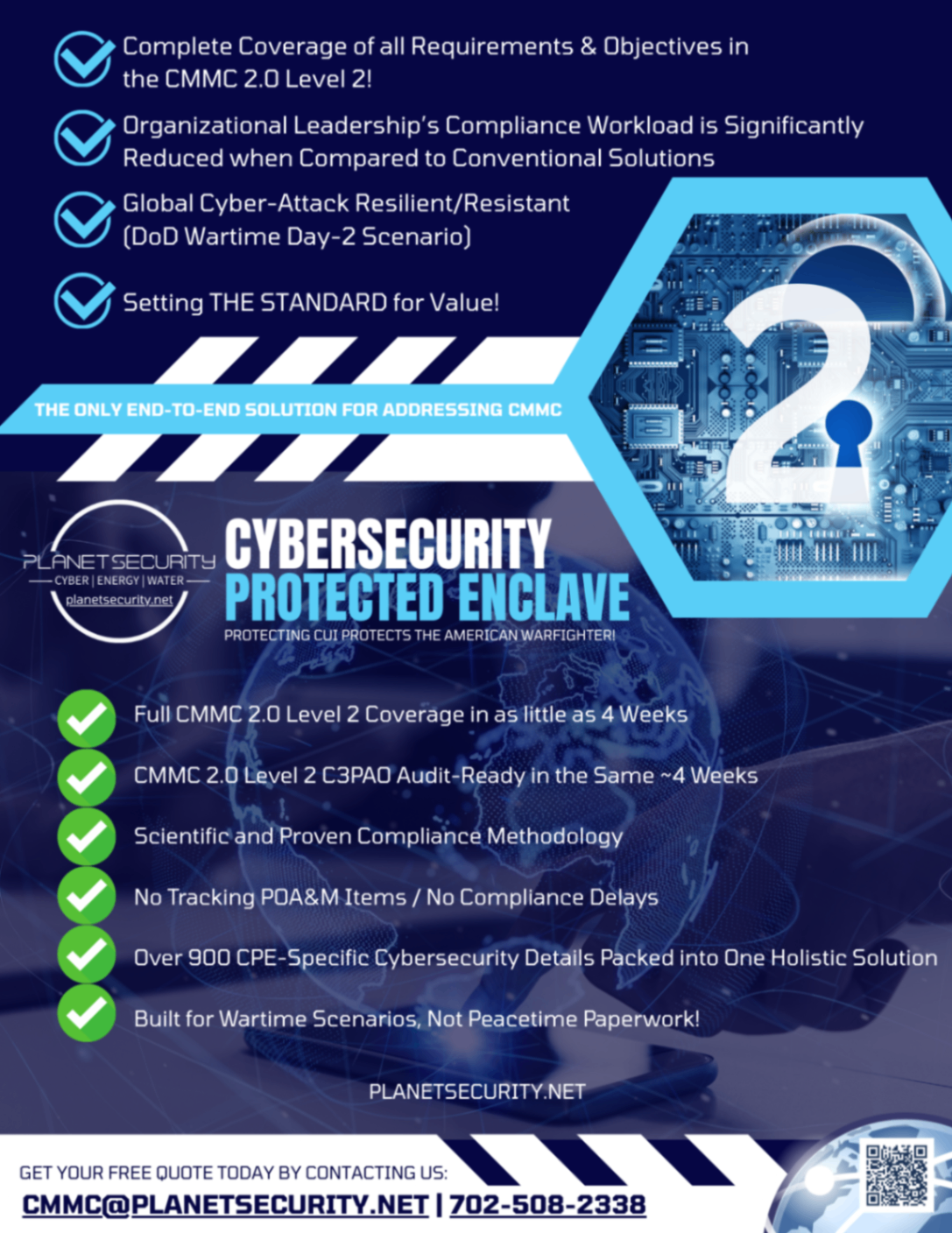
CPE Level 2 includes more than 900 targeted hardening steps across infrastructure, operating systems, identity, network security, logging, backup, endpoint protection, and configuration management.
Those steps support controls such as:
- Least privilege
- Separation of duties
- Secure configuration baselines
- Deny-by-default network communications
- Network segmentation
- FIPS-validated cryptography where required
- Centralized logging
- Vulnerability scanning
- Flaw remediation
- Malware protection
- Incident response
- Backup confidentiality
- Secure remote access
- System inventory
- Change control
- Security alert monitoring
This is why a purpose-built enclave is stronger than assembling a collection of security products and hoping the pieces align.
CPE Level 2 starts from a clean-slate architecture instead of inheriting years of uncontrolled configuration drift.
Zero Trust and Clean-Slate Segmentation
A C3PAO may assess how CUI moves through your environment, which users and devices can access it, and whether the security boundary is actually enforced.
CPE Level 2 uses a security-focused reference architecture with clean-slate segmentation and zero-trust principles:
- Verify every user and device.
- Limit access by role and business need.
- Separate user functionality from system management functionality.
- Control CUI flow through approved boundaries.
- Deny network traffic by default and allow it by exception.
- Restrict administrative access.
- Monitor activity across internal and external boundaries.
- Protect CUI at rest and in transit.
- Maintain evidence of the decisions and configurations that enforce those protections.
The result is a smaller, clearer, more defensible CMMC assessment scope: subject to your organization’s final scoping decisions and C3PAO determination.
AI-Enabled Workflows Without Exposing Client Data
Generic AI tools cannot be trusted with client data, intellectual property, financial information, personal information, or CUI. Sending sensitive records to a general-purpose Big-Tech AI platform can create unacceptable governance, confidentiality, and data-handling risks.
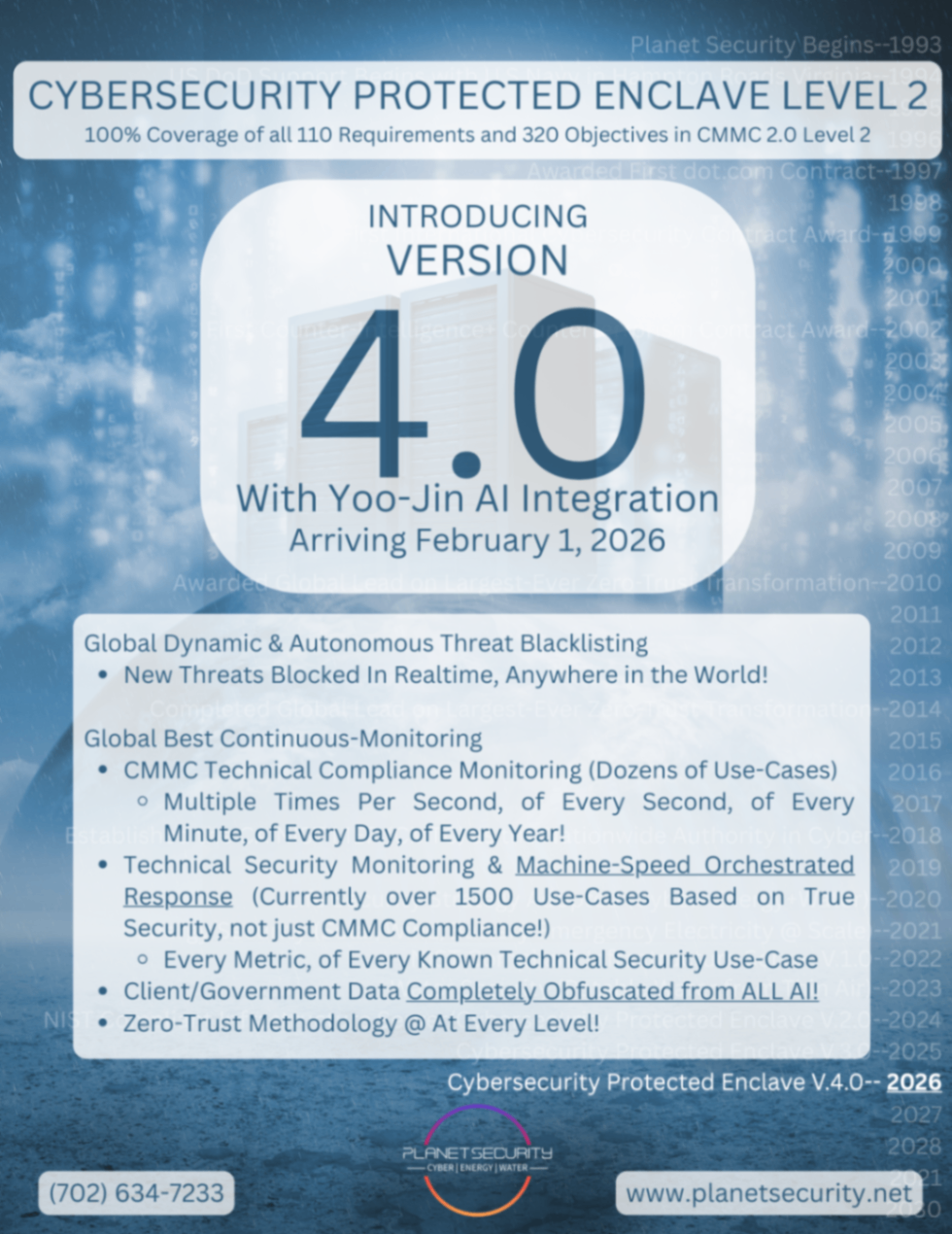
Planet Security takes a different approach with Yoo-Jin privacy-first AI.
Yoo-Jin supports security and compliance workflows using AI-obfuscated data. Client and government data are not made available to the AI in raw form. This design helps the system support automation, analysis, monitoring, and response while reducing the risk of exposing sensitive information to the AI engine.
Yoo-Jin can assist with:
- Security monitoring
- Threat intelligence
- Configuration validation
- Evidence organization
- Compliance use cases
- Automated response workflows
- Security hardening support
- Reporting and alerting
AI should reduce risk: not become another place where CUI can leak.
What Does CPE Level 2 Include?
For organizations with up to 20 users, CPE Level 2 is available at $1,299/month. That includes:
- Enclave infrastructure
- Required licensing
- Managed operations
- Continuous monitoring
- Security monitoring and reporting
- Patching and maintenance
- Backup services
- Required policies and procedures
- Security awareness and role-based training
- Compliance support
- Configuration management
- Audit preparation
- Ongoing technical support
A standard deployment target is approximately 4 weeks when organizational readiness and scope permit. Choosing an 8-week deployment instead of a 4-week deployment reduces the monthly price by $100.
The important point is not the price. The important point is avoiding the cost of failed assessments, lost contract opportunities, unmanaged cyber risk, and the ongoing burden of manually proving that your controls work.
Frequently Asked Questions
Does a screenshot count as CMMC evidence?
A screenshot may support an assessment objective, but a screenshot by itself is rarely sufficient. It must be current, attributable, relevant to the assessed system, and supported by documentation or operational evidence where applicable.
Will a policy prove that a control is implemented?
No. A policy describes what your organization intends to do. The assessor may also need to examine procedures, system configurations, logs, records, and observed activities demonstrating that the policy is operating in practice.
What happens if one assessment objective is missing evidence?
If one applicable objective under a requirement is not satisfied, the requirement can be determined NOT MET. This is why evidence must be managed at the objective level: not just with a high-level control checklist.
Does CPE Level 2 guarantee a passing C3PAO assessment?
No provider can replace the independent judgment of an authorized C3PAO. CPE Level 2 is engineered to provide 100% coverage of the 110 requirements and 320 objectives, produce audit-ready evidence, and maintain the environment through managed operations and continuous monitoring. The C3PAO conducts the official assessment.
Can CPE Level 2 support a smaller CUI enclave?
Yes. CPE Level 2 is designed for defense suppliers that want to isolate CUI in a purpose-built environment rather than place the entire enterprise network into the CMMC assessment scope. Final scope depends on your architecture, data flows, connected assets, and assessment decisions.
How do I verify the technical details?
Review the CPE Level 2 technical details or contact Planet Security directly to discuss your CUI environment, users, contracts, and assessment timeline.
Build Evidence Before Your C3PAO Arrives
A CMMC assessment should not be the first time your organization looks for evidence.
By then, the evidence should already be:
- Collected
- Current
- Mapped
- Protected
- Retrievable
- Supported by operational records
- Consistent with your SSP
- Aligned to the actual CUI boundary
That is the practical advantage of CPE Level 2: the enclave is designed to produce evidence as part of normal secure operations: not as a frantic pre-audit exercise.
There is no substitute for documented, verifiable implementation.
We welcome a discussion on how we may assist in your CMMC success story!
| planetsecurity.net | 702.634.7233 |  |
|---|