Defense suppliers do not have room for ambiguity when a contract involves Controlled Unclassified Information (CUI).
DFARS 252.204-7012: formally titled “Safeguarding Covered Defense Information and Cyber Incident Reporting”: places direct cybersecurity, incident-response, and evidence-preservation obligations on contractors and subcontractors supporting the Department of Defense.
The requirements are clear:
- Safeguard CUI and covered defense information
- Implement NIST SP 800-171
- Report qualifying cyber incidents to the DoD within 72 hours of discovery
- Preserve forensic information and support DoD investigations
- Flow requirements down to applicable subcontractors
- Use appropriate protections when cloud services handle covered information
The challenge is execution. Many suppliers understand the requirements but struggle to implement, maintain, monitor, and prove them.
Planet Security’s CPE Level 2 turns these obligations into a managed, purpose-built operating environment with 100% coverage of the 110 requirements and 320 objectives associated with CMMC 2.0 Level 2.
What DFARS 252.204-7012 Requires
DFARS 252.204-7012 generally applies when a DoD contract involves covered defense information (CDI) or CUI. CDI includes unclassified information provided by or developed for the DoD that requires safeguarding or dissemination controls.
The clause applies to the contractor information systems that process, store, or transmit that information.
The official clause is available through Acquisition.gov.
1. Safeguard CUI
The first obligation is straightforward: CUI must be protected from unauthorized access, disclosure, alteration, loss, and destruction.
That means more than installing antivirus software or placing files in a general-purpose cloud drive. Defense suppliers need a controlled environment with:
- Enforced identity and access management
- Least-privilege permissions
- Multi-factor authentication
- Network segmentation
- Secure configuration management
- Encryption and protected backups
- Security awareness and insider-threat training
- Continuous monitoring and response procedures
- Physical and media protections
A supplier must also know exactly where CUI exists, who can access it, how it moves, and how evidence of protection is maintained.
2. Implement NIST SP 800-171
DFARS 252.204-7012 defines “adequate security” through the implementation of NIST SP 800-171, Protecting Controlled Unclassified Information in Nonfederal Systems and Organizations.
NIST SP 800-171 Rev. 2 contains:
- 110 security requirements
- 14 control families
- 320 assessment objectives
These requirements cover access control, awareness and training, audit and accountability, configuration management, identification and authentication, incident response, maintenance, media protection, personnel security, physical protection, risk assessment, security assessment, system and communications protection, and system and information integrity.
In plain English, NIST SP 800-171 requires the supplier to build a complete security program: not simply purchase a collection of security tools.
A supplier must be able to demonstrate that controls are:
- Implemented
- Documented
- Monitored
- Maintained
- Supported by evidence

3. Report Cyber Incidents Within 72 Hours
DFARS 252.204-7012 requires contractors to rapidly report cyber incidents to the DoD within 72 hours of discovery.
The clock begins when the incident is discovered: not when the investigation is complete, not when the organization has finished containment, and not when leadership has resolved every uncertainty.
A qualifying incident may affect:
- A covered contractor information system
- CUI or CDI stored, processed, or transmitted by that system
- Operationally critical support
After reporting, the contractor must also be prepared to:
- Identify affected systems and information
- Preserve relevant logs, images, and monitoring data
- Protect incident data for at least 90 days
- Submit malicious software to the DoD Cyber Crime Center when required
- Provide DoD access to affected systems and information for forensic analysis
- Support DoD damage assessments
A 72-hour requirement demands continuous visibility. If a supplier only reviews logs after an incident, it may discover the problem too late.
4. Control the Environment Where CUI Resides
DFARS 252.204-7012 does not prescribe one specific physical architecture called a “CUI enclave.” However, a dedicated enclave is one of the most practical ways to scope, secure, monitor, and assess an environment that handles CUI.
A properly designed enclave separates CUI operations from unrelated business systems. This reduces the compliance boundary, limits exposure, and gives the supplier a defensible answer to a critical question:
Which systems are actually in scope for CUI protection and assessment?
That is exactly where CPE Level 2 delivers decisive value.
How CPE Level 2 Covers DFARS 252.204-7012
Planet Security designed CPE Level 2 as a turnkey CUI Protected Enclave for defense suppliers that need complete, operational coverage: not a binder of recommendations.
The solution is engineered to provide 100% coverage of the CMMC 2.0 Level 2 scope: all 110 requirements and 320 objectives.
| DFARS and CUI obligation | How CPE Level 2 addresses it |
|---|---|
| Protect CUI | Segmented, hardened infrastructure designed specifically for CUI workloads |
| Implement NIST SP 800-171 | Technical controls, policies, procedures, training, and managed operations aligned to the full requirement set |
| Detect and respond to incidents | Continuous security monitoring, SIEM capabilities, alerting, and managed response |
| Meet the 72-hour reporting obligation | Operational visibility and incident procedures designed to support rapid reporting |
| Preserve evidence | Centralized logging, monitoring, backups, and audit-support processes |
| Limit access | Identity management, authentication controls, segmentation, and least-privilege practices |
| Maintain compliance | Ongoing patching, maintenance, training, reporting, and vCISO guidance |
| Prepare for assessment | Automated evidence collection and continuous compliance support |
This is not a patchwork of disconnected products. CPE Level 2 combines hardened infrastructure, software, security configurations, organizational policies, procedures, training, monitoring, backup, maintenance, and compliance support.
What Is Included
CPE Level 2 includes a comprehensive operating model built around the CUI environment:
- Hardened enclave infrastructure
- Secure software stack
- More than 900 targeted hardening steps
- Multi-zone network security architecture
- Security-centric segmentation
- Full-drive encryption
- Managed service and managed security operations
- Security patching and maintenance
- Continuous functional and security monitoring
- SIEM monitoring and reporting
- Integrated backup capabilities
- Security awareness and insider-threat training
- CUI handling procedures for electronic and physical media
- Audit-ready evidence collection
- vCISO-level guidance
- Assessment and audit support
- Human client support
- Zero-trust principles applied throughout the environment
The result is a clean-slate, compliance-focused environment that allows a supplier to protect CUI without retrofitting every legacy system in the company.
A Pragmatic, Execution-Driven Deployment
Planet Security’s approach is direct: identify the approved users, establish the operating procedures, configure the environment, train the team, verify the controls, and move into managed operations.
A typical expedited implementation follows this sequence:
- Week 0: Project kickoff and client selection
- Week 1: Approved-person identification and initial training
- Week 2: Continued training and operational preparation
- Week 3: Operational security and procedures rollout
- Week 4: Verification, server installation, and enclave orientation
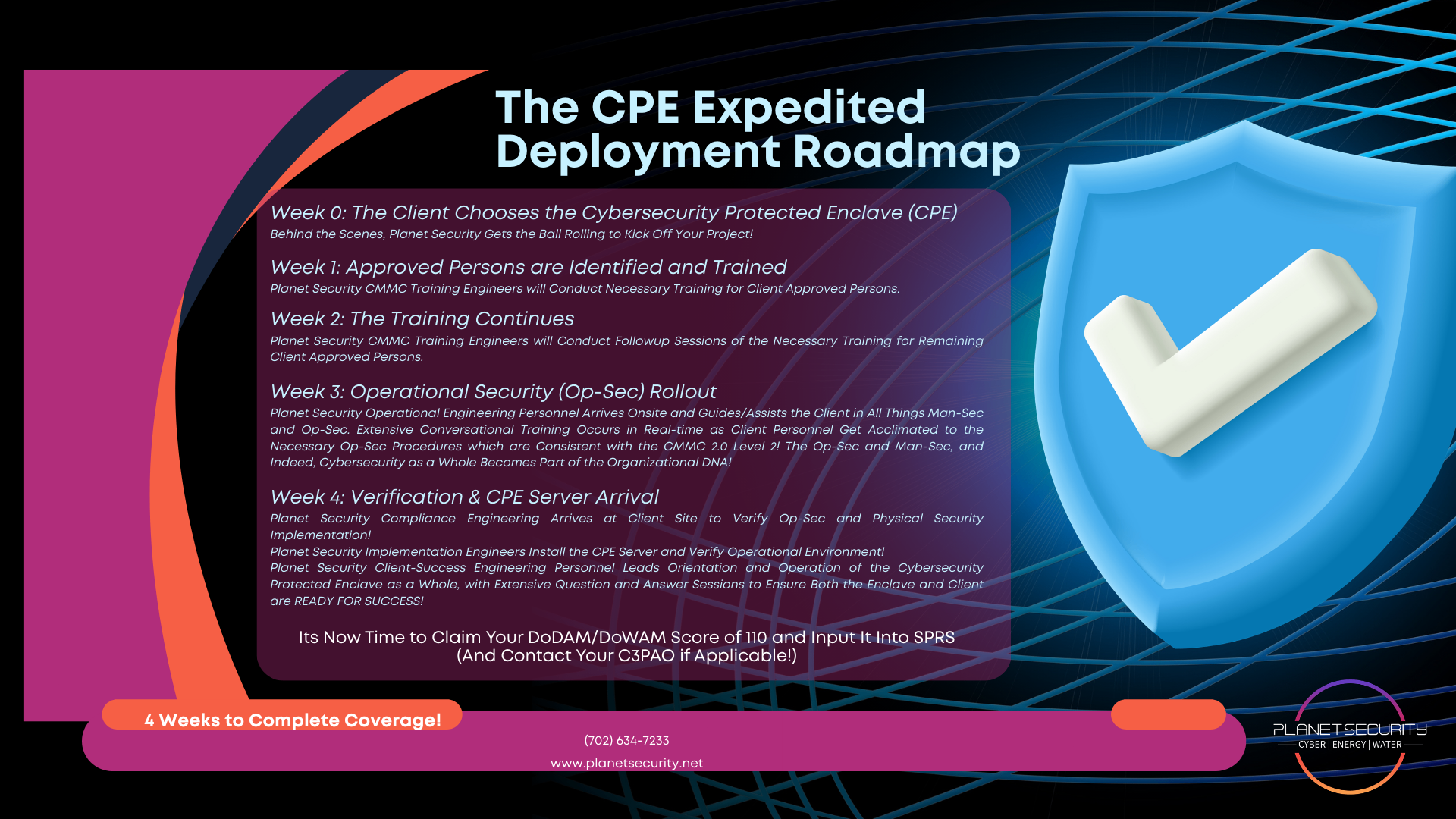
Full implementation timing depends on organizational readiness, user availability, information requirements, and deployment scope. The standard alternative is an 8-week deployment, which provides additional time for training and operational transition.
Planet Security does not treat compliance as a theoretical exercise. The objective is to make the controls part of the supplier’s daily operating discipline.
Why Generic AI Tools Are Not Safe for CUI Workflows
Defense suppliers should be extremely cautious about placing client data, contract information, technical data, or CUI into generic AI tools.
Most public or commercial AI platforms are not automatically authorized to handle CUI. Sending sensitive information to a general-purpose AI service can create uncontrolled data-disclosure, retention, access, and contractual risks.
Planet Security takes a different approach. When AI-enabled workflows are used, Planet Security emphasizes AI-obfuscated data so that security intelligence and workflow automation can operate without exposing client or government data to generic Big-Tech AI systems.
This distinction matters. AI can strengthen security only when the data-handling model is secure first.
What Does CPE Level 2 Cost?
CPE Level 2 pricing is configuration-dependent and should be discussed in the context of the supplier’s users, workload, endpoints, and support requirements.
A standard configuration is $1,299/month for up to 20 users. The monthly service includes the enclave infrastructure, licensing, managed operations, security monitoring, patching, backup, policies, procedures, training, compliance support, and ongoing maintenance.
For organizations that select an 8-week deployment instead of a 4-week deployment, pricing is reduced by $100/month under the applicable configuration.
The decision should not be driven by price alone. The real question is whether the supplier can protect CUI, respond within 72 hours, preserve evidence, and demonstrate continuous compliance without distracting the business from mission delivery.
There is no substitute for a complete, managed operating environment.
Frequently Asked Questions
Is DFARS 252.204-7012 the same as CMMC 2.0 Level 2?
No. They are related but distinct requirements.
DFARS 252.204-7012 requires safeguarding covered defense information using adequate security based on NIST SP 800-171 and includes incident-reporting obligations. CMMC 2.0 Level 2 is an assessment and certification framework built around the protection of CUI and the NIST SP 800-171 requirement set.
CPE Level 2 is designed to address both the DFARS obligations and the 110 requirements and 320 objectives of CMMC 2.0 Level 2.
Does DFARS require a dedicated CUI enclave?
Not by that exact name. DFARS requires protection of covered systems and information. A dedicated enclave is an implementation strategy that helps suppliers reduce scope, isolate CUI, strengthen controls, and simplify evidence collection.
What happens if a cyber incident is discovered?
The supplier must rapidly assess the event and report qualifying incidents to the DoD within 72 hours of discovery. The organization must also preserve relevant forensic information, support investigation, and follow its incident-response procedures.
CPE Level 2 provides the monitoring, logging, managed operations, and response structure needed to support that obligation.
Can a defense supplier use generic cloud services for CUI?
Not automatically. When an external cloud service provider handles covered information, the supplier must address applicable security requirements, including FedRAMP Moderate-equivalent protections under DFARS 252.204-7012.
CPE Level 2 gives suppliers a purpose-built alternative that avoids forcing CUI into an improperly configured general-purpose environment.
Does CPE Level 2 eliminate the supplier’s responsibilities?
No solution eliminates the supplier’s responsibility to operate securely. CPE Level 2 provides the infrastructure, controls, procedures, training, monitoring, and managed support required to make those responsibilities practical and defensible.
It is the execution platform: not an excuse to stop governing the environment.
Protect CUI. Protect the Mission.
DFARS 252.204-7012 is not a paperwork requirement. It is a direct operational mandate to protect information that supports national defense.
Defense suppliers need more than a gap assessment and a future remediation plan. They need 100% coverage, continuous monitoring, rapid incident visibility, documented procedures, and an environment that is secure by design.
Planet Security delivers that through CPE Level 2: a pragmatic, execution-driven CUI Protected Enclave built for suppliers that need to move forward with confidence.
We welcome a discussion on how we may assist in your CMMC success story!
For assistance, call 702.634.7233 or visit planetsecurity.net.
| planetsecurity.net | 702.634.7233 |  |
|---|