Cloud convenience can create a compliance problem
Defense suppliers are under pressure to move faster, reduce IT overhead, and support distributed teams. The cloud appears to solve all three problems.
But when Controlled Unclassified Information (CUI) enters a generic cloud environment, the compliance picture changes immediately.
If an external cloud service provider stores, processes, or transmits CUI, the provider must generally meet security requirements equivalent to the FedRAMP Moderate baseline under DFARS 252.204-7012. That means your organization must understand the provider’s authorization status, inherited controls, shared responsibilities, system boundaries, evidence packages, incident obligations, and continuous-monitoring practices.
That is a significant burden for a small or midsize defense supplier.
CPE Level 2 takes a cleaner approach: keep CUI inside a hardened on-premise or co-located enclave. No generic cloud dependency. No cloud-based CUI storage path. No unnecessary FedRAMP maze attached to the enclave itself.
The result is zero cloud-service exposure for the enclave, zero cloud latency, and a dramatically tighter compliance boundary.
The FedRAMP problem defense suppliers do not see until late
CMMC 2.0 Level 2 is built around the protection of CUI. For suppliers using cloud services, the critical question is straightforward:
Does the cloud service store, process, or transmit CUI?
If the answer is yes, the cloud service becomes a major part of your CUI architecture and assessment evidence.
You may need to verify:
- Whether the specific cloud service, not merely the provider, is FedRAMP Moderate authorized
- Whether the service is inside the provider’s authorized boundary
- Whether the provider claims FedRAMP Moderate equivalency
- Whether equivalency is supported by a complete System Security Plan
- Whether all applicable FedRAMP Moderate controls are implemented
- Whether open control-related POA&Ms exist
- Whether a recognized third-party assessment organization evaluated the environment
- How responsibilities are divided between your company and the provider
- How incidents, forensic access, media preservation, and reporting obligations are handled
- How continuous monitoring evidence will be made available during assessment
A cloud provider’s marketing page is not a CMMC evidence package.
Even when a provider is highly capable, your organization still owns the responsibility for defining the CUI boundary, configuring the service correctly, controlling access, documenting inherited controls, and proving that your implementation satisfies CMMC 2.0 Level 2.
That is how scope expands. One cloud storage service becomes email, identity, backups, logging, collaboration tools, endpoint management, support portals, and third-party integrations. Before long, the assessment boundary is larger than anyone intended.
The clean-slate alternative: on-premise or co-located CUI protection
CPE Level 2 is designed specifically for defense suppliers that need to protect CUI without placing that data into a generic cloud environment.
The enclave can operate on hardened infrastructure installed at your facility or through a co-location arrangement. CUI remains inside the protected enclave instead of traveling through a broad cloud ecosystem.
That delivers several practical advantages:
-
A tighter CUI boundary
Fewer external services touch CUI. Fewer inherited controls must be evaluated. Fewer third-party dependencies create assessment uncertainty. -
Zero cloud-service dependency for enclave operations
Your essential CUI systems are not dependent on a generic cloud provider’s availability, policy changes, routing, or service configuration. -
Zero-latency local performance
Users work directly with local or co-located infrastructure instead of repeatedly moving files across Internet-based services. -
Security-centric segmentation
CUI systems are separated from ordinary business operations through a purpose-built multi-zone network security architecture. -
A defensible compliance story
The environment is built around the requirements and objectives that matter, rather than retrofitted from a general-purpose IT environment.
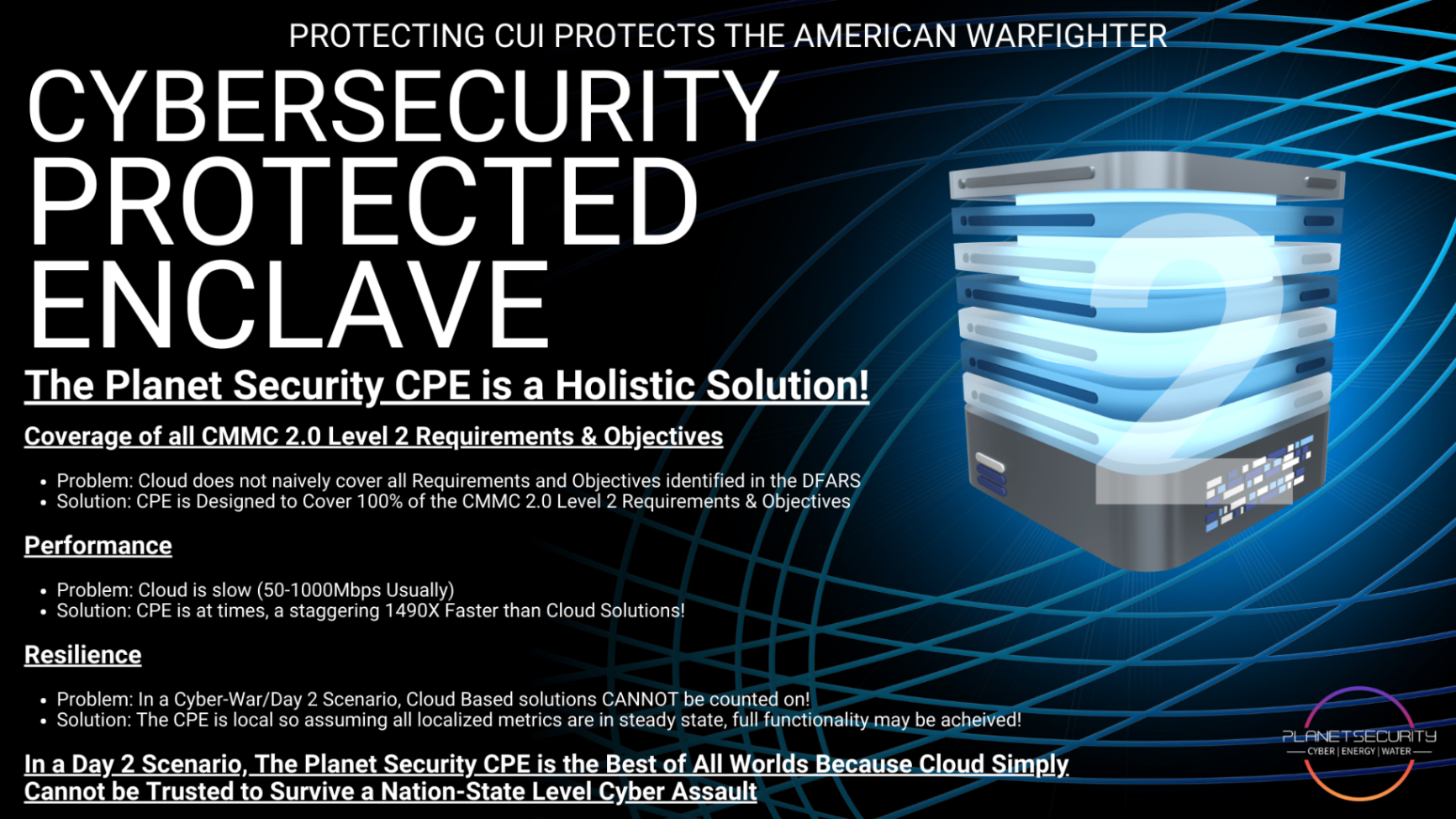
100% coverage of CMMC 2.0 Level 2 requirements and objectives
CPE Level 2 is engineered to provide 100% coverage of the 110 CMMC requirements and 320 assessment objectives associated with NIST SP 800-171 Rev. 2, the foundation of CMMC 2.0 Level 2.
This is not a checklist-only exercise.
Compliance documentation without technical enforcement is not an adequate security posture. A supplier can possess policies, procedures, and a System Security Plan and still remain exposed to ransomware, credential theft, insider threats, misconfiguration, and nation-state activity.
CPE Level 2 combines the compliance framework with technical and operational protection, including:
- Full-drive encryption for data at rest
- Multi-zone network security architecture
- Security-centric segmentation
- Zero-trust access principles
- More than 900 targeted hardening steps
- Continuous security monitoring
- SIEM monitoring and event correlation
- Access control and privilege management
- Security patching and maintenance
- Integrated backup and recovery capabilities
- Audit evidence collection
- Security awareness and insider-threat training
- Policies and procedures for digital and hard-copy CUI
- Virtual CISO guidance
- Ongoing operational support and reporting
The goal is not to appear compliant for one assessment. The goal is to maintain a substantially higher security posture than compliance checklists alone can provide.
Built for real threats, not just audit day
Defense suppliers should assume that adversaries are not waiting for an assessment window.
CUI environments are targeted because they contain engineering data, technical specifications, manufacturing information, contract details, supply-chain information, and other intelligence valuable to foreign competitors and nation-state actors.
A protected enclave must therefore address:
- Credential compromise
- Lateral movement
- Malicious insiders
- Ransomware
- Unauthorized removable media
- Privilege escalation
- Data exfiltration
- Vulnerable software
- Misconfigured systems
- Internet outages
- Cloud service outages
- Coordinated cyberattacks
CPE Level 2 uses layered protection to contain these risks. Encryption protects the data. Segmentation limits movement. Zero-trust verifies access. Hardening removes attack paths. Continuous monitoring identifies abnormal behavior. SIEM capabilities create an actionable record of events.
That is a far stronger position than purchasing disconnected tools and hoping the pieces align.
Privacy-first AI without handing client data to Big Tech
Generic AI tools cannot be trusted with client data.
Uploading CUI, intellectual property, financial records, employee information, or technical data to a general-purpose AI platform creates governance and exposure concerns that defense suppliers cannot afford to ignore. You may not know how the data is retained, reused, shared, logged, or exposed through future model operations.
Yoo-Jin, the privacy-first AI integrated with CPE Level 2, is designed differently.
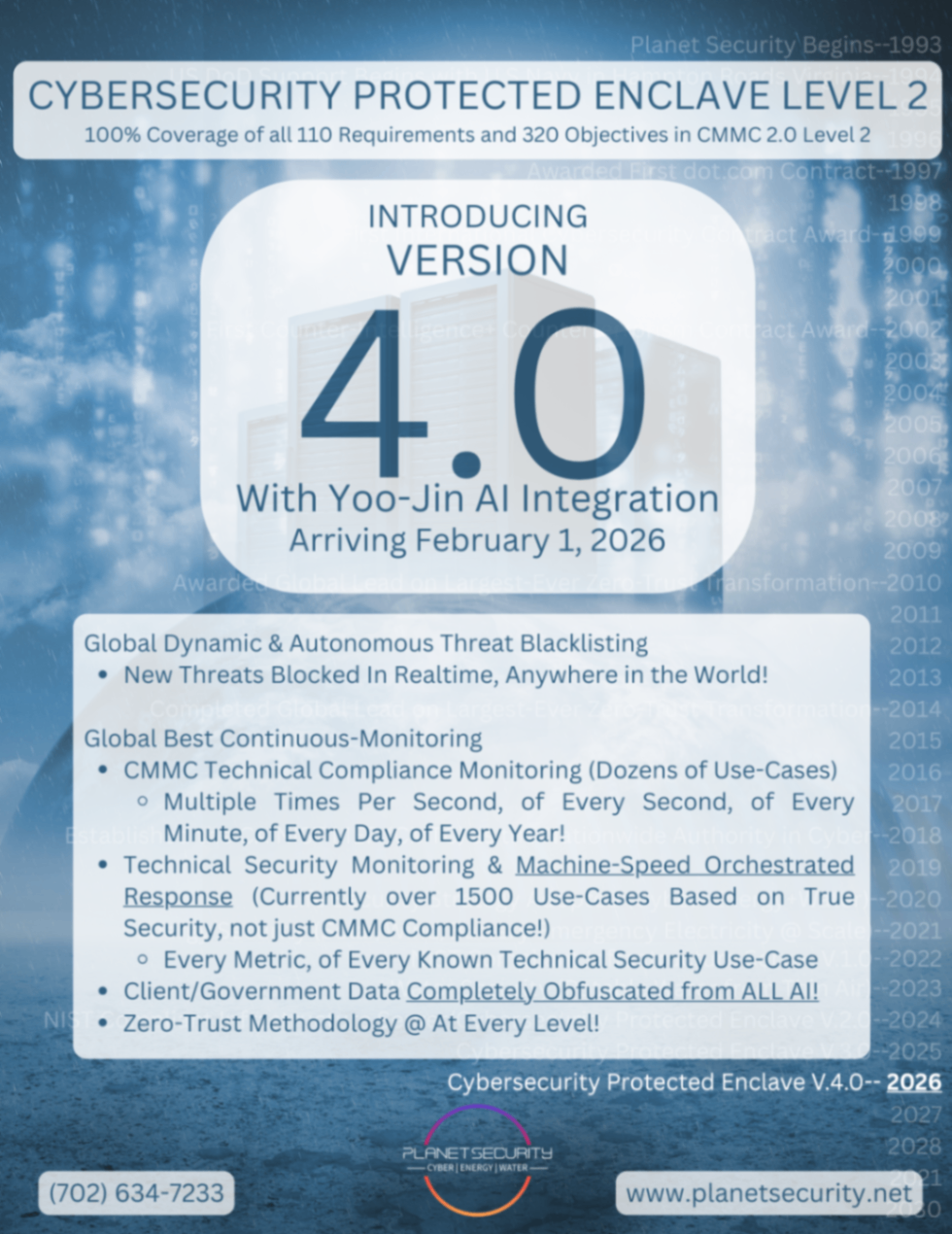
Yoo-Jin uses AI-obfuscated data so client and government data are not exposed directly to the AI workflow. This sharply contrasts with Big-Tech approaches that may ingest sensitive information into systems outside your direct governance.
Yoo-Jin supports:
- Continuous technical compliance monitoring
- Threat intelligence and dynamic blacklist updates
- Automated hardening validation
- SIEM analysis
- Security event documentation
- Zero-trust enforcement
- Machine-assisted response
- Audit preparation and evidence organization
You receive the benefits of AI-enabled operations without treating CUI as training material.
What does CPE Level 2 include?
The standard deployment includes the protected enclave infrastructure, security configuration, operational controls, monitoring, maintenance, and compliance support required to establish a defensible CMMC 2.0 Level 2 environment.
Pricing is $1,299/month for up to 20 users. The emphasis, however, should remain on the risk being removed: uncontrolled cloud exposure, expanding assessment scope, fragmented security tools, and the constant uncertainty of whether your environment is truly ready.
A typical deployment can be completed in approximately four weeks, depending on organizational readiness and requirements. Choosing an 8-week deployment instead of a 4-week deployment reduces pricing by $100/month.
The right deployment timeline is the one that gives your team a secure, sustainable operating environment, not simply the fastest installation date.
FAQ: CUI, cloud, and CPE Level 2
Does storing CUI in the cloud automatically require FedRAMP?
When an external cloud service stores, processes, or transmits CUI, DFARS 252.204-7012 generally requires the provider to meet security requirements equivalent to FedRAMP Moderate. The exact determination depends on the service, data flows, contract requirements, and system boundary.
Does an on-premise enclave eliminate CMMC requirements?
No. You still must meet CMMC 2.0 Level 2 requirements for the CUI environment. The advantage is that an on-premise or co-located enclave can eliminate the external cloud service from the CUI storage, processing, and transmission path, avoiding the additional FedRAMP Moderate cloud-provider obligation for that path.
Is co-location the same as using a cloud service?
Not necessarily. Co-location generally means your dedicated equipment is housed in a facility operated by another party. The provider’s role, access, services, and contract terms must still be evaluated. The key issue is whether the provider stores, processes, or transmits CUI as a cloud service.
How many CMMC requirements and objectives does CPE Level 2 cover?
CPE Level 2 is designed for 100% coverage of 110 requirements and 320 objectives associated with NIST SP 800-171 Rev. 2 and CMMC 2.0 Level 2.
Can our employees still use ordinary business systems?
Yes, but CUI workflows must be controlled. The enclave’s segmentation and access architecture are designed to keep CUI separate from ordinary business systems and reduce unnecessary scope. Your specific data flows and operating procedures should be mapped during deployment.
Can AI tools be used around CUI?
Generic AI tools cannot be trusted with client data. Yoo-Jin is designed for privacy-first operation using AI-obfuscated data, helping defense suppliers use AI-enabled monitoring and compliance workflows without exposing raw CUI to the AI system.
Get your CUI boundary under control
Every additional cloud service connected to CUI introduces another dependency, another evidence request, another shared-responsibility question, and another potential exposure path.
There is no substitute for a clean, purpose-built enclave.
CPE Level 2 gives defense suppliers a direct path to 100% coverage, hardened infrastructure, continuous monitoring, zero-trust protection, and a far higher security posture than compliance documentation alone.
Review the CPE Level 2 technical details, learn about the CUI Protected Enclave, or contact Planet Security at 702.634.7233.
We welcome a discussion on how we may assist in your CMMC success story!
References
- NIST SP 800-171 Rev. 2
- NIST SP 800-171 Rev. 2 publication page
- DFARS 252.204-7012
- CPE Level 2 technical details
- Planet Security privacy-first AI: Yoo-Jin
| planetsecurity.net | 702.634.7233 |  |
|