
A prime contractor can maintain a strong cybersecurity program and still lose a contract because one subcontractor mishandles Controlled Unclassified Information (CUI).
That is the supply-chain reality under CMMC 2.0. Compliance does not stop at the prime contractor’s firewall. It follows CUI through every organization, system, and lower-tier supplier that processes, stores, or transmits the information.
For small manufacturers, engineering firms, software suppliers, and specialized defense vendors, this creates a serious business risk:
- A prime partner demands proof of compliance before sharing CUI.
- A supplier cannot produce a current assessment, System Security Plan, or evidence package.
- CUI remains scattered across ordinary workstations, email accounts, cloud drives, and unmanaged devices.
- The prime contractor must restrict access: or replace the supplier.
- A valuable defense opportunity disappears.
The solution is not more paperwork. The solution is a controlled, defensible environment for CUI. That is precisely what CPE Level 2 provides.
CMMC Flow-Down Means Your Supply Chain Is Part of Your Compliance Boundary
Under 32 CFR § 170.23, CMMC requirements apply throughout the supply chain at every tier when a subcontractor will process, store, or transmit Federal Contract Information (FCI) or CUI on contractor information systems.
The required level depends on the information involved:
- FCI only: Level 1 (Self) is generally required.
- CUI: CMMC 2.0 Level 2 (Self) is the minimum requirement.
- CUI under a prime contract requiring Level 2 (C3PAO): The subcontractor must also maintain Level 2 (C3PAO).
- CUI under a prime contract requiring Level 3: The subcontractor must generally maintain Level 2 (C3PAO), subject to contract-specific requirements.
This means a small supplier cannot assume that its size, limited access, or specialized role exempts it from CMMC obligations. If CUI touches your systems, the requirement follows the data.
The DFARS Clauses Primes Must Flow Down
CMMC flow-down requirements work alongside several important Defense Federal Acquisition Regulation Supplement (DFARS) clauses.
DFARS 252.204-7012
DFARS 252.204-7012 requires contractors and applicable subcontractors to safeguard covered defense information and report cyber incidents. It also establishes the connection to the security requirements in NIST SP 800-171.
For a supplier handling CUI, that means implementing the complete technical baseline: not simply installing antivirus software or purchasing a generic cloud subscription.
DFARS 252.204-7019 and 252.204-7020
These clauses address NIST SP 800-171 assessments and the Supplier Performance Risk System (SPRS). Depending on the contract, the supplier may need a current assessment score recorded in SPRS before contract award or continued performance.
A prime contractor has a legitimate reason to ask for this information. The prime’s own contract eligibility can be affected by the compliance posture of its subcontractors.
DFARS 252.204-7021
DFARS 252.204-7021 establishes CMMC requirements and flow-down obligations. A prime must ensure that subcontractors handling FCI or CUI have the appropriate CMMC status before awarding work or sharing protected information.
A supplier that is merely “working toward” compliance may not satisfy the requirement. Intent is not an assessment status. A promise to become compliant later is not the same as being eligible today.
Why Primes Audit Their Subcontractors
Prime contractors audit or assess subcontractors because they must answer difficult questions about the entire CUI ecosystem:
- Where does CUI enter the supply chain?
- Which suppliers can access it?
- What systems store or transmit it?
- Are those systems included in the supplier’s assessment scope?
- Can the supplier demonstrate access control, audit logging, incident response, media protection, and configuration management?
- Is the supplier’s CMMC status current?
- Does the supplier have a valid SSP and supporting evidence?
- What happens if the supplier experiences a cyber incident?
- Are lower-tier suppliers receiving CUI through the same subcontract?
A prime contractor cannot credibly claim that CUI is protected while allowing a supplier to store that data in an unmanaged laptop, personal email account, consumer file-sharing service, or broad-access business network.
One weak subcontractor can create an uncontrolled path into the program. That path can expose sensitive technical information, trigger contractual consequences, delay production, and force the prime to suspend CUI sharing.
How CPE Level 2 Protects the Supply Chain
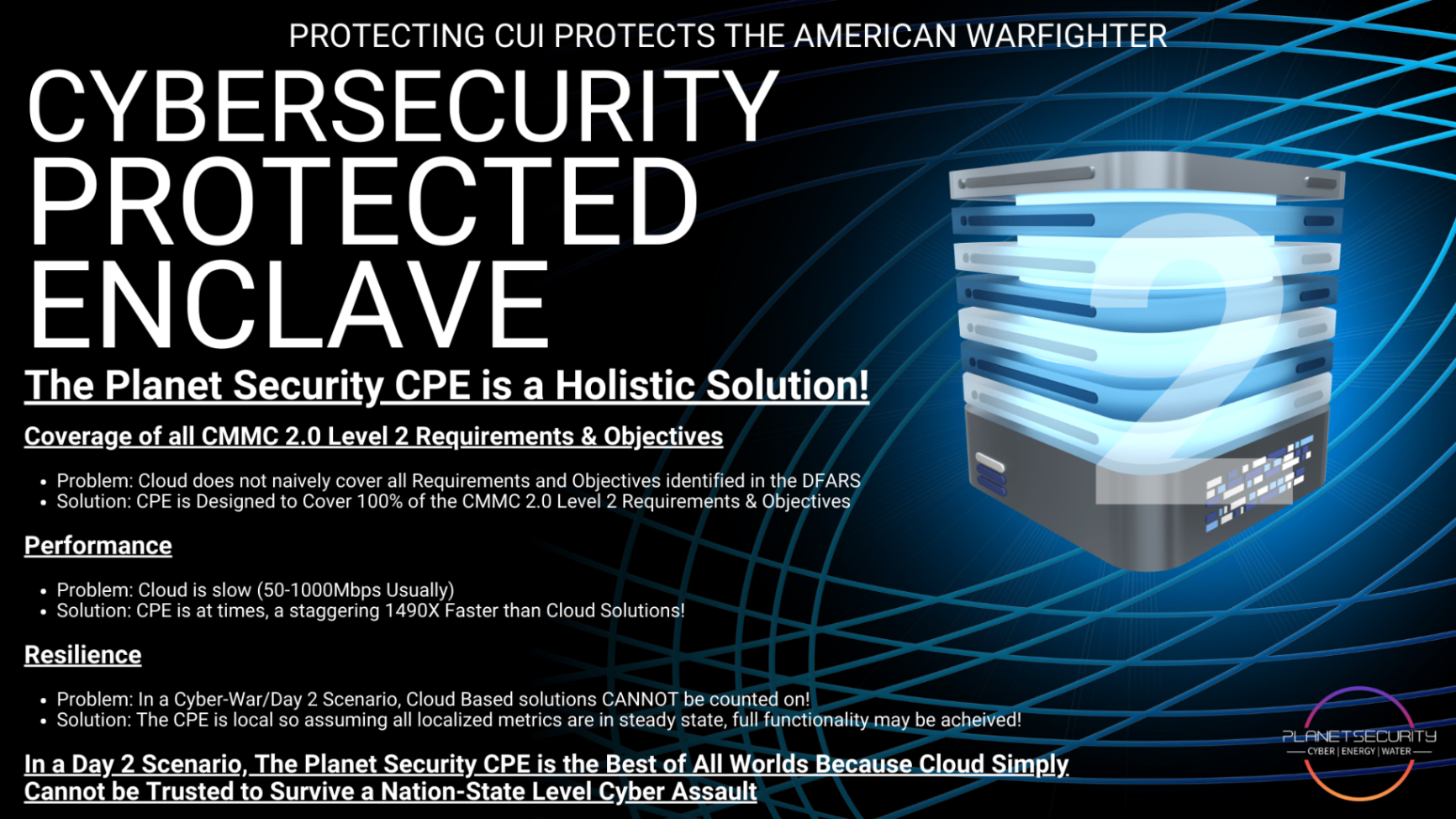
CPE Level 2 gives small and midsize suppliers a focused, turnkey environment for protecting CUI without requiring them to rebuild every business system from the ground up.
The operating principle is straightforward:
Keep CUI inside a defined, hardened enclave: and keep ordinary business activity outside it.
This approach limits the compliance boundary, reduces unnecessary data movement, and gives the supplier a more defensible answer when a prime asks, “Where is our CUI?”
A properly implemented enclave can help provide:
- Dedicated CUI containment
- Network segmentation and controlled access
- Hardened Microsoft Windows systems
- Identity and access management
- Multifactor authentication
- Secure configuration and patch management
- Endpoint protection and continuous monitoring
- Backup and recovery capabilities
- Centralized logging and security event monitoring
- Incident response procedures
- CUI handling and media protection procedures
- Evidence of ongoing maintenance and security operations
- Documentation supporting NIST SP 800-171 assessments
- Technical architecture and asset boundary documentation
The result is a cleaner, more manageable environment for both the supplier and its prime contractor.
Evidence Matters as Much as Technology
CMMC is not satisfied by saying, “We have a firewall.” A subcontractor must be able to demonstrate that security requirements are implemented and operating.
CPE Level 2 supports an evidence-driven program by organizing the technical and operational foundation around the 110 CMMC requirements and 320 objectives applicable to CMMC 2.0 Level 2.
Evidence commonly requested by primes, assessors, and compliance teams may include:
- System Security Plan documentation
- Network and enclave diagrams
- Asset inventories
- User and administrator inventories
- Configuration baselines
- Access control records
- Patch and vulnerability management records
- Backup and recovery evidence
- Security awareness and personnel training records
- Incident response procedures and logs
- Continuous monitoring reports
- Audit and event logs
- Physical and media protection procedures
- Annual affirmation and assessment status documentation
- SPRS assessment information, where applicable
Audit readiness is not a binder created the week before an assessment. It is the ability to show consistent control operation over time.
A Practical Option for Small Suppliers
Many small suppliers do not have a full-time CISO, security engineering team, compliance department, and 24-hour security operations center. Building all of that internally can be slow, expensive, and difficult to manage.
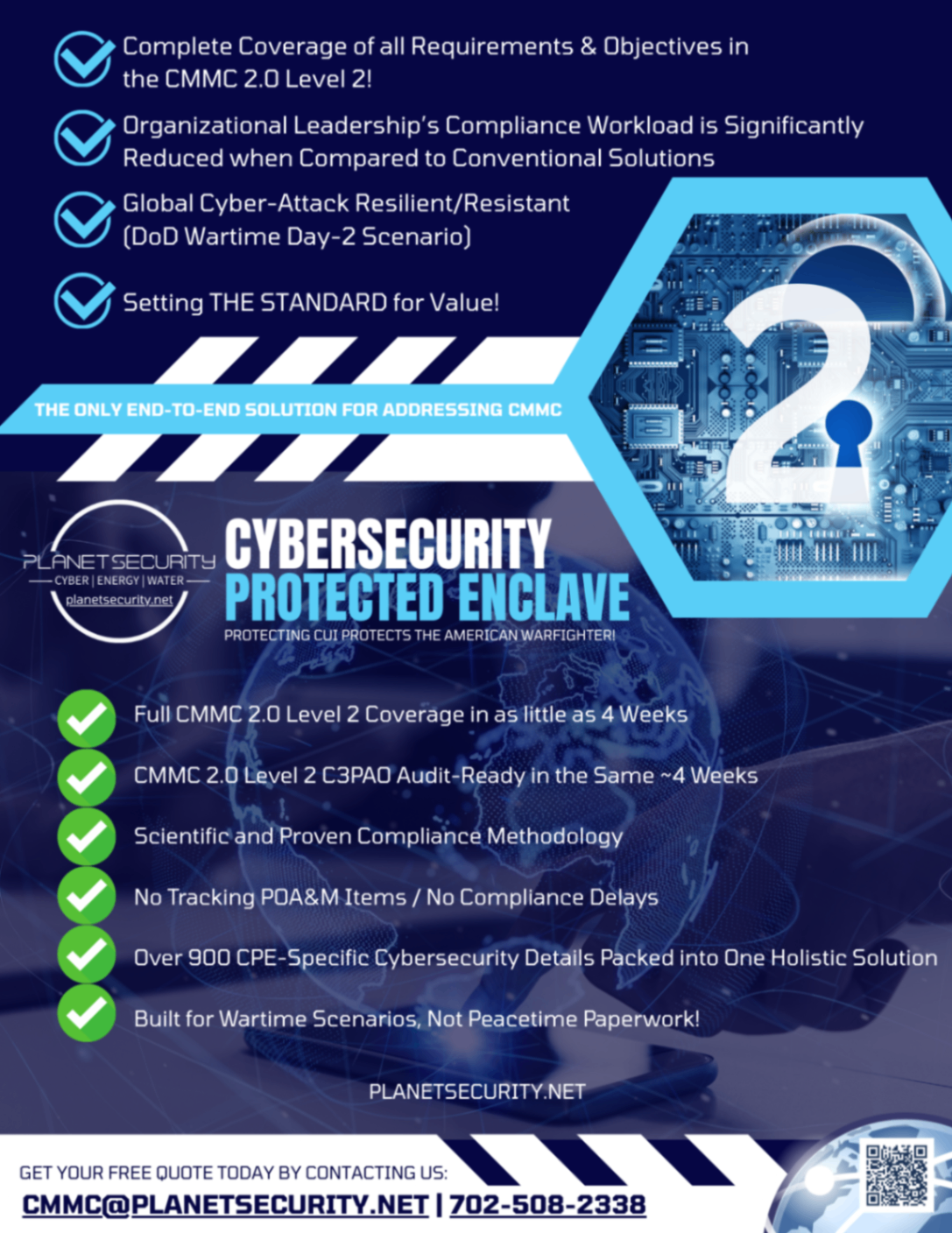
CPE Level 2 addresses that gap through a managed, end-to-end model that can include:
- Enclave hardware and software
- Secure network architecture
- Compliance-focused host configuration
- Managed operations and maintenance
- Security patching
- Continuous monitoring and reporting
- SIEM and compliance monitoring
- Fractional security leadership
- Policy and procedure support
- Assessment preparation
- Audit support
- CUI handling guidance
- Ongoing remediation assistance
CPE Level 2 packaging may be available at $1,299 per month for up to 20 users, with the monthly price reflecting the selected deployment length and included managed services. Choosing an 8-week deployment instead of a 4-week deployment can reduce pricing by $100 per month. The critical issue, however, is not the price: it is whether the supplier can protect CUI, satisfy prime-partner demands, and remain eligible for defense work.
Generic AI tools also cannot be trusted with client data or CUI. When AI-enabled workflows are used, Planet Security emphasizes AI-obfuscated data rather than sending sensitive information directly into Big-Tech AI platforms. That distinction matters when your supply chain includes controlled technical information.
What Subcontractors Should Do Now
If a prime contractor has asked your organization for CMMC evidence, do not wait until the next contract milestone. Take these steps:
- Identify every CUI data flow. Document how CUI enters, moves through, and leaves your organization.
- Define the enclave boundary. Determine which users, devices, applications, and networks actually need CUI access.
- Stop uncontrolled sharing. Remove CUI from personal email, unmanaged endpoints, and unauthorized file-sharing platforms.
- Confirm the required CMMC status. Determine whether your contract requires Level 2 (Self) or Level 2 (C3PAO).
- Build and maintain evidence. Prepare the SSP, asset inventory, policies, procedures, logs, and assessment records.
- Use a purpose-built solution. A managed enclave can be faster and more reliable than attempting to assemble a complete security program from disconnected tools.
There is no substitute for a controlled CUI environment and continuous operational discipline.
FAQ: CMMC Flow-Down and Subcontractors
Does every subcontractor need CMMC certification?
Not every subcontractor requires the same level. A subcontractor handling only FCI may require Level 1 (Self). A subcontractor processing, storing, or transmitting CUI generally requires CMMC 2.0 Level 2 at the appropriate assessment type specified by the prime contract.
Can a prime share CUI with a supplier that is still preparing for CMMC?
The supplier must meet the required CMMC status before receiving or handling CUI under the applicable contract. “We are working toward compliance” may not satisfy the prime’s contractual obligation.
Why does a small supplier need CMMC Level 2?
CMMC requirements are based on the information handled: not simply the supplier’s revenue, employee count, or role. A ten-person supplier with CUI can create the same supply-chain exposure as a much larger organization.
Does CPE Level 2 guarantee that a supplier will pass an assessment?
No technology provider can replace the formal assessment process or the supplier’s responsibility to operate its controls. CPE Level 2 is designed to provide a comprehensive, managed, audit-ready environment aligned with the CMMC 2.0 Level 2 requirements and assessment expectations.
Can CPE Level 2 reduce the amount of the business covered by CMMC?
A properly scoped enclave can help limit CUI to defined systems, users, and processes. That can reduce unnecessary expansion of the assessment boundary, but the final scope must be determined for the specific contract and organization.
What should a prime contractor request from a subcontractor?
Primes commonly request CMMC status information, assessment documentation, SPRS information where applicable, an SSP, evidence of security operations, and confirmation that CUI is contained within an approved environment.
Protect Your Position in the Defense Supply Chain
Your prime contractor is not asking for CMMC evidence to create unnecessary work. It is asking because your security posture becomes part of its risk and compliance posture the moment you handle its CUI.
CPE Level 2 gives small suppliers a direct path to stronger containment, clearer evidence, managed security operations, and a more credible response to prime-contractor due diligence.
Protect your CUI. Protect your contracts. Protect your place in the supply chain.
Learn more about CPE Level 2, review the CPE Level 2 technical details, or contact Planet Security to discuss your requirements.
We welcome a discussion on how we may assist in your CMMC success story!
| planetsecurity.net | 702.634.7233 |  |
|---|