For defense suppliers, CMMC 2.0 Level 2 is not a paperwork exercise. It is a practical test of whether your organization can protect Controlled Unclassified Information (CUI) every day: not just during an assessment.
That is why many small and midsize defense contractors are taking a smarter approach: place CUI inside a purpose-built, security-first environment instead of trying to rebuild the entire company network.
Planet Security’s CPE Level 2 is designed specifically for that mission. It combines protected infrastructure, hardened configurations, managed operations, continuous monitoring, policies, procedures, training, and compliance support into one integrated solution.
The result is a more focused path to CMMC readiness, stronger protection for CUI, and a significantly reduced compliance burden for leadership.
What CMMC 2.0 Level 2 Actually Requires
CMMC 2.0 Level 2 is built around the requirements in NIST SP 800-171 Revision 2. That means your in-scope environment must address:
- 110 CMMC security requirements
- 320 assessment objectives
- 14 security domains
- Documented policies and procedures
- A current System Security Plan (SSP)
- Asset inventories and network diagrams
- Evidence showing controls are implemented and operating
- Ongoing monitoring, remediation, and security assessment activities
Assessors do not simply ask whether you purchased cybersecurity tools. They examine, interview personnel, and test the environment to determine whether controls are implemented correctly, operating as intended, and producing the desired outcome.
The official CMMC Level 2 Scoping Guide confirms that organizations may define a specific enclave or enclaves as their assessment scope. The CMMC Level 2 Assessment Guide explains how assessors evaluate the requirements and objectives within that scope.
That distinction matters.
Why an Enclave Is a Smarter Path
Trying to apply every CMMC control across every workstation, application, department, and business system can become a long, expensive, disruptive project.
A protected enclave gives you a defined boundary for CUI. Instead of allowing sensitive contract information to move through the general business environment, you establish a controlled zone where CUI is stored, processed, and transmitted under a consistent security architecture.
This approach can help you:
-
Reduce unnecessary scope
Systems that cannot process, store, or transmit CUI may remain outside the CMMC assessment scope when properly separated and documented. -
Centralize security controls
MFA, access control, encryption, audit logging, endpoint protection, segmentation, and backup protections are implemented within one managed environment. -
Simplify evidence collection
A clearly defined environment makes it easier to connect requirements with configurations, policies, logs, training records, and operational evidence. -
Protect business productivity
Your general business systems do not necessarily need to be rebuilt around every CMMC requirement when CUI workflows are properly contained. -
Create repeatable operations
New users, new contracts, system changes, and security updates can follow documented processes instead of being handled ad hoc.
The goal is not to hide complexity. The goal is to put complexity where it can be controlled.
Security-First Design for CUI
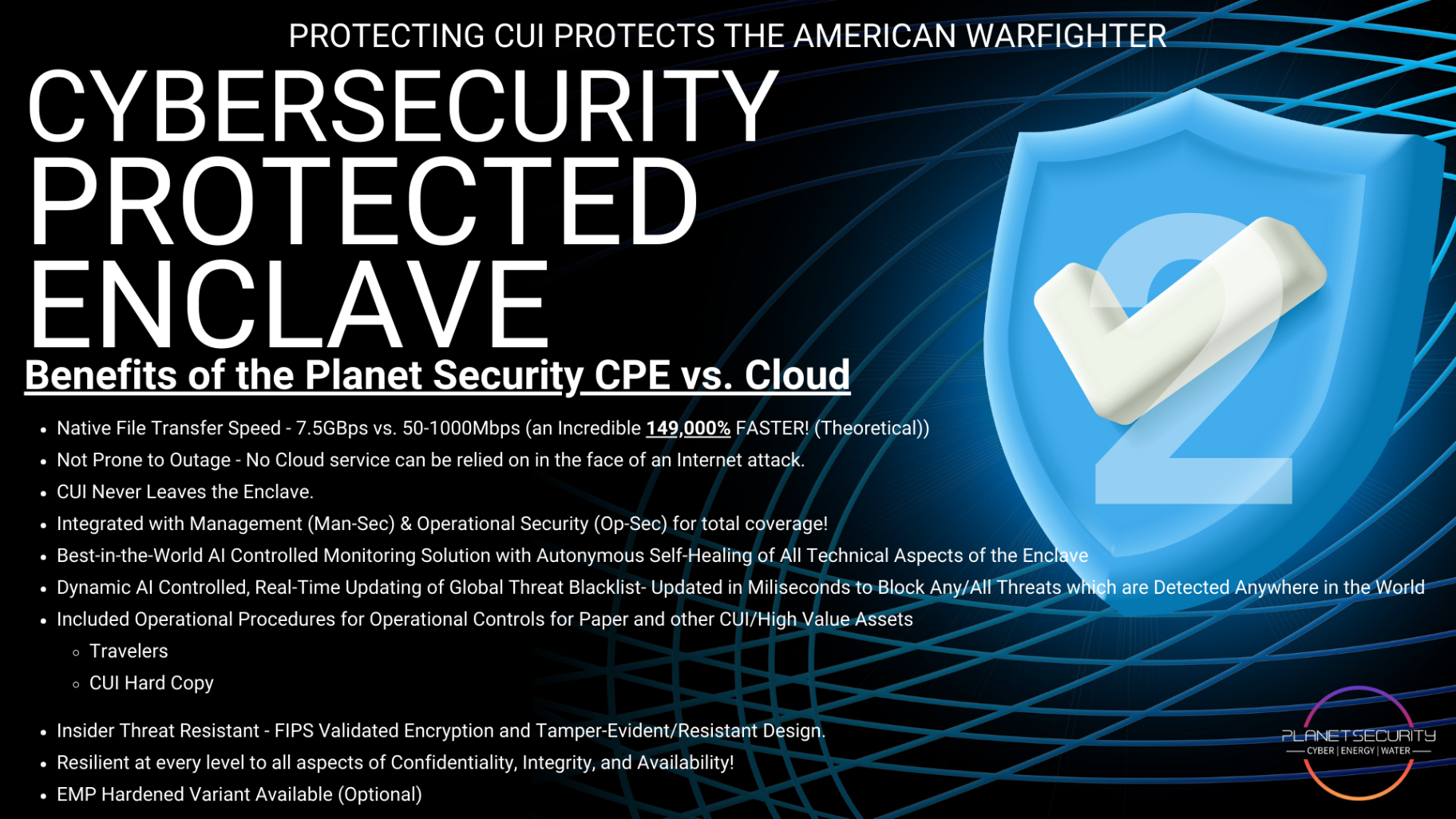
The CPE Level 2 technical details describe an environment built from the ground up around CMMC requirements and objectives.
Core protections include:
- Security-centric network segmentation
- Defined external and internal boundaries
- Deny-by-default network communication policies
- Controlled remote access
- Multifactor authentication
- Least-privilege access
- Separation of user and system-management functionality
- Full-drive encryption
- FIPS-validated cryptographic protections where required
- Endpoint and malicious-code protection
- Vulnerability scanning and remediation
- Centralized audit logging
- Backup protection and recovery processes
- Physical and hard-copy CUI procedures
- Insider-threat awareness
- Secure configuration baselines
- Change-control processes
- System security planning and documentation
This is a major advantage over assembling disconnected tools and hoping they collectively satisfy CMMC. CPE Level 2 is designed as an integrated operating environment: not a random collection of products.
Managed Operations Reduce the Compliance Burden
A secure environment is only useful if it stays secure.
CMMC is not a one-time installation project. Systems change. Employees change roles. Vulnerabilities are discovered. Threat actors change tactics. Cloud services, applications, firewalls, and endpoints require ongoing maintenance.
With CPE Level 2, managed operations support the daily work required to keep the environment secure and defensible, including:
- Security patching and maintenance
- Ongoing environment monitoring
- Backup operations
- Vulnerability management
- Security awareness training
- Insider-threat training
- Policy and procedure support
- Compliance reporting
- Monthly vCISO guidance
- Audit and assessment representation
- Hardware warranty coordination
This is where many organizations struggle: they may implement controls during a compliance project but lack the personnel, time, or processes to sustain them.
Managed operations help turn CMMC from an annual scramble into a repeatable business function.
Continuous Monitoring Means Fewer Surprises
CMMC Level 2 expects organizations to monitor security controls on an ongoing basis. That does not mean checking a dashboard once a month and calling it done.
Effective monitoring should help identify:
- Unusual account activity
- Unauthorized access attempts
- Configuration drift
- Failed logging processes
- Suspicious inbound or outbound traffic
- Malware indicators
- Vulnerability findings
- Unauthorized software
- Changes to privileged accounts
- Backup failures
- Potential data-exfiltration activity
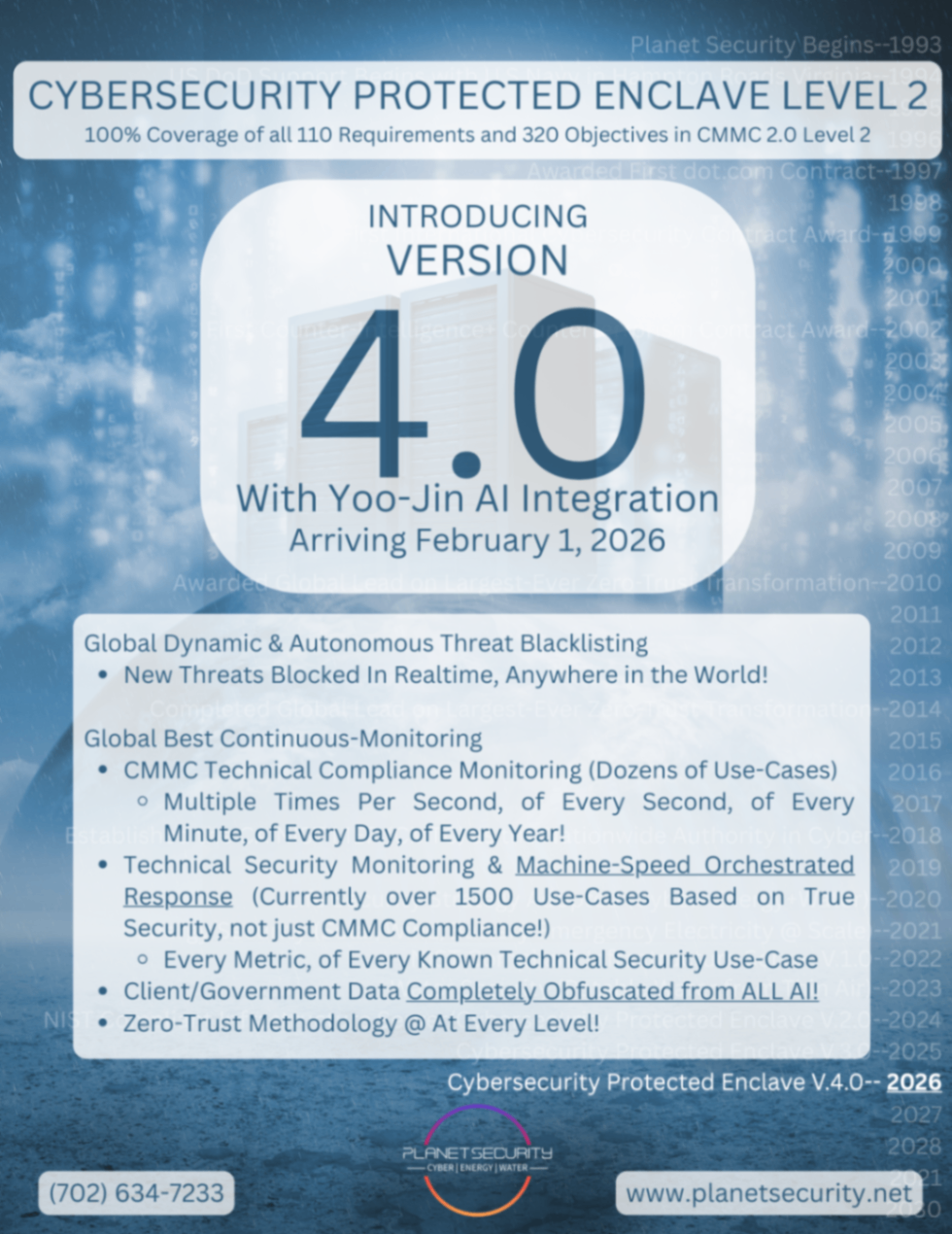
CPE Level 2 is designed to support continuous technical and compliance monitoring across the protected environment.
Planet Security also emphasizes AI-obfuscated data when discussing AI-enabled workflows. Generic AI tools cannot be trusted with client data, CUI, security logs, or sensitive government information simply because they are convenient. Sending protected information to Big-Tech AI platforms can create unacceptable confidentiality and supply-chain risks.
AI-enabled security workflows must be designed around data minimization and privacy: not blind data sharing. AI-obfuscated data helps support useful automation while reducing exposure of client and government information.
Faster Implementation Without Cutting Corners
A properly scoped protected environment can be implemented far more efficiently than a complete enterprise-wide transformation.
Planet Security states that implementation is often available in approximately 4 to 8 weeks, depending on the organization, environment, users, deployment requirements, and readiness. The timeframe is not a substitute for proper assessment preparation, but it can provide a practical route to establishing a controlled CUI environment quickly.
The standard CPE Level 2 service is $1,299 per month for up to 20 users and includes the protected environment, managed operations, security maintenance, monitoring, required training, required policies and procedures, backups, vCISO sessions, and support for assessment preparation.
Organizations choosing an 8-week deployment instead of a 4-week deployment may reduce pricing by $100 per month, subject to qualification and deployment requirements.
The important point is not the monthly number. The important point is what it replaces: fragmented tools, unmanaged systems, undocumented processes, and the constant uncertainty of whether your environment can withstand an assessment or a real attack.
A Practical Path Forward
If you are preparing for CMMC 2.0 Level 2, start with these steps:
- Identify where CUI enters your organization.
- Document where CUI is stored, processed, and transmitted.
- Separate CUI workflows from general business operations.
- Define the proposed CMMC assessment scope.
- Inventory systems, users, devices, applications, and security protection assets.
- Map the environment to all 110 requirements and 320 objectives.
- Establish monitoring, maintenance, incident response, and evidence processes.
- Prepare the SSP, policies, procedures, diagrams, and assessment artifacts.
- Validate the environment before engaging a C3PAO.
- Maintain the controls after the assessment.
A protected enclave does not eliminate your organizational responsibilities. Leadership still owns governance, personnel decisions, contract obligations, data handling, and business processes. But it can provide a much cleaner technical and operational foundation for meeting those responsibilities.
Frequently Asked Questions
Is CPE Level 2 only for large defense contractors?
No. It is particularly useful for small and midsize defense suppliers that handle CUI but do not want to build and operate an entire enterprise security program internally.
Does an enclave automatically guarantee CMMC certification?
No solution can guarantee an assessment outcome. CPE Level 2 is designed to support coverage of the applicable requirements and objectives, but your organization must operate within the defined scope, follow required procedures, provide evidence, and complete the applicable assessment.
Can our regular business network remain outside the assessment scope?
Potentially, if it cannot process, store, or transmit CUI and is properly separated from the CUI environment. Scoping must be carefully documented, and systems that provide security protections for the enclave may still be in scope.
What happens if employees need remote access?
Remote access must be controlled, authorized, monitored, and protected with appropriate cryptography and multifactor authentication. CPE Level 2 is designed to support secure remote workflows without allowing uncontrolled access to CUI.
Can we use generic AI tools with CUI?
No. Generic AI tools should not be trusted with client data or CUI. Any AI-enabled workflow should use strict data handling controls, including AI-obfuscated data, to reduce the risk of exposing sensitive information to third parties.
How do we get started?
Begin by identifying your CUI workflows, users, contracts, current systems, and target assessment requirements. Then discuss whether a protected enclave is appropriate for your organization.
Protect CUI. Reduce Scope. Strengthen Readiness.
For defense suppliers, the smarter path is clear: contain CUI, harden the environment, manage it continuously, and maintain evidence as part of normal operations.
CPE Level 2 brings those priorities together in one security-first solution built for CMMC 2.0 Level 2.
There is no substitute for disciplined execution and ongoing protection.
We welcome a discussion on how we may assist in your CMMC success story!
| planetsecurity.net | 702.634.7233 |  |
|---|