
For defense suppliers, cybersecurity compliance is no longer just an IT project. It is a contract-performance obligation: and an inaccurate representation can become a False Claims Act problem.
On June 18, 2026, the U.S. Department of Justice announced that LOGZONE Inc., an Alabama defense contractor, agreed to pay $507,144 to resolve alleged False Claims Act liability related to cybersecurity violations on two Department of the Navy contracts.
The settlement is a direct warning to every organization that handles Controlled Unclassified Information: Your SPRS score must reflect what is actually implemented, not what you hope to implement.
That is true even while the timing of CMMC Phase II remains paused or subject to change. The FCA risk is already active. DOJ does not need to wait for a formal CMMC certification failure when a contractor’s cybersecurity representations, contract claims, and technical reality do not align.
The LOGZONE case: When the score and the system did not match
According to the DOJ’s official announcement, LOGZONE allegedly failed to implement certain NIST SP 800-171 security controls between May 2021 and March 2025.
A government assessment reportedly found an actual score of -170, near the bottom of the NIST SP 800-171 scoring range of -203 to 110.
That result created a serious gap between the contractor’s reported cybersecurity posture and its assessed posture. Industry reporting on the case states that LOGZONE had previously submitted a perfect SPRS self-assessment score of 110.
The lesson is not complicated:
- A score of 110 communicates full implementation of the applicable requirements.
- A score of -170 communicates extensive deficiencies.
- A gap of that size is not a documentation issue.
- It is a credibility issue, a contract issue, and potentially an FCA enforcement issue.
The DOJ also emphasized that the settlement involved allegations only and that there was no determination of liability. That legal qualification matters. The operational lesson matters more: government assessments, contract certifications, and self-reported cybersecurity scores are being compared.
Why an SPRS score is now Exhibit A
The Supplier Performance Risk System is not a casual compliance dashboard. For defense suppliers, the score is part of the government’s view of supplier risk.
Under DFARS requirements, contractors handling covered defense information must provide adequate security in accordance with NIST SP 800-171. The score reported in SPRS summarizes the organization’s implementation status.
The risk appears when a supplier:
- Reports a score based on policies that are not operational.
- Claims a control is implemented when it is only planned.
- Uses outdated evidence from a prior configuration.
- Excludes systems that store, process, or transmit CUI.
- Treats a Plan of Action and Milestones as if it were completed remediation.
- Fails to update its score after major changes or an internal discovery.
- Cannot produce evidence supporting the score during an assessment.
A defensible score requires more than a spreadsheet. It requires a repeatable process that continuously connects the requirement, the system configuration, the responsible person, the evidence, and the current status.
That is where CPE Level 2 changes the compliance equation.

CMMC 2.0 Level 2 is not a “mostly compliant” exercise
For organizations handling CUI, CMMC 2.0 Level 2 covers 110 NIST SP 800-171 Rev. 2 requirements and 320 assessment objectives.
Those requirements span the full operating environment, including:
- Access Control
- Awareness and Training
- Audit and Accountability
- Configuration Management
- Identification and Authentication
- Incident Response
- Maintenance
- Media Protection
- Personnel Security
- Physical Protection
- Risk Assessment
- Security Assessment
- System and Communications Protection
- System and Information Integrity
The 320 objectives provide the detailed assessment lens. They help determine whether each requirement is actually satisfied through appropriate practices and evidence.
This is why a policy-only approach fails. A policy can say that access is reviewed. Evidence must demonstrate that access reviews occur, that inappropriate access is removed, and that the process is repeatable.
A supplier may have a beautifully written incident response plan and still fail if:
- Logs are not retained.
- Alerts are not reviewed.
- Roles are unclear.
- Backups are not tested.
- Devices are not hardened.
- Users retain excessive privileges.
- Evidence cannot be retrieved quickly.
The standard is not what the organization intends to do. The standard is what the organization can prove.
How CPE Level 2 keeps the score honest
CPE Level 2 is a turnkey protected environment designed around the actual technical and operational demands of CMMC 2.0 Level 2.
Instead of forcing a small or midsize defense supplier to retrofit every legacy system, the solution creates a controlled environment for CUI with compliance built in from the beginning.
The approach includes:
- Hardened infrastructure and secure software
- Network segmentation for CUI
- More than 900 targeted cybersecurity hardening steps
- Continuous monitoring and reporting
- SIEM and compliance monitoring
- Patch management and configuration maintenance
- Backup and recovery support
- Access control and authentication safeguards
- Audit logging and accountability
- Evidence collection tied to security activities
- Managed operations and ongoing maintenance
- Audit preparation and assessment support
- vCISO-level guidance when needed
- Human-based client support
The goal is not to generate an impressive score. The goal is to make the score accurate, current, and defensible.
When a configuration changes, when a user is added, when a vulnerability is identified, or when an alert is investigated, those activities should contribute to an evidence trail. That trail gives leadership and assessors a practical view of the environment: not a theoretical one.
Why generic AI tools cannot be trusted with CUI
AI-enabled workflows can improve compliance operations, but defense suppliers must be careful about where their data goes.
Generic AI tools cannot be trusted with client data, intellectual property, financial information, personal information, or CUI. Sending sensitive content to a Big-Tech model without clear governance creates a new security and contract risk.
Yoo-Jin AI takes a different approach within CPE Level 2.

Planet Security uses AI-obfuscated data in AI-enabled workflows. Yoo-Jin AI is designed to support security monitoring, compliance automation, and evidence workflows without accessing client data.
That distinction is critical:
- The system can assist with operational signals.
- It can support hardening and monitoring workflows.
- It can help organize compliance evidence.
- It can identify configuration and security conditions.
- It does not need unrestricted access to the underlying client content.
There is no reason to trade data privacy for automation. A compliance platform should reduce risk, not create a new data-exposure path.
Four to eight weeks to establish a defensible environment
Deployment timelines depend on organizational readiness, user count, technical dependencies, and the scope of the CUI environment. In many cases, CPE Level 2 can be deployed in approximately 4 to 8 weeks.
A typical deployment sequence includes:
- Scope and discovery: Identify users, CUI workflows, systems, and contract requirements.
- Environment preparation: Establish the protected enclave and required security boundaries.
- Configuration and hardening: Apply the technical safeguards and security settings.
- Evidence and operations: Activate monitoring, reporting, procedures, and evidence collection.
- Readiness review: Validate the environment against the applicable requirements and objectives.
The important point is not simply speed. Speed without evidence is just a faster way to create uncertainty. The objective is a controlled, documented, operational environment that can support an honest SPRS score and a future assessment.
What the monthly CPE Level 2 service includes
For organizations with up to 20 users, CPE Level 2 is $1,299/month for up to 20 users with a 4-week deployment.
Choosing an 8-week deployment instead of 4 weeks reduces the monthly price by $100.
The monthly service includes the protected infrastructure, software, managed security operations, maintenance, monitoring, compliance support, evidence workflows, and ongoing operational assistance required to maintain the environment.
The need is not a lower price. The need is confidence. Defense suppliers need to know that their CUI is protected, their controls are operating, their evidence is available, and their SPRS score is not built on assumptions.
FAQ: What defense suppliers should ask now
Does a paused CMMC Phase II eliminate FCA exposure?
No. CMMC implementation timing does not erase existing contract cybersecurity obligations. If a contract requires NIST SP 800-171 compliance or related safeguards, those obligations remain relevant.
Is a high SPRS score enough?
No. A score is only defensible when it is supported by current technical evidence, documented processes, and actual implementation.
Can a POA&M solve every gap?
No. A POA&M can document planned remediation where permitted, but it does not transform an unimplemented control into a completed control.
What happens if an assessment finds a major discrepancy?
The organization may face contract consequences, loss of trust, corrective action, assessment delays, or potential FCA scrutiny depending on the facts and representations involved.
How does CPE Level 2 help?
It provides a controlled environment with technical safeguards, managed operations, continuous monitoring, and evidence collection aligned to all 110 requirements and 320 objectives applicable to CMMC 2.0 Level 2.
The warning shot is clear
The LOGZONE settlement demonstrates that cybersecurity representations can be treated as material contract certifications. An SPRS score is not a shield if the underlying environment cannot support it.
Defense suppliers should act before an assessor, contracting officer, investigator, or government cybersecurity team discovers the gap first.
Build a protected environment. Collect evidence continuously. Review the score against reality. Keep the representation honest.
There is no substitute for implemented security and defensible evidence.
Learn more about CPE Level 2, review the CPE Level 2 technical details, or explore Planet Security’s CUI Protected Enclave.
We welcome a discussion on how we may assist in your CMMC success story!
| planetsecurity.net | 702.634.7233 | 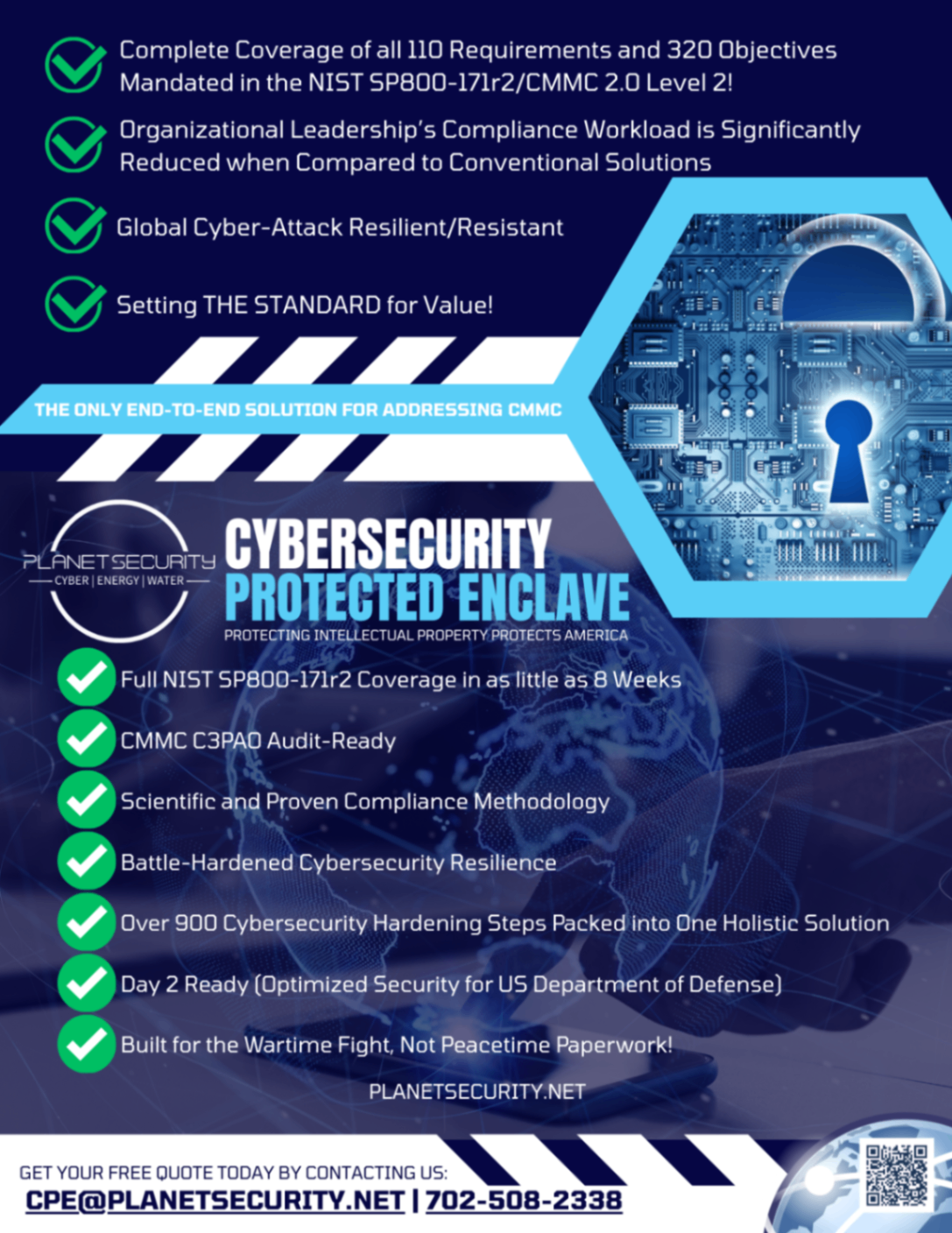 |
|---|