
Let's talk about something that keeps defense contractors up at night: or at least it should. Your CMMC self-assessment isn't just a checkbox exercise anymore. It's a legal attestation to the federal government that can trigger catastrophic financial penalties if you get it wrong.
In April 2025, a defense contractor learned this lesson the hard way, paying $4.6 million for submitting an inflated SPRS score. Their actual score? Negative 142. But they certified compliance anyway. The Department of Justice didn't care whether it was intentional fraud or sloppy oversight: the False Claims Act doesn't make that distinction.
The False Claims Act Isn't Messing Around
Here's what makes the False Claims Act (FCA) so terrifying: you don't need to intentionally lie to face massive penalties. The "knowing" standard includes actual knowledge, deliberate ignorance, or reckless disregard for the truth.
That means if you:
- Submit inaccurate SPRS scores that overstate your compliance
- Sign annual attestations without actually verifying your cybersecurity implementation
- Ignore known compliance gaps while continuing to certify readiness
- Fail to update your scores between third-party assessments
You're exposed to FCA liability. Period.
The penalties are brutal. In 2025 alone, violations reached up to $28,619 per false claim plus triple the damages the government sustains. And here's the kicker: each of the 110 NIST SP 800-171 controls required at CMMC Level 2 could potentially trigger separate FCA penalties.
Do the math. Multiple control deficiencies × $28,000+ per violation × treble damages = millions in exposure.

Why 2025 Changed Everything
The enforcement environment has intensified dramatically. The DOJ settled seven cybersecurity-related FCA cases in 2025 alone, and civil cyber-fraud resolutions have tripled year-over-year. Since launching the Civil Cyber-Fraud Initiative in October 2021, the DOJ has recovered $52 million across cyber cases.
This isn't a pilot program anymore. It's institutional enforcement policy.
With CMMC now a prerequisite for contract award and continued performance under Phase 1 (November 2025–November 2028), misstatements about your certification status in SPRS submissions are considered material to the government's payment decisions. Translation: every false claim directly impacts whether you get paid.
The Annual Attestation Time Bomb
Here's what most contractors don't realize: your FCA exposure isn't a one-time event. Annual attestations create ongoing vulnerability throughout your contract performance.
You must maintain "current CMMC status" and affirm compliance no less than annually. Between independent third-party assessments (required every three years under the CMMC rule), you're responsible for continuously monitoring and accurately reporting your compliance posture.
That means every year you sign that attestation without proper monitoring in place, you're potentially creating a new false claim exposure. If your compliance has degraded: or was never properly implemented to begin with: you're compounding your liability year after year.
Whistleblowers Are Watching
The False Claims Act's qui tam provisions add another layer of risk. Whistleblowers can bring FCA claims on behalf of the government and receive up to 30 percent of any recovery.
The $851,000 whistleblower award in the MORSE case demonstrates the financial incentive for reporting inaccurate certifications. That's a strong motivator for disgruntled employees, former staff, or anyone who knows your cybersecurity house isn't in order.

The Traditional Self-Assessment Problem
Most defense contractors approach CMMC compliance the old-fashioned way: spreadsheets, quarterly reviews, maybe an annual audit, and a whole lot of hoping everything stays in place between assessments.
This approach is a ticking time bomb.
You have no real-time visibility into whether:
- Security configurations are drifting from baseline
- New vulnerabilities are being introduced
- Staff are following proper CUI handling procedures
- Your 110 CMMC requirements and 320 objectives are actually being met
When it's time to sign that annual attestation, you're essentially making an educated guess. And as we've established, reckless disregard for the truth counts as "knowing" under the False Claims Act.
How CPE Level 2 Removes the Guesswork
This is exactly why Planet Security built CPE Level 2 with continuous monitoring at its core.
Our Yoo-Jin AI monitors more than 1,500 checkpoints across your environment: not quarterly, not monthly, but continuously. This isn't generic AI that scrapes your data and feeds it to Big-Tech cloud platforms. Yoo-Jin operates with AI-obfuscated data, keeping your client information and government data secure from external AI providers.
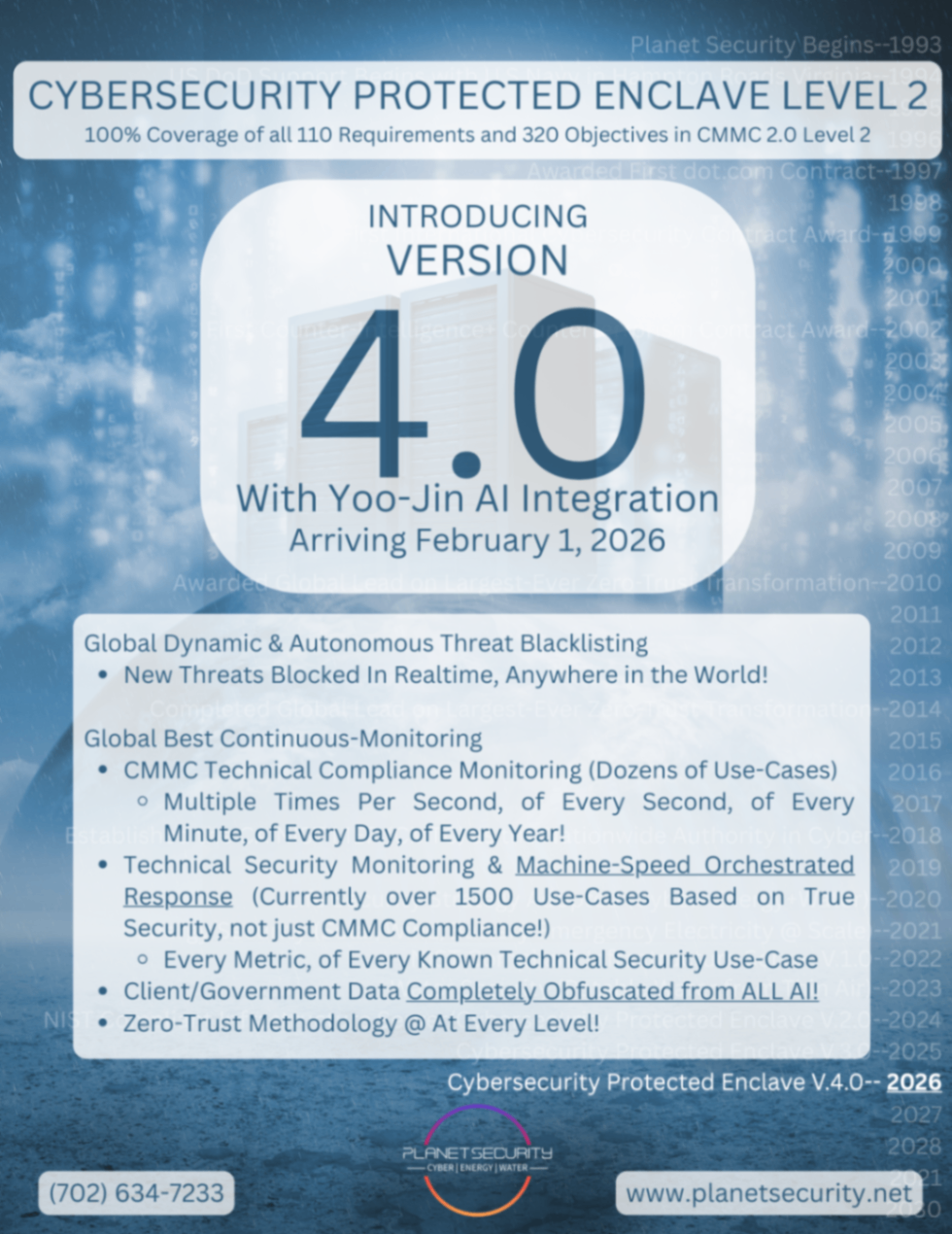
Here's what continuous monitoring actually means:
- Real-time compliance tracking across all 110 CMMC requirements
- Automated detection when configurations drift from approved baselines
- Immediate alerts when security controls fail or degrade
- Documented evidence for every checkpoint, every day
- Annual attestation confidence backed by actual data, not guesswork
When you sign your annual CMMC attestation with CPE Level 2, you're not hoping you're compliant. You know you're compliant because Yoo-Jin has verified it across 1,500+ checkpoints.
The Privacy Advantage You Can't Get from Big-Tech
Let's address the elephant in the room: most AI-enabled security tools feed your data into third-party cloud platforms. Microsoft, Google, AWS: they all want access to your information to "improve their services."
That's a non-starter for defense contractors handling CUI.
Planet Security's approach is fundamentally different. Yoo-Jin AI uses obfuscated data during analysis, meaning your client information and government data never leaves your protected environment in a readable format. We're not mining your data for AI training. We're not sharing it with Big-Tech cloud providers.
Your data stays yours. That's the whole point of a Cybersecurity Protected Enclave.
The 4-Week Fast Track to Compliance
Traditional CMMC Level 2 implementations take 12-18 months and cost anywhere from $100,000 to $500,000+. By the time you're finally compliant, you've missed contract opportunities, burned through cash reserves, and still don't have continuous monitoring in place for that annual attestation.
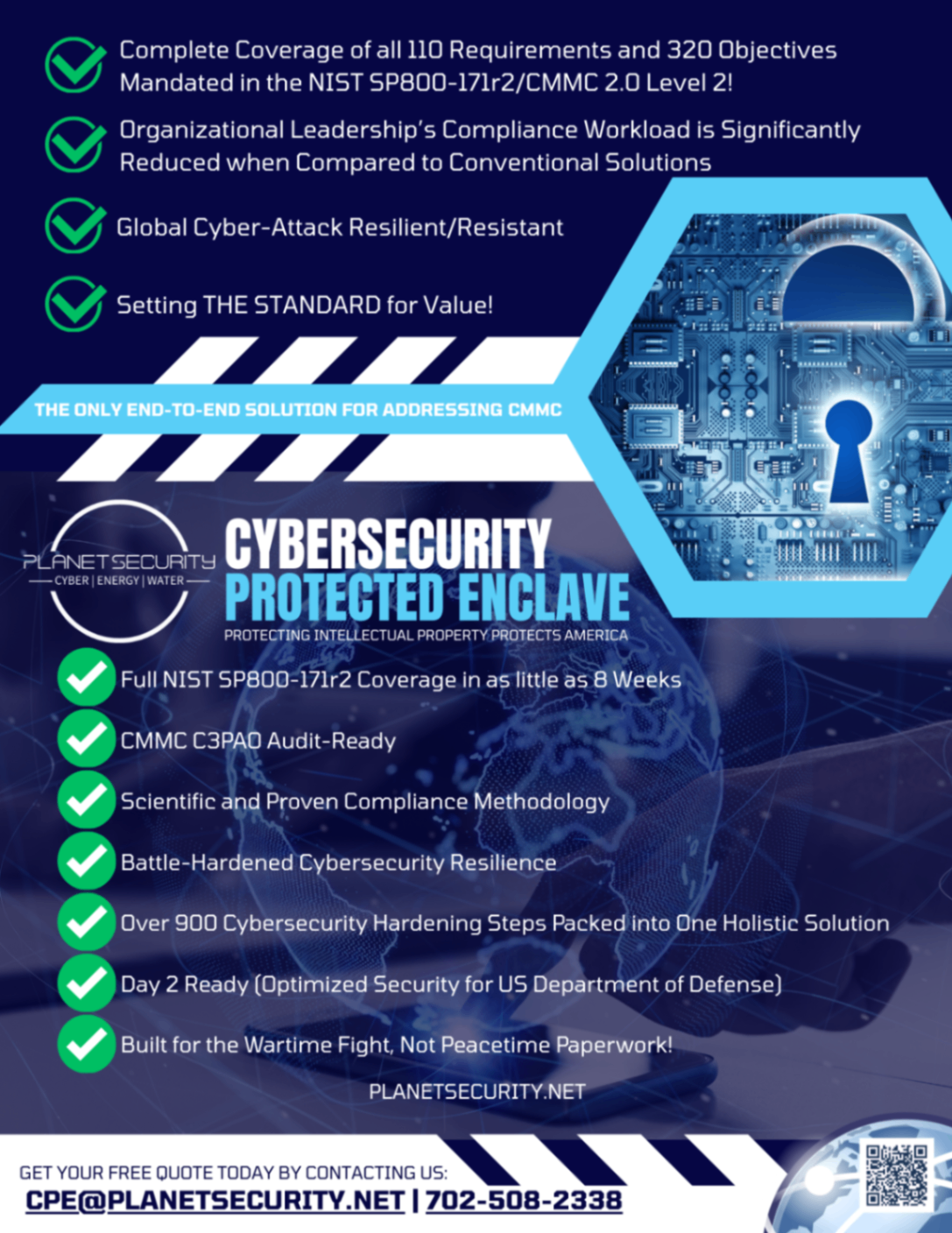
CPE Level 2 gets you audit-ready in 4 weeks at $1,299/month for up to 20 users. (Choose an 8-week deployment instead and reduce your monthly cost by $100.)
What's included:
- Complete hardware and software infrastructure
- Full CMMC 2.0 Level 2 compliance (all 110 requirements, 320 objectives)
- Yoo-Jin AI continuous monitoring (1,500+ checkpoints)
- Network segmentation and CUI isolation
- MSP/MSSP services with 24/7 support
- vCISO guidance and audit support
- System Security Plan (SSP) documentation
- Zero upfront cost
No POA&M tracking required. No hoping you've maintained compliance between audits. No guessing when you sign your annual attestation.
Making the Smart Choice
The False Claims Act isn't going away. DOJ enforcement is accelerating. Whistleblower incentives are substantial. And annual attestations create recurring exposure that traditional compliance approaches simply can't address.
You can spend 18 months and six figures building compliance infrastructure that still leaves you exposed to FCA liability because you lack continuous monitoring. Or you can deploy CPE Level 2 in 4 weeks with AI-powered verification that removes the guesswork from every attestation.
The choice is pretty clear.
When the DOJ comes knocking: or a whistleblower files a qui tam claim: you want to be able to prove your compliance with documented evidence, not spreadsheets and good intentions. CPE Level 2 gives you that proof, continuously monitored and ready for audit.
Stop gambling with million-dollar FCA exposure. Get the continuous monitoring and compliance confidence that defense contractors actually need in 2026.
Ready to eliminate your False Claims Act risk? Learn more about CPE Level 2 and get audit-ready in 4 weeks. Contact us at CMMC@PLANETSECURITY.NET or call 702-508-2338.