If you're a defense contractor or subcontractor, you've probably stared at a DoD contract and wondered: "Do I need DFARS 7012 compliance, CMMC 2.0, or both?" The short answer? You need both. And if that sounds confusing, you're not alone.
Let's break down what each requirement actually means, how they overlap, and: most importantly: how you can cover both without losing your mind or your budget.
What Is DFARS 7012?
DFARS 7012 (officially DFARS Clause 252.204-7012) has been around since December 31, 2017. It's a clause that applies to any DoD contractor or subcontractor handling Controlled Unclassified Information (CUI).
Here's what you need to know:
- It requires 110 NIST SP 800-171 controls to protect CUI on your network
- Self-attestation is the assessment method : meaning you monitor and report your own compliance
- Incident reporting is mandatory within 72 hours if there's a breach involving CUI
- It applies to all unclassified DoD contracts that involve CUI (which is almost all of them)
DFARS 7012 was the DoD's first serious attempt at getting contractors to lock down their cybersecurity. The problem? Self-attestation doesn't inspire a ton of confidence. Contractors could report their own scores without independent verification, which led to inflated claims and inconsistent security postures across the defense industrial base.
What Is CMMC 2.0?
Enter CMMC 2.0 (Cybersecurity Maturity Model Certification), which officially launches in phases throughout 2025 and beyond. The DoD realized self-attestation wasn't cutting it, so they built a three-tiered certification framework to replace the honor system with actual third-party assessments.
Here's the breakdown:
- CMMC Level 1: 17 basic cybersecurity practices (self-assessment allowed for now)
- CMMC Level 2: All 110 NIST SP 800-171 Rev. 2 controls, covering 110 CMMC requirements and 320 objectives : requires third-party assessment by a C3PAO (Certified Third-Party Assessment Organization)
- CMMC Level 3: NIST SP 800-172 controls for the most sensitive programs (higher-tier defense contracts)
Most defense contractors will need CMMC Level 2, which aligns almost perfectly with DFARS 7012 but adds the critical element of independent verification.
The Key Differences Between DFARS 7012 and CMMC 2.0
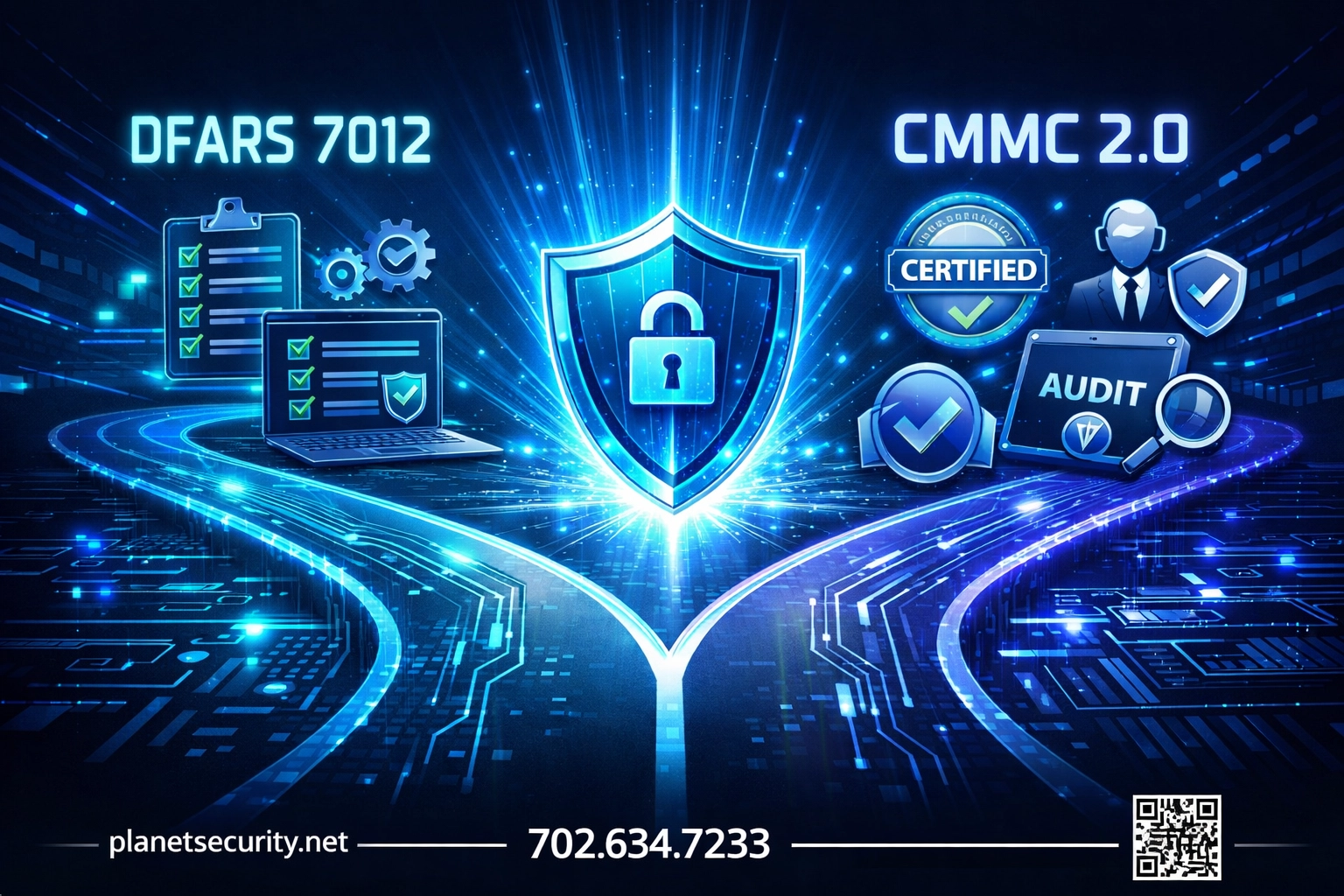
Here's where things get interesting. DFARS 7012 and CMMC 2.0 Level 2 are built on the same foundation (NIST SP 800-171), but they differ in how compliance is proven and enforced:
Assessment Method
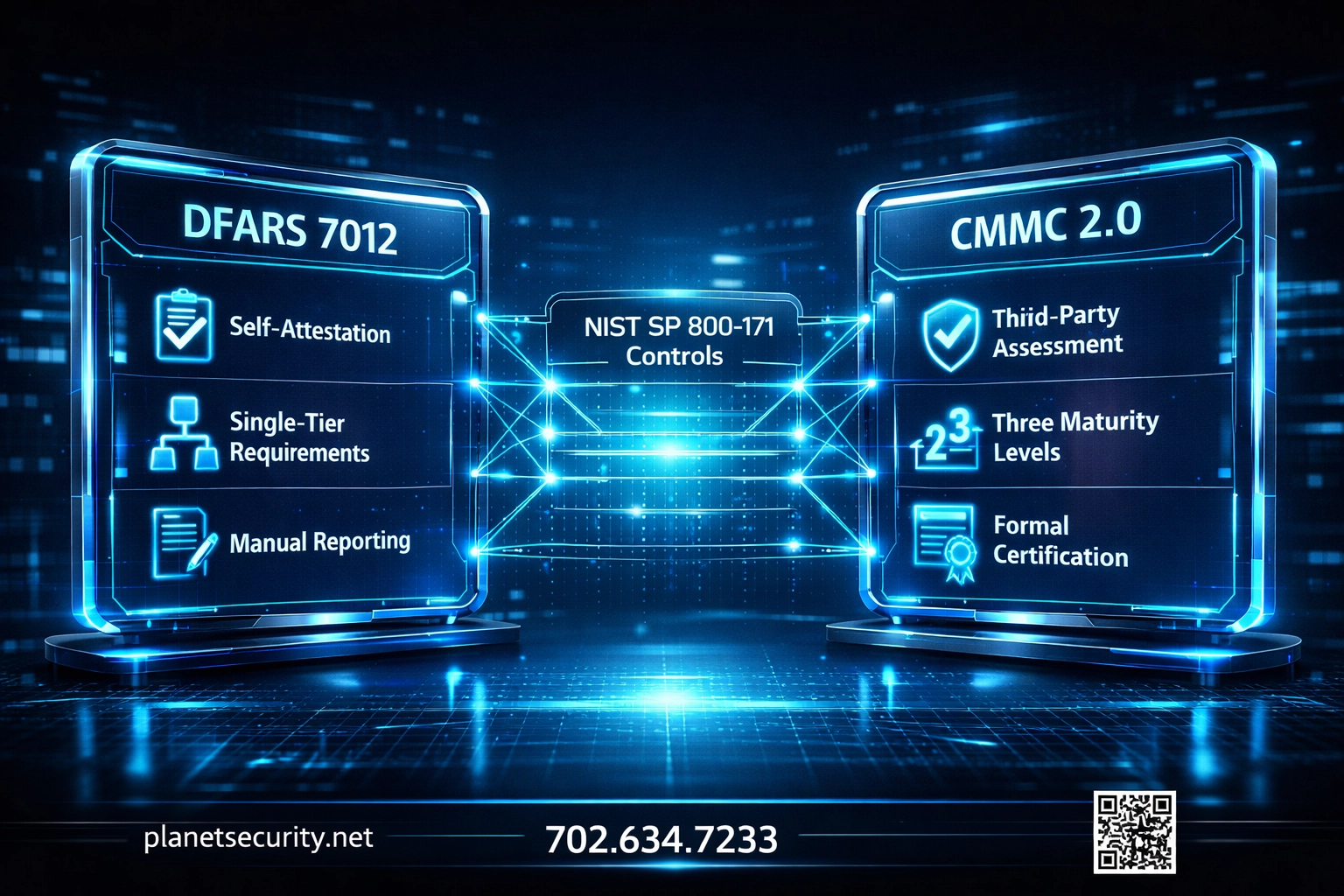
- DFARS 7012: Self-attestation. You fill out your own scorecard and submit it to the DoD via the Supplier Performance Risk System (SPRS).
- CMMC 2.0 Level 2: Third-party assessment. A certified C3PAO audits your environment and issues a formal certification that's valid for three years.
This is the biggest difference. CMMC eliminates the honor system and forces contractors to prove their security posture through independent verification.
Maturity Levels
- DFARS 7012: One single tier of requirements.
- CMMC 2.0: Three distinct maturity levels, allowing the DoD to tailor requirements based on contract sensitivity.
Reporting Requirements
Both frameworks require cyber incident reporting within 72 hours, but CMMC 2.0 formalizes the process and ties it directly to your certification status. If you fail to report an incident properly, your CMMC certification could be at risk.
Flowdown Requirements
Both DFARS 7012 and CMMC 2.0 include flowdown requirements, meaning prime contractors must include these clauses in all subcontracts without alteration. If you're a subcontractor handling CUI, you're subject to the same rules as the prime.
So, Which One Applies to Your Defense Contract?
Here's the reality: If you work with the DoD and handle CUI, both requirements currently apply.
- DFARS 7012 has been in effect since 2017 and applies to all relevant contracts immediately.
- CMMC 2.0 is being phased in through DFARS Clause 252.204-7021, which will appear in new contracts and renewals starting in 2025.
By 2026, every defense contractor will need to comply with both requirements. DFARS 7012 remains in effect for ongoing compliance and incident reporting, while CMMC 2.0 certification becomes the gatekeeping mechanism for winning new contracts.
Qualifying for one does not automatically mean compliance with the other. You can't just submit your CMMC certification and call it a day on DFARS 7012 reporting. They have different administrative and reporting obligations, even though the technical controls are nearly identical.
The Overlap (And the Challenge)
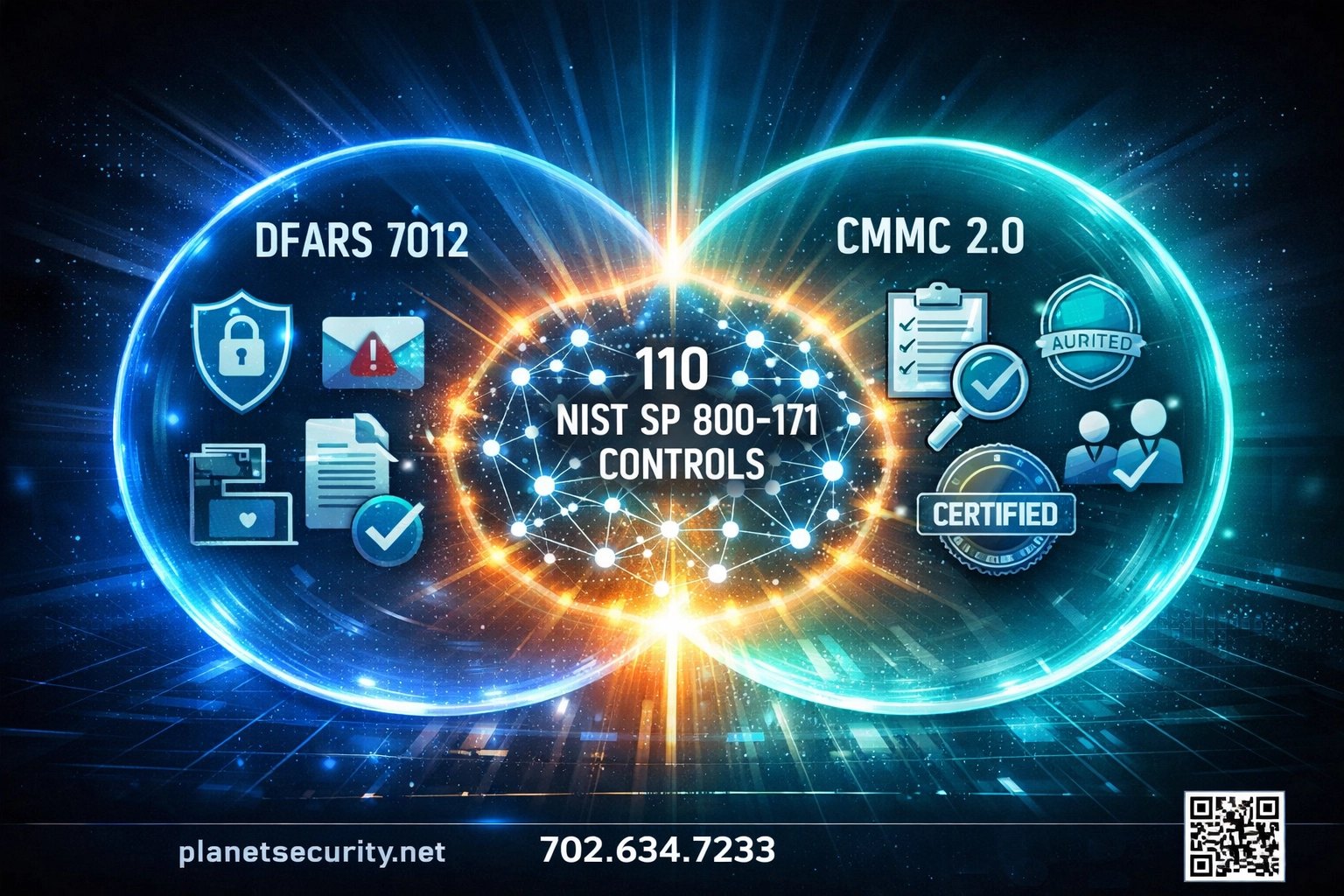
Here's the good news: The technical security controls for DFARS 7012 and CMMC Level 2 are essentially the same. Both require the 110 NIST SP 800-171 controls, which means if you've hardened your systems for one, you're 90% of the way there for the other.
The challenge? Meeting both sets of reporting, documentation, and assessment requirements without duplicating effort or spending six figures on consultants.
Most defense contractors face these pain points:
- Manual compliance tracking across multiple frameworks
- Expensive third-party assessments that can cost $30,000–$100,000+ for CMMC Level 2
- POA&M (Plan of Action & Milestones) management for any gaps in your security controls
- Continuous monitoring requirements to maintain compliance between assessments
- Incident response coordination across DFARS and CMMC reporting channels
This is where most contractors get stuck. Traditional approaches to compliance can take 12–18 months and cost well into six figures by the time you factor in hardware, software, consulting, and ongoing managed services.
How CPE Level 2 Solves Both Requirements
CPE Level 2 (Cybersecurity Protected Enclave Level 2) was built specifically to address both DFARS 7012 and CMMC 2.0 Level 2 requirements in a single, turnkey solution.
Here's what makes it different:
100% Coverage of Both Frameworks
CPE Level 2 delivers complete technical compliance with all 110 NIST SP 800-171 controls, covering both DFARS 7012 and CMMC 2.0 Level 2 requirements. There's no gap analysis, no POA&M tracking, and no wondering if you've missed something.
Yoo-Jin AI Automates 900+ Hardening Steps
Unlike generic cloud solutions or traditional IT consulting, CPE Level 2 uses Yoo-Jin AI to automate over 900 CPE-specific hardening steps during deployment. This isn't a cookie-cutter approach: it's a purpose-built enclave that's scientifically hardened to DoD standards.
And here's the kicker: Yoo-Jin AI uses AI-obfuscated data to enhance security without exposing your sensitive information to Big-Tech AI models. Your client data never leaves your enclave and is never visible to third-party AI systems.
Continuous Compliance Monitoring
CPE Level 2 includes continuous monitoring that tracks your compliance posture in real time. You're not flying blind between audits: you have 24/7 visibility into your security controls, incident response readiness, and audit preparedness.
This addresses both DFARS 7012's ongoing compliance requirements and CMMC 2.0's expectation that you maintain your security posture between triennial assessments.
4-Week Deployment (Not 18 Months)
Most contractors spend 12–18 months trying to achieve CMMC Level 2 readiness. CPE Level 2 gets you audit-ready in 4 weeks.
That's not an exaggeration. The enclave includes:
- Hardware (firewall, switches, backup infrastructure)
- Software (operating systems, security tools, monitoring platforms)
- Managed Services (MSP/MSSP, security patching, backup management)
- vCISO Support (compliance documentation, policy development, audit coordination)
- Audit Readiness (pre-audit assessments, documentation packages, C3PAO coordination)
Everything you need for DFARS 7012 and CMMC 2.0 Level 2 compliance in one package.
Pricing That Actually Makes Sense
Traditional compliance approaches can cost $75,000–$150,000+ upfront, plus ongoing managed services fees. CPE Level 2 starts at $1,299/month for up to 20 users with no upfront capital expense.
That's all-inclusive. You're not nickel-and-dimed for additional services, and there's no surprise consulting bill at the end of the deployment.
Want to adjust your deployment timeline? Choosing an 8-week deployment instead of 4 weeks reduces your monthly pricing by $100/month. You get flexibility without sacrificing compliance coverage.
The Bottom Line
DFARS 7012 and CMMC 2.0 both apply to your defense contracts, and they're not going anywhere. The technical controls are nearly identical, but the reporting and assessment requirements are different enough that you need a strategy for both.
CPE Level 2 is the only solution that covers both frameworks in a single, turnkey deployment. You get 100% compliance coverage, continuous monitoring powered by Yoo-Jin AI, audit readiness in 4 weeks, and pricing that doesn't require a board-level budget approval.
Stop trying to manage compliance piecemeal. Get a solution that's purpose-built for DFARS 7012 and CMMC 2.0 Level 2: and get back to focusing on your mission.
Ready to simplify your compliance? Learn more about CPE Level 2 and see how you can achieve audit readiness in 4 weeks. Contact us at CMMC@PLANETSECURITY.NET or call 702-508-2338 today.