Defense contractors love to talk about phishing, MFA, and “zero trust.” All important. But there’s a compliance risk sitting in plain sight that most companies still treat like “someone else’s problem”:
The U.S. power grid is aging, overstressed, and increasingly targeted, and when it fails, your compliance posture fails with it.
If your CUI environment depends on grid power, municipal water pressure, “cloud uptime,” and normal internet routing, you don’t have a resilience plan, you have a hope plan. And hope doesn’t pass an assessment.
The grid isn’t just “old.” It’s a cascading failure machine.
Here’s the practical reality: a large portion of transmission lines, transformers, and supporting infrastructure were built for a different era. Equipment ages. Maintenance backlogs grow. Demand increases. Weather gets more extreme. And when a single component fails, it can trigger wider outages.
This matters for compliance because availability is not optional when you’re handling Controlled Unclassified Information (CUI). CMMC and NIST expectations don’t magically pause because your region lost power.
Outage impacts that become compliance problems fast:
- Loss of access controls (badging systems, electronically locked rooms, camera systems, alarms)
- Loss of logging/monitoring continuity (SIEM, EDR dashboards, syslog collectors, NTP time sync drift)
- Loss of environmental protection (HVAC downtime can damage systems and storage)
- Forced process changes (staff start using personal hotspots, personal email, personal devices “temporarily”)
- Data handling shortcuts (printing CUI because “systems are down,” then storing paper insecurely)
And yes, auditors ask about this. Your customer asks about this. Your insurer asks about this. Reality asks about this.
Cyber-kinetic threats are real (and global tensions make them more likely)
Most organizations still split “cyber” and “physical” into separate buckets. Attackers don’t.
Cyber-kinetic means the adversary uses cyber techniques to create real-world physical effects: outages, equipment damage, water disruption, or operational paralysis. With current geopolitical tensions, it’s not theoretical, it’s a playbook.
The grid is a high-value target because it’s a multiplier:
- Knock out power → disrupt manufacturing, logistics, communications, and response
- Create confusion → force workarounds and policy violations
- Increase pressure → people make mistakes, shortcuts happen, and controls get bypassed
If your CUI protection strategy assumes stable utilities, stable internet, and stable cloud access, you’re planning for peace-time conditions in a world that isn’t peace-time.
The uncomfortable compliance truth: “IT controls” don’t work if the lights are off
A lot of compliance programs are built on software-first assumptions:
- “We have MFA.”
- “We have endpoint protection.”
- “We have a cloud DLP product.”
- “We have backup in the cloud.”
Good. But controls must remain effective during disruption, or you’re just compliant “on sunny days.”
What typically breaks first during a prolonged outage:
- Authentication + authorization dependencies (IdP outages, DNS issues, certificate problems, token failures)
- Central logging visibility (SOC tools can’t reach endpoints; endpoints can’t reach collectors)
- Secure comms (VPN concentrators and ISP paths become unreliable)
- Process discipline (people “just need to send the file”)
When operations are stressed, CUI is exactly what tends to get mishandled, because it’s tied to contracts, delivery deadlines, and real money.
CMMC 2.0 Level 2 isn’t just software, resilience is part of the security story
Let’s be blunt: CMMC 2.0 Level 2 (with its 110 CMMC requirements and 320 objectives) is not a “buy a tool, check a box” situation. A mature compliance posture includes the operational capability to keep CUI protected when conditions degrade.
That’s why we treat resilience as a first-class compliance concern, because it is.
A grid failure can create a direct path to noncompliance via:
- Uncontrolled data exfil paths (personal devices, unmanaged networks)
- Incomplete audit trails (loss of logs = loss of evidence)
- Breakdown of physical protections (facilities controls and monitoring)
- Improper media handling (paper becomes the “system”)
So if your plan for a 24–72 hour outage is “we’ll figure it out,” you’re not prepared for a Level 2 reality.
What “availability” actually means for a CUI environment
Availability isn’t “our server is up.” Availability is: your security controls stay enforceable and your team can keep executing without breaking rules.
Here’s the operational definition we recommend:
1) Keep the enclave secure during disruption
- Power continuity for core security infrastructure (firewalls, switches, storage, authentication services)
- Network segmentation remains intact (no “flat network” emergency mode)
- Monitoring stays live (even if reduced, it’s still collecting and time-synced)
2) Keep people productive without unsafe workarounds
- A controlled way to communicate and transfer files
- Approved devices only
- Procedures that don’t force policy violations to hit deadlines
3) Keep CUI contained
- No “temporary” cloud uploads
- No personal email forwarding
- No consumer AI tools used to “summarize requirements” with sensitive content
That last point matters more than ever: generic AI tools cannot be trusted with client data. If you paste contract details, drawings, incident notes, or internal security information into a public AI tool, you’ve likely created an uncontrolled disclosure event.
Planet Security’s approach uses AI-obfuscated data for AI-enabled workflows, so you can gain speed without handing your sensitive information to Big Tech.
The new baseline: Off-grid energy + water contingencies (yes, water)
If you’re thinking, “Energy, sure: but why water?”: because long outages don’t just mean darkness. They can mean:
- loss of municipal pumping capacity
- loss of cooling capacity
- loss of sanitation and facility usability
- forced facility closure (which triggers remote-work scramble)
For defense contractors, that can become a compliance incident. If your facility can’t operate, your team improvises. Improvisation is where CUI escapes.
Your contingency stack should include:
- Off-grid energy sized to keep security and CUI operations stable (not necessarily the entire building)
- Clean power conditioning (protects sensitive equipment from brownouts and surges)
- Fuel planning and runtime modeling (not “a generator somewhere”)
- Water contingency appropriate to your site and operational needs (cooling, sanitation, basic continuity)
If you want to go deeper on the energy side, Planet Security maintains practical guidance here:
And we take water continuity seriously as well: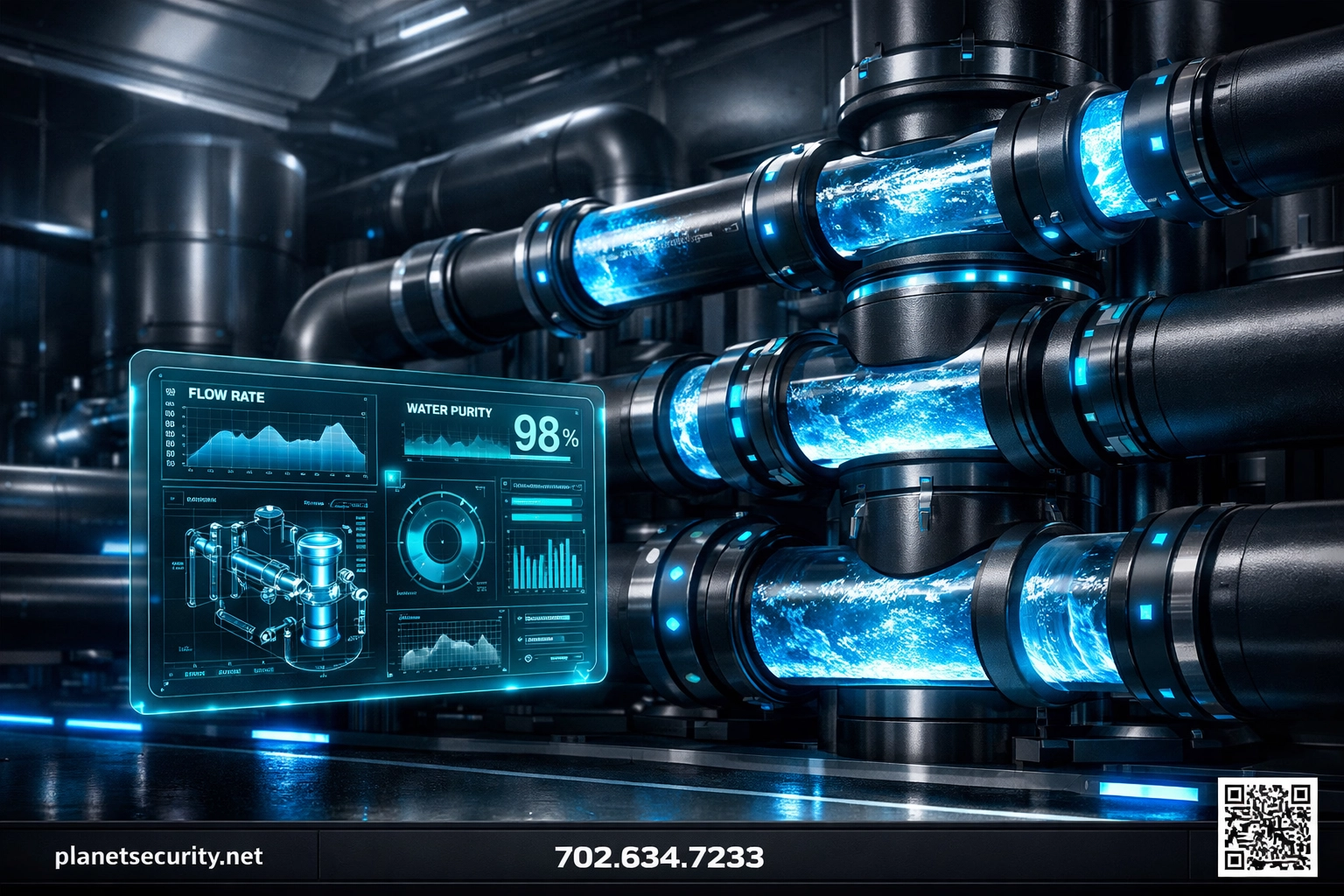
Where most compliance programs fail: they don’t connect resilience to control evidence
Assessments are evidence-driven. You don’t pass because you “care.” You pass because you can demonstrate controls are implemented and operating effectively.
A grid event exposes gaps in evidence like:
- missing log retention because collectors went down
- inconsistent time sync during outage window
- undocumented emergency processes (or processes that contradict policy)
- uncontrolled use of personal devices
Your resilience plan needs to be auditable. That means:
- documented triggers (when you switch to contingency mode)
- defined roles (who approves what)
- technical diagrams (what stays up, what shuts down)
- tested procedures (tabletops aren’t enough: do real tests)
How we solve it: execution-driven CMMC readiness, not theory
Planet Security is not in the business of handing you a binder and wishing you luck. We’re execution-first, because compliance isn’t “understanding”: it’s operational reality.
That’s why we emphasize CPE Level 2 as the core of a serious defense-contractor compliance strategy. CPE Level 2 is built to protect CUI and keep operating when conditions are bad, not just when everything is normal.
![[IMAGE] CPE Level 2 promotional graphic](https://cdn.marblism.com/Blqfxx1yM88.png)
What CPE Level 2 changes immediately
- CUI is contained in a purpose-built enclave (not scattered across laptops and random SaaS tools)
- Local resilience beats cloud dependency when the grid is unstable
- Security tooling and hardening are integrated, not bolted on
- Operational controls (including process and procedure support) are part of the system
When you’re aiming for CMMC 2.0 Level 2, you don’t need a stack of “maybe” products. You need an environment designed to meet the intent of the model and survive real-world disruption.
Practical roadmap: reduce grid-driven compliance risk in 30 days
You don’t need a 12-month transformation plan to start. Here’s a direct, practical sequence that produces real risk reduction:
Step 1: Identify your “CUI minimum viable operations”
Define the smallest set of systems that must stay up to:
- keep CUI protected
- keep work moving
- keep audit evidence intact
Typically: firewall, switching, core servers/storage, authentication, logging, secure workstations, and controlled file transfer.
Step 2: Design power continuity around controls, not comfort
You’re not trying to run the whole building. You’re trying to keep:
- security controls enforced
- CUI workflows controlled
- logs preserved
This is where off-grid energy becomes a compliance control enabler, not just an operations upgrade.
Step 3: Lock down “outage behavior” with written rules
Make it explicit:
- no personal email for work artifacts
- no personal cloud drives
- no consumer AI for any sensitive content
- no unmanaged hotspots unless explicitly authorized and controlled
Step 4: Implement a hardened enclave for CUI
This is where CPE Level 2 delivers the biggest step-function improvement: a controlled environment that’s designed for CMMC 2.0 Level 2 execution, not just policy writing.
Pricing (kept simple): what CPE Level 2 costs and what it includes
Most readers don’t need a price list: they need a reliable path to compliance and safety. Still, here’s a clear example structure:
CPE Level 2 starting at $1,299/month for up to 20 users, typically includes:
- enclave design and implementation aligned to CMMC 2.0 Level 2 (110 requirements, 320 objectives)
- hardened configuration baseline and managed security stack
- monitored security posture and technical compliance support
- integrated guidance for CUI handling procedures (so people don’t improvise)
- optional resilience enhancements (including off-grid energy and contingency planning)
Deployment length affects price: choosing an 8-week deployment instead of 4 weeks reduces pricing by $100/month, because the delivery effort is spread over a longer window.
If you want the full breakdown and capabilities, start here: CPE Level 2.
Q&A: the “grid failure” questions we get from defense contractors
Q: “Isn’t grid reliability a utility problem, not a compliance problem?”
No. The utility owns the grid. You own your ability to protect CUI. If grid instability causes you to lose control of access, logging, or data handling discipline, it becomes your compliance issue instantly.
Q: “We’re in the cloud: doesn’t that solve outages?”
Cloud reduces some infrastructure burdens, but it also introduces dependencies:
- your internet path
- regional ISP congestion during emergencies
- identity provider availability
- cloud service availability
And it doesn’t stop employees from using unsafe workarounds when they can’t access systems. Cloud doesn’t replace a resilience plan.
Q: “Can’t we just use a generator?”
A generator is not a plan by itself. You need:
- runtime modeling
- fuel logistics
- power conditioning
- priority circuits
- testing
- documented operating procedures
Otherwise it’s just an expensive hope.
Q: “How does water connect to CUI protection?”
When facilities become unusable, teams scatter and improvise. That’s when CUI ends up on unmanaged devices and consumer platforms. Water continuity supports operational continuity, which supports controlled CUI handling.
Q: “What about AI: can we use ChatGPT to speed up policy work?”
Do not put sensitive client or contract data into generic AI tools. Generic AI tools cannot be trusted with client data. Planet Security differentiates with AI-obfuscated data approaches so you can gain efficiency without handing your sensitive information to third parties.
The bottom line: the aging grid is a compliance threat multiplier
If your compliance plan assumes stable power and normal operations, it’s incomplete. Grid failures don’t just disrupt production: they pressure people into noncompliant behavior and break the evidence chain you need for assessment confidence.
Defense contractors who treat resilience as part of CMMC readiness are the ones who:
- keep delivering during disruption
- keep CUI contained
- keep audit evidence intact
- keep customers confident
And that’s exactly why CPE Level 2 isn’t “just software.” It’s a security-and-continuity posture built for the world we’re in: where cyber and kinetic risks are converging, and the grid is not getting younger.