Most CMMC planning begins with the threats outside the company: phishing, ransomware, credential theft, malware, and nation-state attacks.
Those threats matter. But they are not the entire CUI problem.
A careless employee can email a controlled document to the wrong recipient. A privileged administrator can access files outside their role. A terminated worker can retain an active credential. A supply-chain partner can receive broad access to systems they do not need. A disgruntled insider can copy sensitive information to removable media, or simply misuse legitimate permissions.
No patch fixes excessive access. No firewall repairs a bad authorization. No antivirus tool can undo a CUI file that was intentionally or accidentally exfiltrated by an authorized user.
That is why defense suppliers need more than perimeter security. They need an architecture designed to limit trust, restrict CUI movement, monitor behavior, and preserve evidence.
They need CPE Level 2.
Insider Threats Are Already Inside the Boundary
An insider threat is not limited to a malicious employee. It includes any person who uses authorized access, intentionally or unintentionally, to harm the confidentiality, integrity, or availability of systems or information.
For defense suppliers, common insider-threat paths include:
- Negligent employees mishandling CUI, using unauthorized collaboration tools, or leaving a workstation unlocked.
- Credential misuse involving shared accounts, excessive privileges, stolen passwords, or administrator accounts used for routine work.
- Disgruntled insiders deliberately downloading, modifying, deleting, or disclosing sensitive information.
- Contractors and supply-chain partners accessing systems, applications, or data beyond their approved business need.
- Former employees retaining credentials, badges, tokens, files, or remote-access permissions after termination.
- Portable media carrying CUI outside controlled areas without proper encryption, accountability, or authorization.
- AI-enabled workflows that expose CUI or intellectual property to generic AI tools that cannot be trusted with client data.
The quiet danger is that these actions may look legitimate at first. The user may have a valid account. The device may be approved. The connection may be authenticated.
Authentication alone does not establish safe access.
CMMC 2.0 Level 2 requires defense suppliers to address this risk through least privilege, separation of duties, personnel security, insider-threat awareness, auditability, incident response, and continuous monitoring.
The official CMMC Model Overview identifies Level 2 as the protection level for CUI aligned to NIST SP 800-171 Revision 2. That means 110 security requirements and 320 assessment objectives must be addressed, not merely acknowledged in a policy document.
Why Conventional Security Models Struggle With Insiders
Traditional security programs often divide the world into “trusted” internal users and “untrusted” external attackers.
That model creates dangerous assumptions:
- Employees inside the network are trusted too broadly.
- Administrators can see or change more than necessary.
- Business networks and CUI systems share infrastructure.
- Supply-chain connections remain open because they are convenient.
- Cloud collaboration tools become informal CUI repositories.
- Security logs exist, but no one correlates them quickly enough to identify abnormal behavior.
- Access is granted once and reviewed later, if it is reviewed at all.
An insider does not need to exploit a software vulnerability when the organization has already granted excessive permissions.
The strongest insider-threat defense is to reduce the opportunity for misuse before it occurs.
That requires a clean-slate environment where CUI is segmented, access is explicitly authorized, privileged actions are recorded, communications are controlled by exception, and suspicious behavior is continuously evaluated.
CPE Level 2 Applies Zero Trust Where CUI Actually Lives
Zero trust is often discussed as a broad enterprise strategy. For defense suppliers, its most important application is practical: protect the CUI enclave as though every user, device, process, and connection must continuously prove its legitimacy.
CPE Level 2 applies this approach through:
1. Clean-Slate Segmentation
CPE Level 2 is built as a dedicated environment for CUI rather than treating sensitive information as just another folder on the corporate network.
Its security-centric segmentation helps separate:
- CUI processing and storage;
- User functionality;
- System-management functionality;
- Remote-access pathways;
- Backup and recovery services;
- Security monitoring and audit infrastructure;
- External systems and supply-chain connections.
When CUI is contained within a defined enclave, the blast radius of an insider mistake or compromised account is materially reduced.
2. Least-Privilege Access
CPE Level 2 supports the CMMC requirements for limiting access to the information, systems, functions, and security capabilities users need to perform assigned duties.
That includes:
- Role-based access;
- Non-privileged accounts for ordinary work;
- Restricted administrator accounts;
- Separation of duties;
- Controlled remote access;
- Managed access-control points;
- Logged privileged functions;
- Formal access changes after transfers and terminations.
The objective is direct: a user should not be able to browse, copy, alter, or administer what their job does not require.
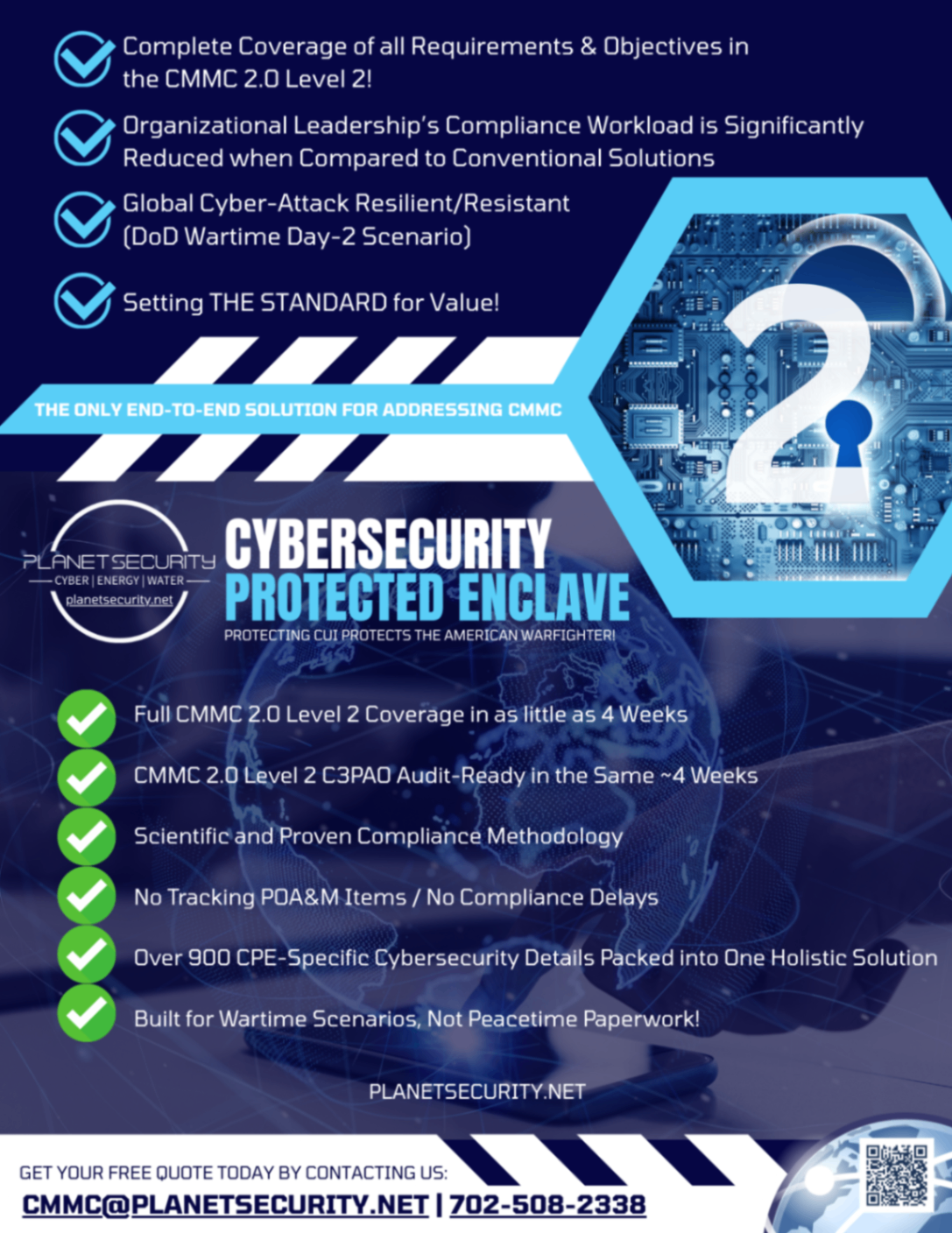
3. More Than 900 Hardened Security Configurations
CMMC compliance is not achieved by installing a single security product. It requires coordinated implementation across hardware, software, firmware, networks, policies, procedures, training, and operations.
CPE Level 2 incorporates 900+ hardened security configurations and CPE-specific cybersecurity details into one integrated environment. These configurations support:
- Secure system baselines;
- Restricted ports, protocols, and services;
- Application execution controls;
- Strong authentication;
- Audit logging;
- Vulnerability management;
- Host and network compliance;
- Backup protection;
- Malware protection;
- Security configuration enforcement.
A hardened baseline gives administrators fewer opportunities to create accidental exceptions, and gives insiders fewer technical pathways to abuse.
FIPS-Validated Encryption Protects CUI Beyond Intent
Insider risk is not limited to what a person can intentionally do. Devices are lost. Files are copied. Backups are transported. Remote sessions traverse networks outside the organization’s direct control.
CMMC-aligned encryption must be more than “strong encryption” in a marketing description. Where cryptography protects CUI confidentiality, organizations must evaluate whether the cryptographic module is FIPS validated.
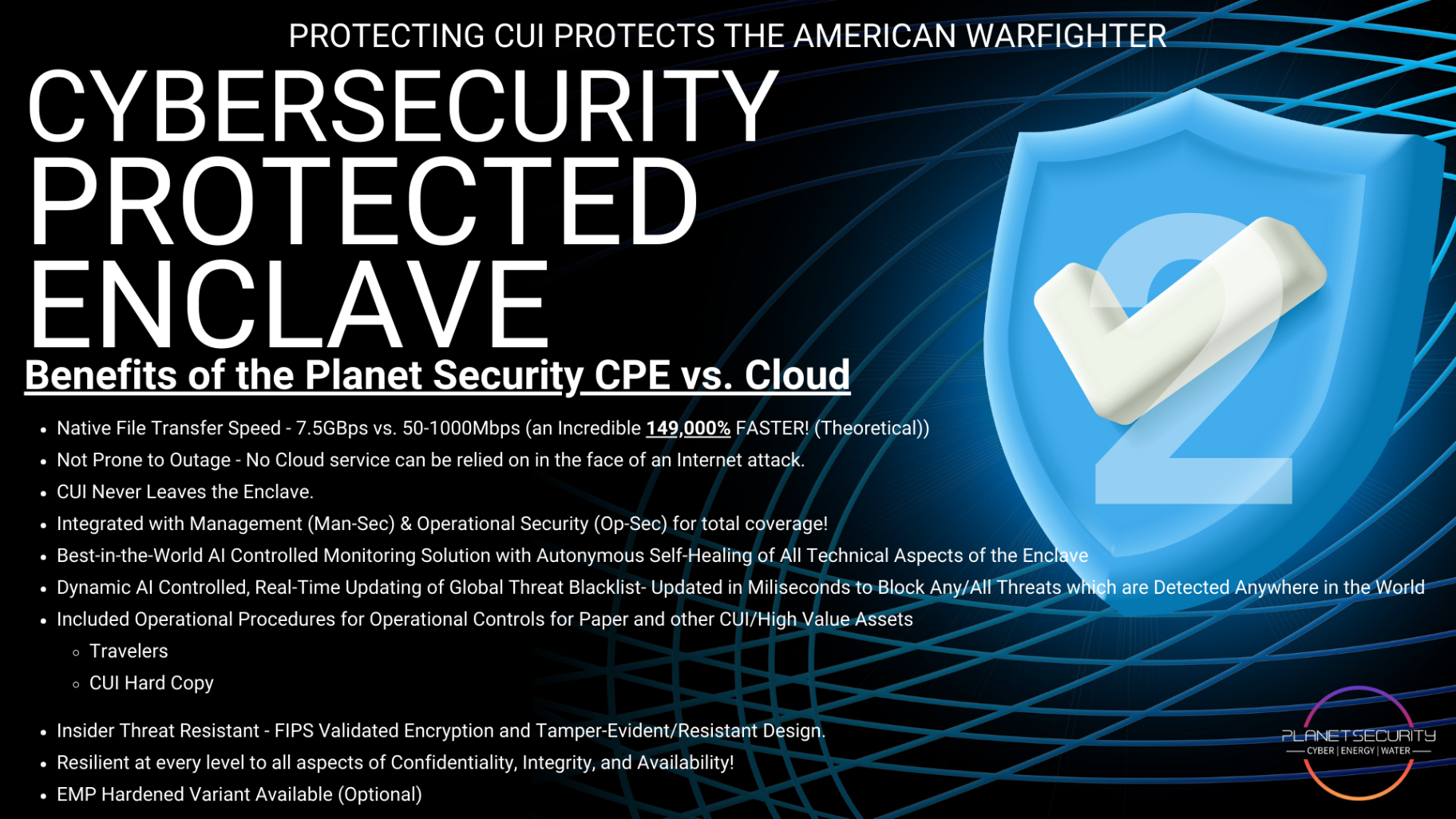
CPE Level 2 incorporates FIPS-validated encryption into its protected-enclave design for applicable CUI use cases, including:
- Data at rest;
- Remote access sessions;
- CUI in transit;
- Portable or removable media;
- Backup protection;
- Mobile computing scenarios where applicable.
Encryption does not replace access control, but it provides a critical second layer when access restrictions fail.
On-Premise or Co-Located CUI With No Cloud Dependency
CPE Level 2 is designed for on-premise deployment, with co-location options available. This gives defense suppliers a direct alternative to placing CUI inside broad cloud ecosystems or generic collaboration platforms.
The benefits include:
- CUI remains inside the defined enclave.
- Reduced dependence on cloud-provider availability.
- No need to make a general-purpose cloud platform the center of CUI operations.
- Lower exposure to unauthorized third-party access paths.
- Controlled physical and logical boundaries.
- Local performance without unnecessary network latency.
- Direct alignment between the system boundary and the System Security Plan.
For organizations concerned about cloud sprawl, an on-premise or co-located enclave provides zero cloud-storage risk for CUI maintained within that enclave. The architecture is built around containment rather than convenience.
Yoo-Jin AI Monitors Without Taking Client Data
Continuous monitoring is essential for insider-threat resistance. The system must identify unusual access, suspicious transfers, unauthorized use, privilege changes, logging failures, and other indicators that a traditional periodic review may miss.
CPE Level 2 includes Yoo-Jin AI, Planet Security’s privacy-first monitoring and automation engine. Yoo-Jin AI supports:
- Continuous security and compliance monitoring;
- Threat-intelligence and blacklist updates;
- Configuration verification;
- Access and privilege monitoring;
- Audit-trail documentation;
- Vulnerability and patch-status tracking;
- Evidence organization;
- Security alerting and reporting.
However, generic AI tools cannot be trusted with client data. Sending CUI, intellectual property, financial information, or personally identifiable information into a public or poorly governed AI system creates a new data-exposure path.
Yoo-Jin AI is differentiated by its use of AI-obfuscated data. Yoo-Jin does not need direct access to sensitive client data to monitor the security state of the enclave. This privacy-centered approach avoids the Big-Tech model of indiscriminately ingesting valuable information into systems with unclear reuse, sharing, or governance.
The AI works for the enclave without becoming another insider.
A Four-Week Path to Implementation
CPE Level 2 can be deployed in as little as four weeks, depending on organizational readiness, scope, site requirements, user count, and implementation conditions.
A focused deployment generally addresses:
- Scope and data-flow confirmation , identify users, devices, systems, applications, and CUI pathways.
- Enclave installation and segmentation , establish the dedicated protected environment.
- Security configuration and access control , apply the hardened baseline, least privilege, MFA, logging, and encryption.
- Operationalization and evidence readiness , activate monitoring, training, procedures, reporting, and assessment support.
The result is a structured environment designed to provide 100% NIST SP 800-171 coverage across the applicable requirements and objectives, with ongoing managed operations, maintenance, security monitoring, and compliance support.
Insider-Threat Q&A for Defense Suppliers
Q: Does CMMC require protection against insider threats?
A: Yes. AT.L2-3.2.3 requires security awareness training on recognizing and reporting potential insider-threat indicators. Insider-threat resistance also depends on access control, least privilege, separation of duties, personnel security, audit logging, incident response, and continuous monitoring.
Q: Can an employee with valid credentials still be an insider threat?
A: Absolutely. A valid credential does not make every action valid. CPE Level 2 limits users to approved systems, data, transactions, and functions while recording security-relevant activity for accountability.
Q: How does CPE Level 2 help with supply-chain partners?
A: The enclave can restrict partner access to approved pathways and authorized resources. This supports controlled CUI flow, external-system restrictions, remote-access monitoring, and least-privilege implementation.
Q: Does CPE Level 2 eliminate the need for employee training?
A: No. Technology and training work together. CPE Level 2 includes security awareness and insider-threat training support because people must know how to recognize, report, and avoid risky behavior.
Q: Is CPE Level 2 a cloud service?
A: CPE Level 2 is designed as an on-premise or co-located protected enclave. That architecture helps keep CUI within a defined environment and avoids unnecessary cloud dependency.
Q: How fast can a defense supplier deploy CPE Level 2?
A: Deployment can occur in as little as four weeks, subject to scope, readiness, site conditions, and implementation requirements. Review the CPE Level 2 technical details for additional solution information.
The CUI Risk You Cannot Patch Requires a Different Architecture
External attackers will continue to target the Defense Industrial Base. But defense suppliers cannot secure CUI by focusing only on phishing, ransomware, and vulnerabilities.
The trusted insider, overprivileged account, unmanaged partner, and careless workflow can be just as damaging as an external exploit.
CPE Level 2 addresses that reality with:
- Zero-trust methodology;
- Clean-slate CUI segmentation;
- 900+ hardened security configurations;
- Least-privilege access;
- Separation of duties;
- FIPS-validated encryption;
- On-premise or co-located deployment;
- Continuous Yoo-Jin AI monitoring;
- AI-obfuscated data;
- 100% NIST SP 800-171 coverage;
- Support for all 110 CMMC requirements and 320 objectives;
- Deployment in as little as four weeks.
There is no substitute for containing CUI, limiting trust, and continuously verifying what users and systems are doing.
We welcome a discussion on how we may assist in your CMMC success story!
| planetsecurity.net | 702.634.7233 | 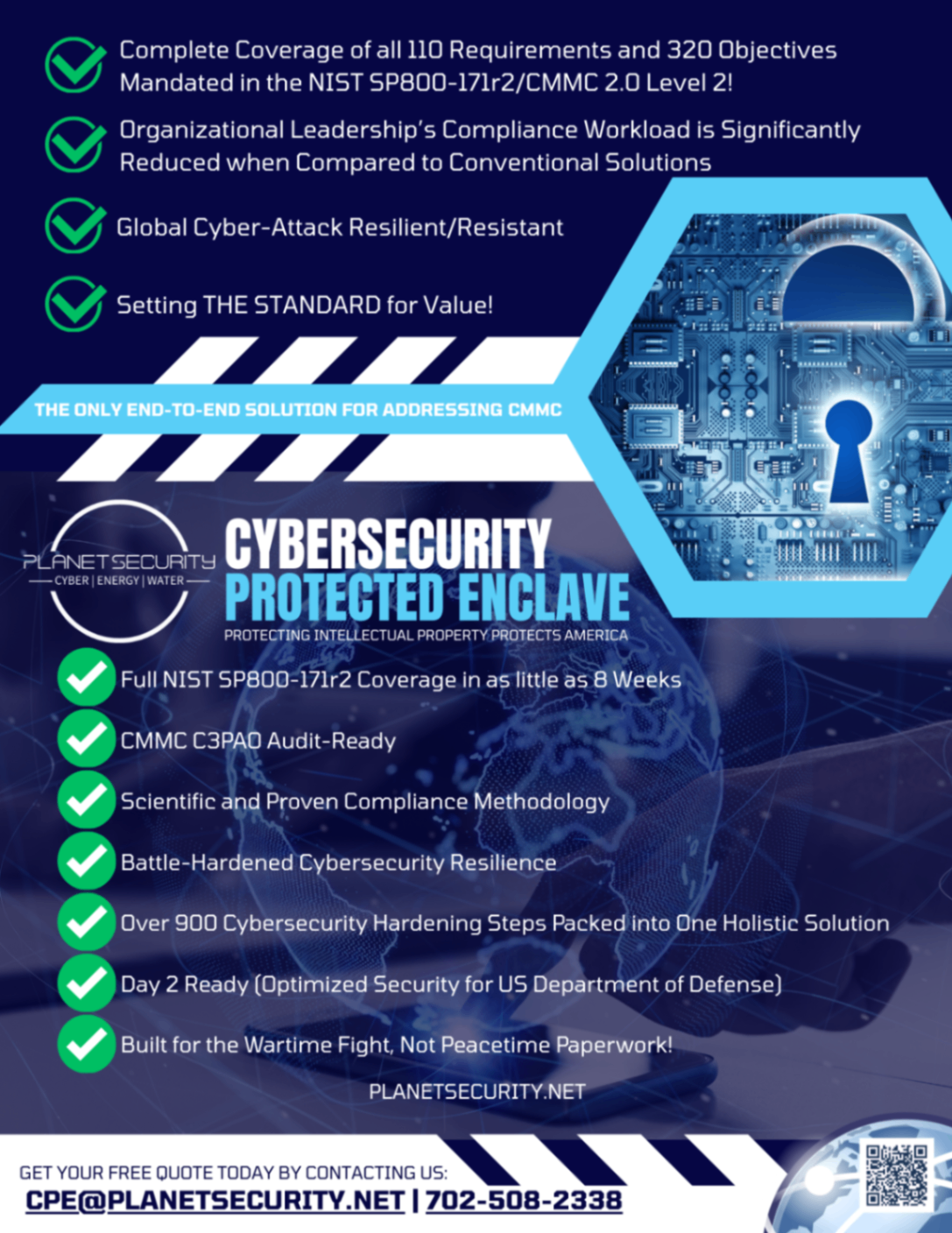 |
|---|