
Prime contractors are under increasing pressure to prove that cybersecurity requirements are enforced throughout the defense supply chain. A weak subcontractor environment can create contract delays, assessment findings, data exposure, and reputational damage for everyone involved.
The problem is straightforward: CMMC compliance does not stop at your company’s network boundary. When Controlled Unclassified Information (CUI) flows from a prime contractor to a subcontractor, the applicable cybersecurity obligations must flow down with it.
For defense contractors handling CUI, a collection of disconnected tools is not enough. You need a defined scope, hardened architecture, continuous monitoring, documented evidence, and operational discipline. That is exactly where CPE Level 2 delivers decisive value.
The Prime Contractor Flow-Down Crunch Is Already Here
Prime contractors must understand where CUI is created, stored, processed, and transmitted across the supply chain. They must also determine which subcontractors and external service providers require access to that information.
In practical terms, a prime contractor should:
- Identify every subcontractor that receives, creates, processes, stores, or transmits CUI.
- Determine the required CMMC status for each organization and system in scope.
- Flow down applicable contract clauses and cybersecurity obligations.
- Verify that subcontractors can demonstrate implementation: not merely promise it.
- Maintain evidence that the supply chain remains protected over time.
A subcontractor that does not handle CUI may not require CMMC 2.0 Level 2. But when CUI enters its environment, the risk profile changes immediately. The prime contractor must be able to distinguish between systems that touch CUI and systems that do not.
Guesswork is unacceptable. A poorly documented data flow or loosely defined enclave can expand assessment scope, increase remediation costs, and expose the prime to supply chain risk.
CMMC 2.0 Level 2 Means 110 Requirements and 320 Objectives
For the CMMC 2.0 Level 2 scope addressed in this article, the technical foundation is NIST SP 800-171 Rev. 2:
- 110 security requirements
- 320 assessment objectives
- 14 control families
- Protection for Controlled Unclassified Information in nonfederal systems
- Assessment evidence evaluated through examination, interviews, and testing
The distinction between requirements and objectives matters. A contractor cannot simply say, “We have access control,” and expect that statement to satisfy an assessor.
The assessment process examines whether the individual objectives are implemented correctly, operating as intended, and producing the desired outcome. Evidence may include:
- Access control configurations
- Multifactor authentication settings
- Audit logs and event reviews
- Vulnerability scans and remediation records
- Security awareness and role-based training records
- Configuration baselines and inventories
- Incident response procedures and test results
- System Security Plans (SSPs)
- Network and data-flow diagrams
- Backup and media protection records
- Physical access logs
- Continuous monitoring reports
One missing objective can cause an entire requirement to be marked NOT MET. That is why manual spreadsheets and disconnected policy folders are so dangerous. They create the appearance of progress without delivering reliable, repeatable evidence.
The official NIST publication and the DoD CMMC Level 2 Assessment Guide provide the authoritative technical and assessment context.
Why Conventional Remediation Fails Under Flow-Down Pressure
Traditional compliance projects often fail for predictable reasons:
- The CUI boundary is never clearly defined.
- Corporate and CUI systems are mixed together.
- Technical controls are purchased but not properly configured.
- Policies do not match actual operations.
- Evidence is collected manually and inconsistently.
- Employees are trained once, then forgotten.
- Vulnerability remediation is not tracked to completion.
- Changes are made without security impact analysis.
- Management does not receive timely risk reporting.
- Subcontractor evidence is accepted without verification.
This approach creates a recurring cycle of panic: a prime requests evidence, the subcontractor searches across systems, outdated documents are assembled, and everyone discovers that the evidence does not prove current implementation.
CMMC is not a paperwork exercise. It is an operational requirement for protecting sensitive information against real threats.
How CPE Level 2 Strengthens the Supply Chain
CPE Level 2 is designed as a turnkey, controlled environment for organizations that need to protect CUI while reducing compliance complexity.
The solution combines infrastructure, security configuration, operational processes, training, monitoring, and ongoing support into one managed approach.
1. A defined CUI boundary
A properly designed enclave helps separate CUI from ordinary business operations. This can reduce unnecessary assessment scope and make data flows easier to understand.
Planet Security’s Security Reference Architecture supports segmentation, boundary protection, controlled communications, and defense-in-depth architecture.
2. Automated audit evidence collection
Automated evidence collection changes the compliance workload completely.
Instead of waiting until an assessment is scheduled, the environment can continuously collect and organize evidence associated with:
- System configurations
- Patch and update status
- Authentication events
- Privileged activity
- Security alerts
- Vulnerability management
- Backup operations
- Monitoring activities
- Training completion
- Access reviews
- Configuration changes
This creates a defensible record of ongoing implementation. It also allows leadership to see whether controls are operating effectively before a prime contractor or C3PAO requests proof.
3. Continuous technical monitoring
CMMC requirements must remain effective after implementation. CPE Level 2 technical details describe ongoing monitoring, security patching, backup protection, operational support, and compliance-focused management.
A control that worked last year may fail today because of a configuration change, expired account, new vulnerability, or unauthorized connection. Continuous monitoring identifies those changes before they become assessment surprises or security incidents.
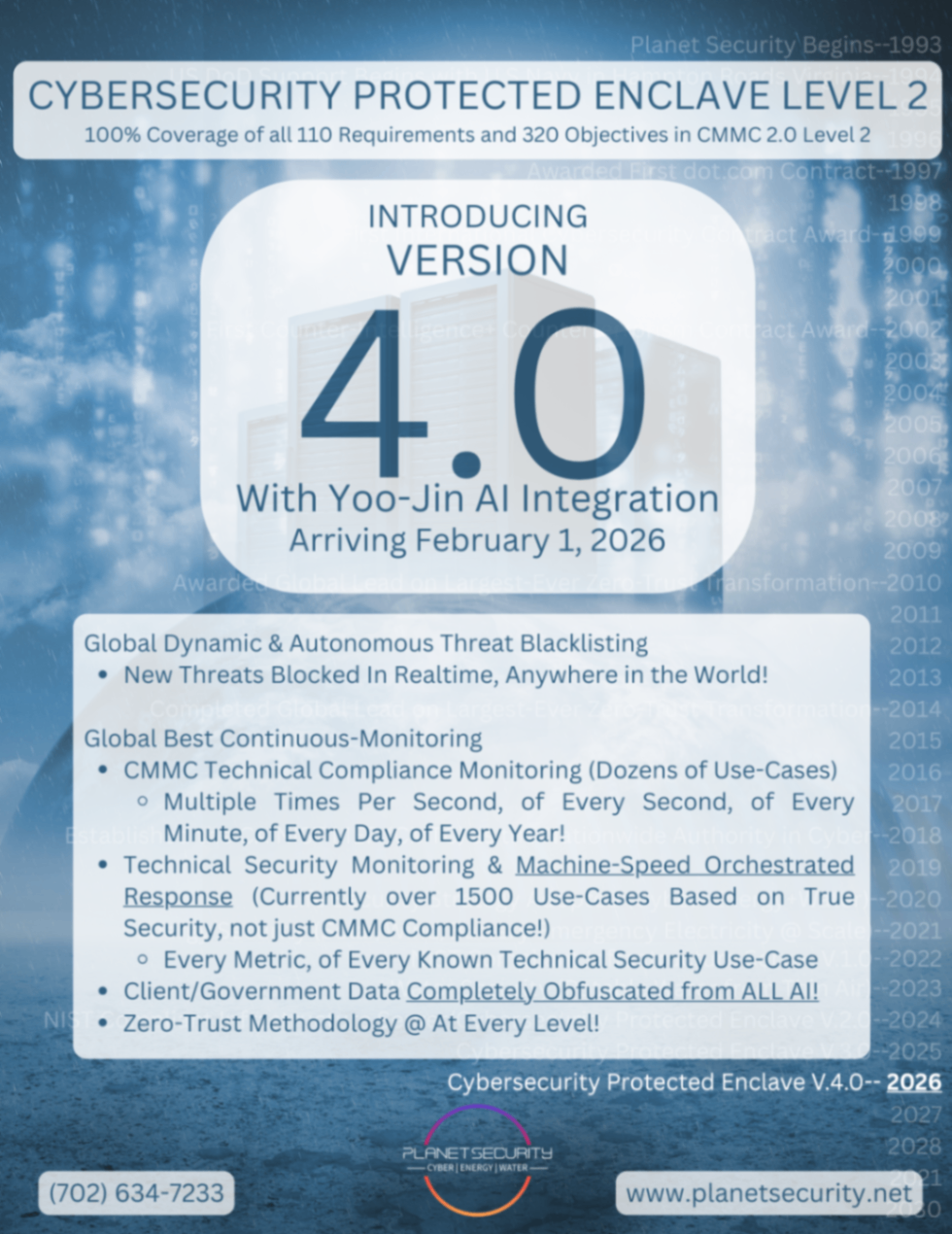
4. AI-obfuscated data safeguards
Generic AI tools cannot be trusted with client data, CUI, proprietary engineering information, or government-sensitive material. Sending sensitive content to Big-Tech AI platforms can create unacceptable confidentiality, retention, and secondary-use risks.
Planet Security differentiates its AI-enabled workflows through AI-obfuscated data safeguards. Data is protected before AI-supported analysis is performed, helping prevent sensitive client or government information from being exposed to generic AI systems.
The CPE Level 2 Version 4.0 announcement highlights AI-obfuscated data, zero-trust methodology, dynamic threat blacklisting, continuous CMMC technical compliance monitoring, and machine-speed response capabilities.
AI should improve security operations: not become a new data leakage channel.
A Four-Week Expedited Deployment Path
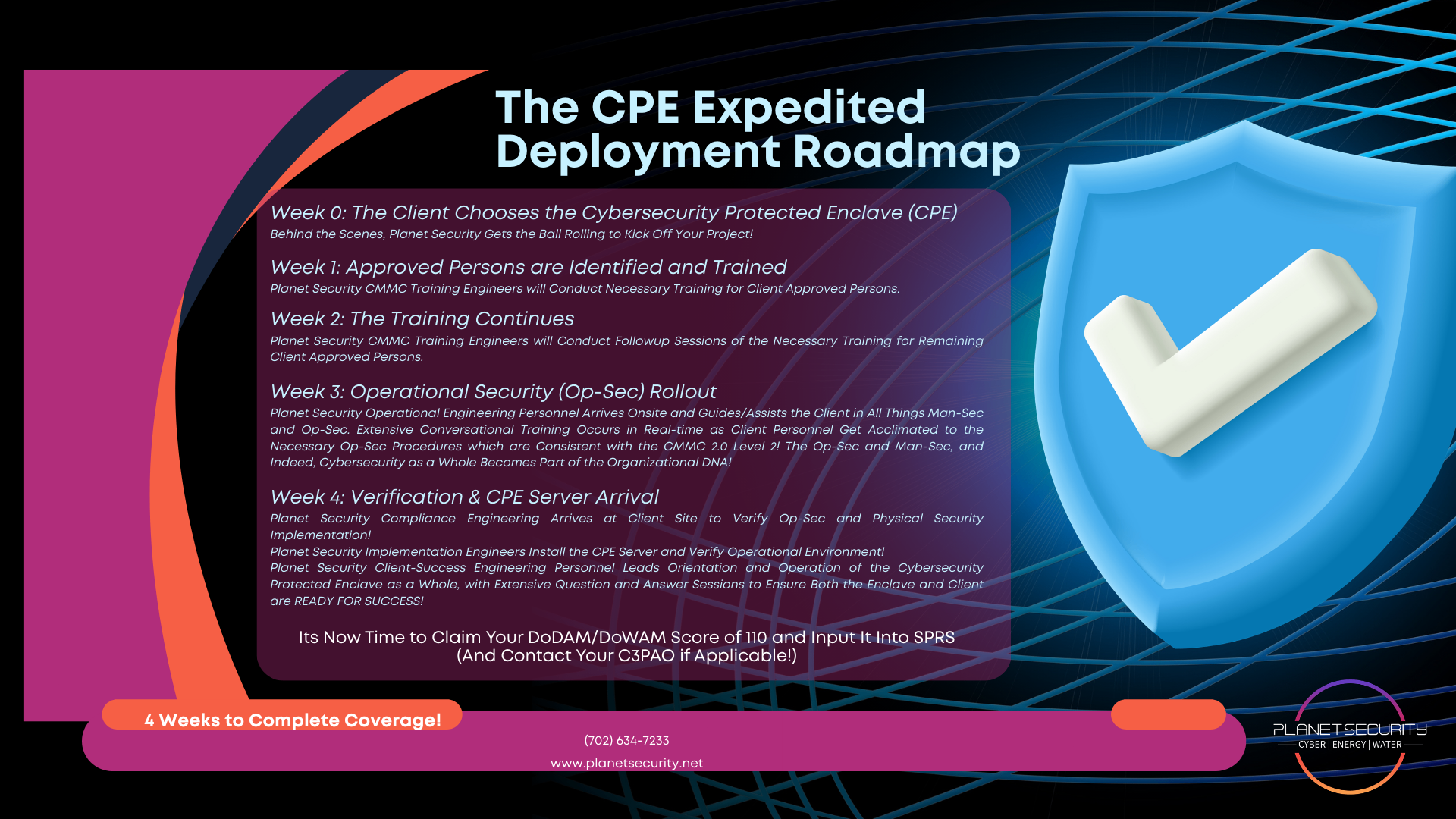
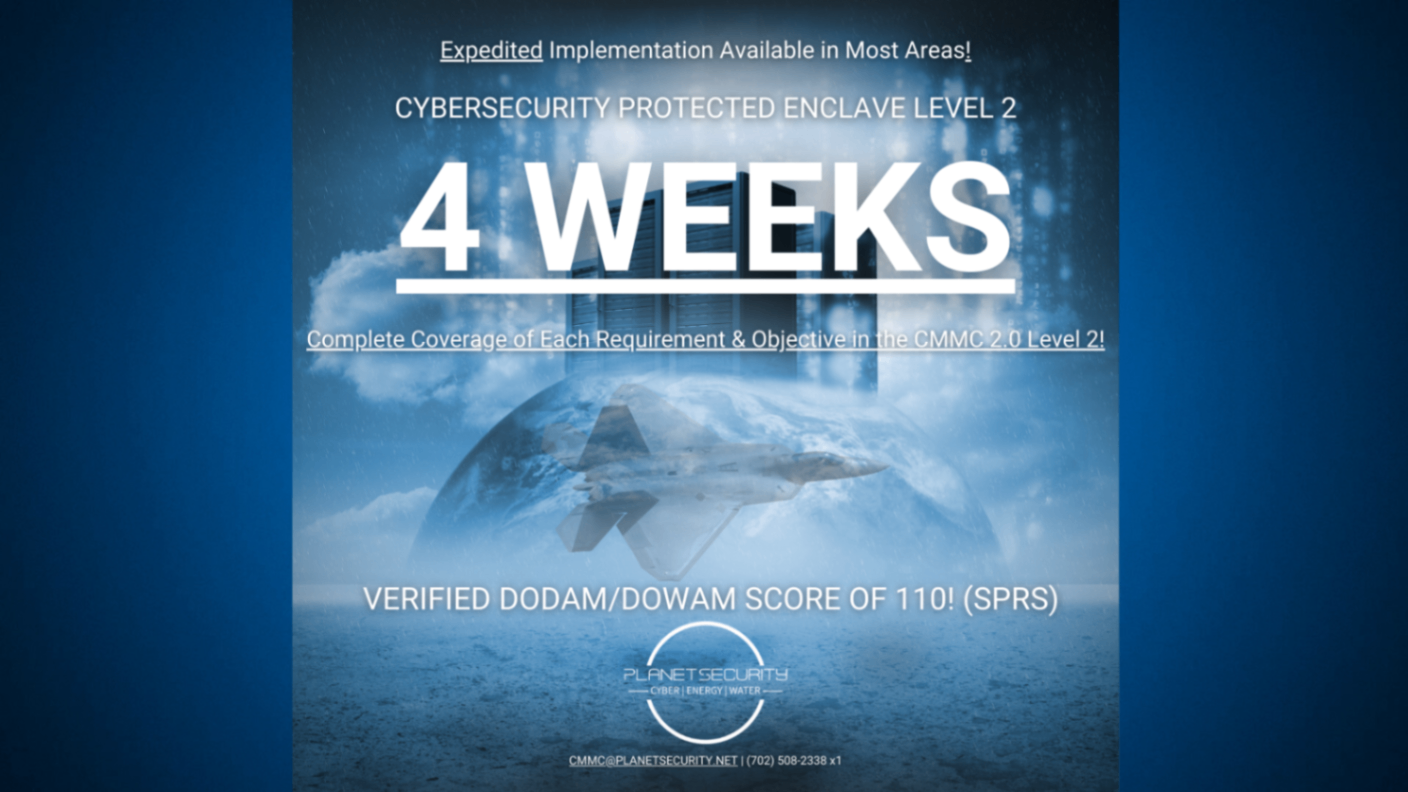
Qualified organizations may be able to use an expedited four-week deployment path. The implementation roadmap typically includes:
- Week 0: Client selection, scope confirmation, and project kickoff
- Week 1: Approved-person identification and required training
- Week 2: Continued training and operational preparation
- Week 3: Operational security and management rollout
- Week 4: Verification, server installation, orientation, and readiness activities
Some environments require a longer implementation schedule because of staffing, facility, data migration, operational, or integration requirements. A standard eight-week deployment may be appropriate when the organization needs additional time.
Transparent pricing is available: CPE Level 2 is $1,299/month for up to 20 users. The monthly price includes the managed enclave environment, required security policies and procedures, training support, server and licensing components, patching, monitoring, backup capabilities, compliance support, and ongoing operational services.
Choosing an eight-week deployment instead of four weeks reduces pricing by $100/month. The priority, however, should remain clear: protect CUI, satisfy prime contractor expectations, and establish a sustainable security posture.
What Prime Contractors Should Ask Subcontractors
Before accepting a subcontractor’s compliance statement, ask:
Do you have a defined CUI environment?
The subcontractor should identify the system boundary, CUI data flows, connected systems, users, devices, and external service providers.
Can you produce evidence for all 110 requirements and 320 objectives?
A high-level policy statement is not enough. Evidence must demonstrate implementation at the technical, procedural, and operational levels.
Is evidence collected automatically?
Manual evidence collection is slow, inconsistent, and difficult to validate. Automated collection provides greater visibility and more reliable audit preparation.
How is CUI protected from generic AI tools?
The subcontractor should explain whether client data is exposed to public or commercial AI platforms. AI-obfuscated data safeguards should be mandatory for AI-enabled workflows involving sensitive information.
What happens after the assessment?
CMMC compliance requires ongoing maintenance. Ask how the subcontractor handles patching, monitoring, incident response, training, access changes, backups, and evidence updates.
FAQ: Flow-Down and CPE Level 2
Does every subcontractor need CMMC 2.0 Level 2?
No. The requirement depends on the information handled, the contract language, and the defined assessment scope. A subcontractor that processes, stores, or transmits CUI may require CMMC 2.0 Level 2.
Can an enclave reduce assessment scope?
A properly designed and documented enclave can help isolate CUI systems from unrelated corporate assets. Scope decisions must be based on the actual environment and applicable CMMC rules.
Does CPE Level 2 guarantee a CMMC certification?
No technology can replace organizational accountability or the formal assessment process. CPE Level 2 is engineered to provide complete coverage of the applicable requirements, operational support, and audit-ready evidence, while each organization remains responsible for operating within its defined scope.
Why is automated evidence important?
Because CMMC assessors evaluate whether controls are implemented and operating effectively. Automated evidence collection supports continuous visibility and reduces the risk of missing documentation, configuration, or monitoring records.
Stop Treating Flow-Down Compliance as Someone Else’s Problem
Prime contractors need supply chain partners that can demonstrate security: not simply claim it. Subcontractors need a practical path to protect CUI without spending years assembling disconnected technologies and documentation.
There is no substitute for a controlled boundary, hardened infrastructure, continuous monitoring, automated evidence, and disciplined operations. CPE Level 2 gives defense contractors a decisive way to address the flow-down crunch and build a stronger supply chain future.
We welcome a discussion on how we may assist in your CMMC success story!
Contact Planet Security or call 702.634.7233.
| planetsecurity.net | 702.634.7233 | 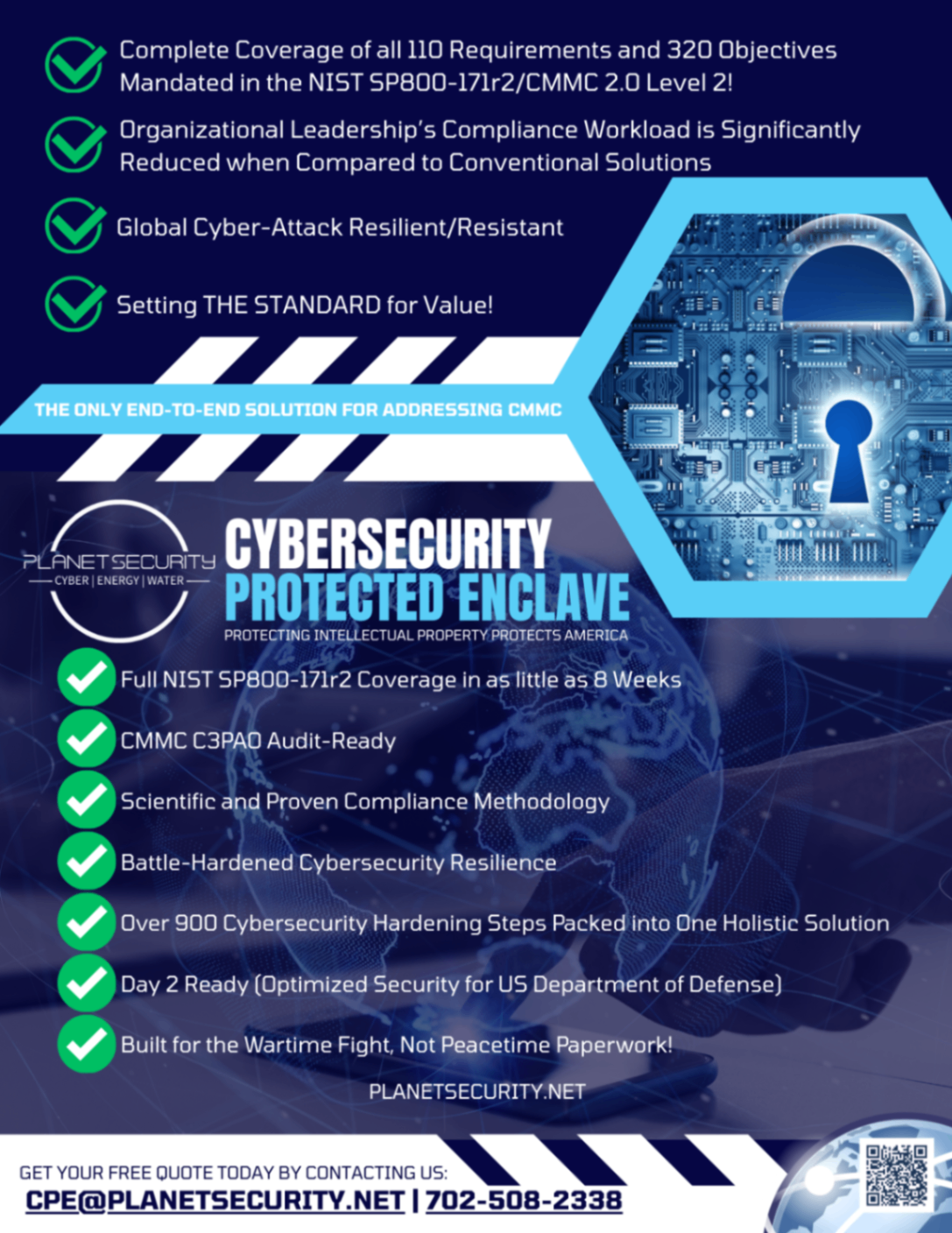 |
|---|