
Let's be honest about something that's become a major problem in the CMMC consulting world: half the providers out there are just winging it. They've read a few blog posts, maybe skimmed through some NIST documentation, and suddenly they're "CMMC experts" ready to guide your defense contracting business through compliance.
The problem? Your business is on the line. A botched CMMC implementation doesn't just mean you fail an audit – it means you lose DoD contracts, face potential liability, and could be shut out of the defense supply chain entirely.
So how do you separate the real experts from the Google warriors? Here's your no-nonsense guide to spotting the difference.
The Dead Giveaways: Red Flags That Scream "Amateur Hour"
They Can't Explain the CMMC vs. NIST SP 800-171 Relationship
Real talk: If your provider can't clearly explain how CMMC and NIST SP 800-171 work together, run.
Here's what they should know: CMMC defines the assessment framework, while NIST SP 800-171 contains the actual security requirements. CMMC Level 2 requires implementing all 110 controls from NIST SP 800-171 Revision 2, organized across 14 families. A provider who talks about these as separate, unrelated standards or who can't explain this relationship is showing you they've never actually implemented either one.
They Don't Know Which Revision You Need
Amateur providers will talk about "NIST SP 800-171" like it's one static document. Real experts know that defense contractors currently must implement Revision 2 with its 110 controls, while Revision 3 (with 97 requirements) exists but isn't yet mandated. If your provider doesn't know which revision applies to your contracts or can't explain the differences, they're operating off Wikipedia-level knowledge.

They Treat System Security Plans as Optional
This is a huge red flag. Your System Security Plan (SSP) isn't a nice-to-have document – it's mandatory. The SSP must detail how every single one of those 110 controls is implemented in your environment. Any provider who doesn't emphasize SSP development or treats it as an afterthought has never been through a real C3PAO assessment.
What Real NIST SP 800-171 Expertise Actually Looks Like
They Know the Regulatory Landscape Inside and Out
Genuine experts understand DFARS Clause 252.204-7012 and can explain exactly which contractors need CMMC Level 1 versus Level 2 based on the type of information they handle. They know that most contractors handling Controlled Unclassified Information (CUI) need Level 2, and they can walk you through the specific requirements for your situation.
They Understand Third-Party Assessment Requirements
Real experts know that CMMC 2.0 requires certification through C3PAO auditors for most contracts, not self-assessments. They understand what C3PAOs look for, how the assessment process works, and what happens if you get dinged during an audit. Fake experts will downplay the assessment process or suggest it's just a formality.
They Can Discuss Implementation Specifics
Here's where the rubber meets the road. Real experts can talk about:
- Network segmentation requirements and how to properly isolate CUI
- Access control implementation beyond just "use strong passwords"
- Incident response procedures specific to CUI handling
- Audit logging requirements and how to maintain proper documentation
- Physical security controls for systems processing CUI
If your provider gives vague answers about "following best practices," they're probably out of their depth.
The Questions That Separate Experts from Pretenders
Technical Implementation Questions
Ask them: "How do you implement AC-3 (Access Enforcement) in a typical small business environment?"
A real expert will discuss role-based access controls, least privilege principles, and specific technologies. A fake expert will give you generic advice about "controlling access."
"What's your approach to implementing SI-4 (System Monitoring)?"
Real experts will talk about SIEM solutions, log aggregation, continuous monitoring tools, and specific detection capabilities. Pretenders will mention "keeping an eye on things."
Process and Documentation Questions
"Walk me through your SSP development process."
Genuine experts will outline a systematic approach to documenting each control, mapping it to your specific environment, and creating the evidence needed for assessment. Fake experts will be vague about documentation requirements.
"How do you handle POA&M development and tracking?"
Real experts understand Plan of Action and Milestones requirements and can explain how to properly document and track remediation efforts. Amateur providers often don't even know what POA&Ms are.
Why Most Providers Get It Wrong (And What That Means for You)
The brutal truth is that implementing NIST SP 800-171 correctly is incredibly complex. It requires deep understanding of cybersecurity principles, regulatory requirements, and how to translate high-level controls into specific technical implementations.
Most providers take shortcuts because:
- They've never been through a real assessment
- They don't understand the technical depth required
- They're trying to apply generic cybersecurity advice to specific CMMC requirements
- They don't grasp the compliance vs. security distinction
The CPE Level 2 Solution: Why Turnkey Beats DIY
Here's what separates real expertise from guesswork: Planet Security's CPE Level 2 isn't based on theory or Google searches. It's a proven, turnkey solution that provides 100% coverage of all CMMC Level 2 requirements.
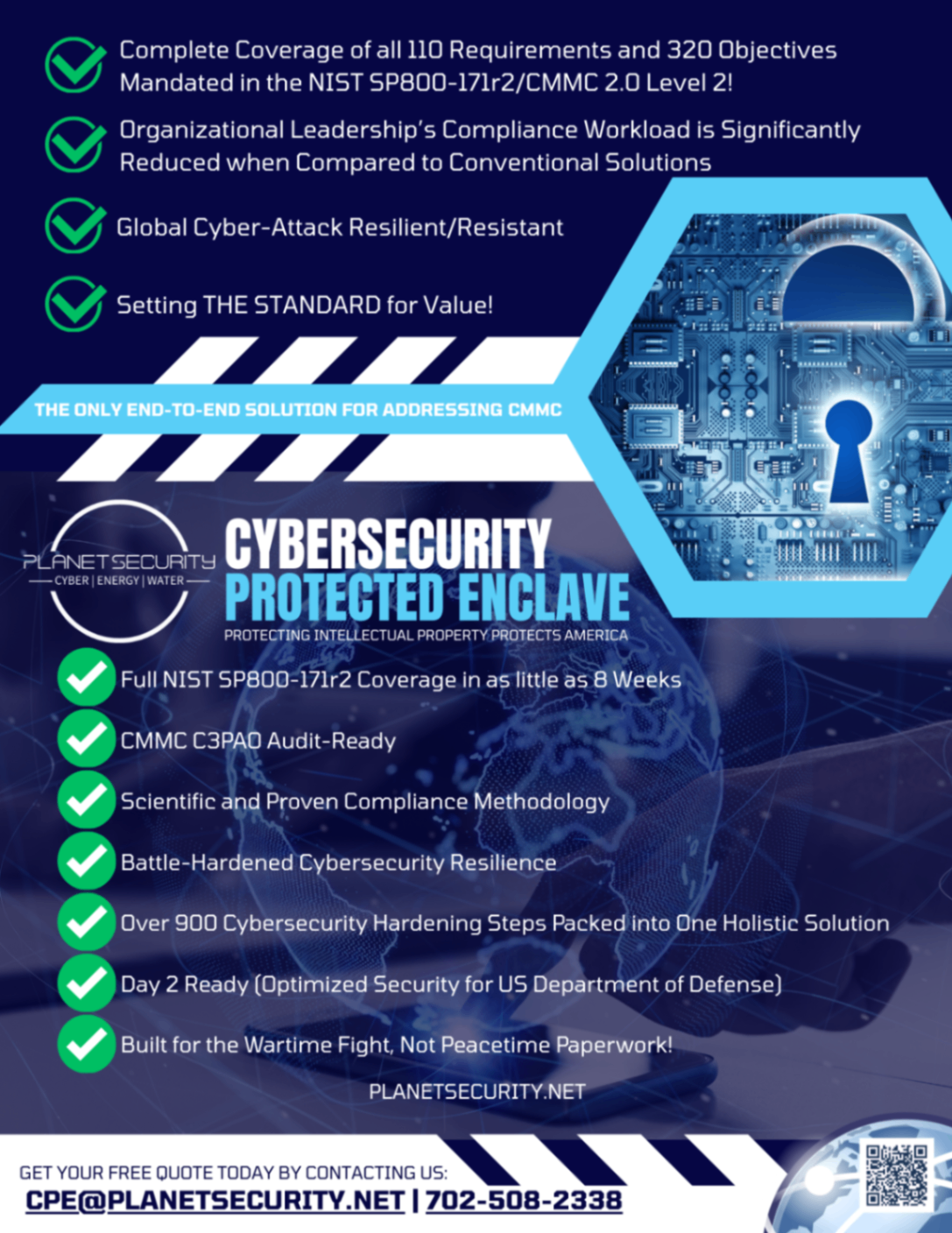
Why does this matter? Because instead of hoping your provider really understands how to implement 110 different controls, you get a pre-configured, audit-ready environment that's been through real assessments with real C3PAOs.
The CPE Level 2 Advantage
No guesswork. No improvisation. No hoping your consultant's Google skills are up to par.
The CPE Level 2 provides:
- Complete implementation of all 110 NIST SP 800-171 Rev 2 controls
- Pre-built System Security Plan documentation
- Continuous monitoring and incident response capabilities
- Proven compliance methodology developed through actual assessments
- 4-week implementation timeline instead of months of uncertainty
The Bottom Line: Don't Gamble with Your Business
Your CMMC compliance isn't a place to experiment. When providers are learning on your dime, using your business as their testing ground, you're the one who pays the price if they get it wrong.
Real expertise shows up in specific, technical knowledge. It shows up in understanding regulatory nuances. Most importantly, it shows up in proven solutions that actually work.
The CPE Level 2 represents years of real-world CMMC implementation experience, not theoretical knowledge pulled from search results. When your defense contracts depend on getting compliance right, there's no substitute for proven expertise.
Don't let Google warriors experiment with your business. Demand real expertise. Demand proven solutions. Demand CPE Level 2.
Planet Security Inc.
planetsecurity.net