
There is a dangerous misconception sweeping the defense industrial base today: the belief that because certain third-party CMMC assessment timelines have experienced shifts, defense contractors can afford to hit the snooze button on their cybersecurity posture. Nothing could be further from the truth.
While commercial chatter focuses on phase-in schedules, the Defense Contract Management Agency (DCMA) Defense Industrial Base Cybersecurity Assessment Center (DIBCAC) remains fully active, highly aggressive, and relentless in its enforcement. DIBCAC-led assessments, NIST SP 800-171 Rev. 2 baselines, and Supplier Performance Risk System (SPRS) reporting requirements are fully operational right now.
If your organization is handling Controlled Unclassified Information (CUI) under DFARS 252.204-7012, 7019, and 7020, waiting around or relying on unverified self-assessments is compliance Russian roulette. The exposure is immense: stretching from immediate contract termination to catastrophic False Claims Act (FCA) liability and severe federal penalties.
In this comprehensive guide, we examine why DIBCAC assessments are still knocking at your door, why traditional remediation fails, and how deploying CPE Level 2 delivers 100% coverage, automated audit-ready evidence, and unassailable protection.
1. The Myth of the Waiting Period: Why DIBCAC Is Knocking Today
Many defense contractors operate under the false assumption that enforcement is paused. In reality, DIBCAC Medium and High-Confidence assessments are actively targeting organizations across the supply chain.
+-------------------------------------------------------------------------+
|                  DIBCAC & SPRS ENFORCEMENT REALITY                      |
|                                                                         |
|  [ DFARS 7012 / 7019 / 7020 ]  -->  Mandatory SPRS Score Submission     |
|  [ DIBCAC Medium / High ]      -->  Unannounced / Targeted Audits       |
|  [ False Claims Act ]          -->  Enforced for Unsubstantiated Scores |
+-------------------------------------------------------------------------+
When a DIBCAC auditor knocks, they do not ask for your future intentions or your roadmap. They demand verifiable audit evidence for every single control in your System Security Plan (SSP). If your SPRS score sitting in the database is a speculative +110 backed by a handful of policy binder documents rather than cryptographic, technical proof, your organization is standing on quicksand.
- There is no substitute for concrete proof.
- Self-assessments without automated evidence collection are immediate audit failures.
- False claims regarding cybersecurity compliance carry criminal and civil liabilities.
2. Demystifying the Scope: 110 Requirements and 320 Objectives
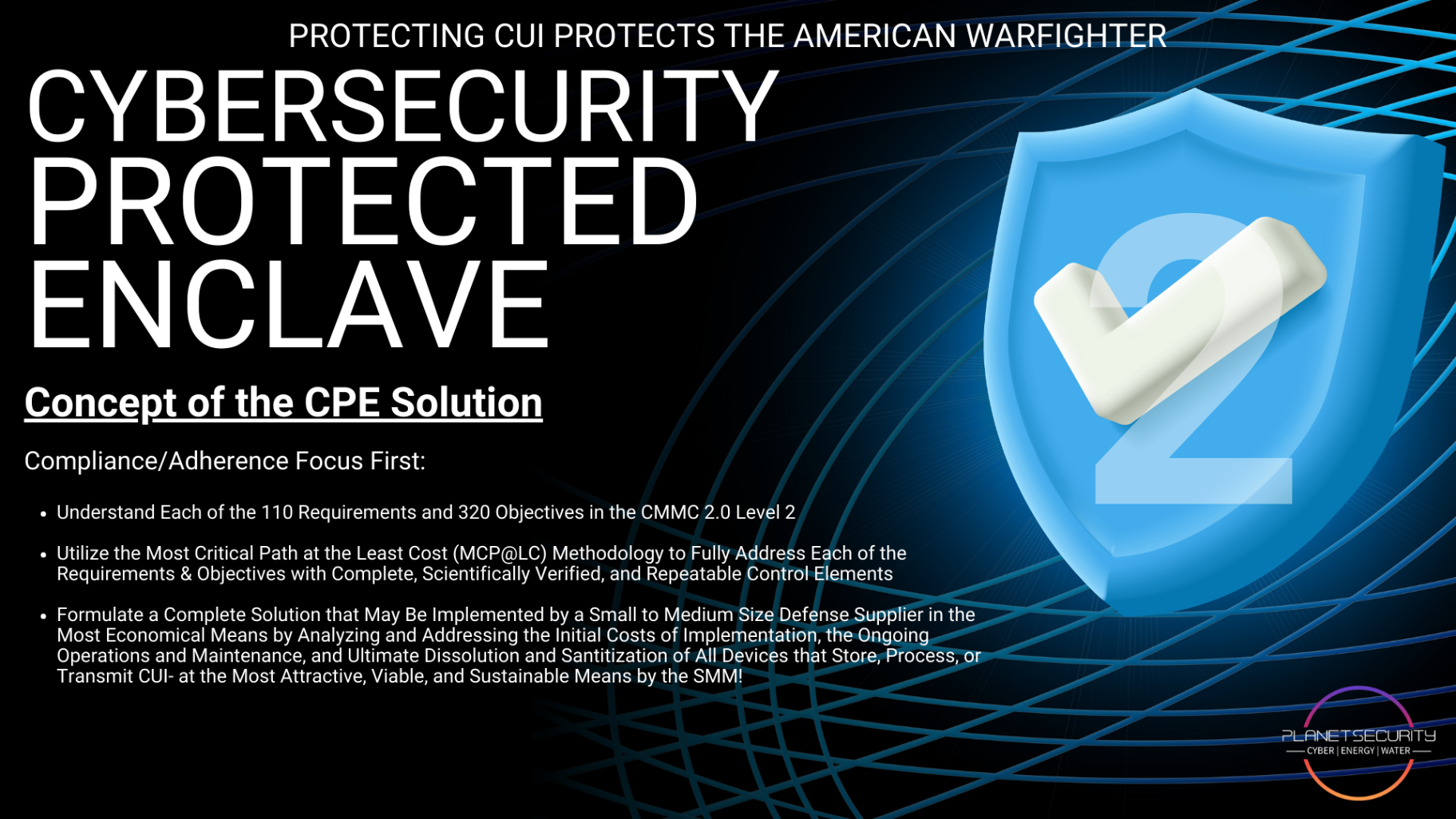
Achieving and maintaining compliance is not a casual administrative task. When evaluating CMMC 2.0 Level 2, organizations must account for the full rigor of 110 CMMC requirements and 320 objectives derived directly from NIST SP 800-171 Rev. 2.
Attempting to manually engineer, monitor, and document 320 distinct assessment objectives across every endpoint, server, and network boundary is a recipe for burnout and failure. Consider the sheer breadth of what must be proven:
- Access Control (AC): Limiting system access to authorized users and devices.
- Configuration Management (CM): Establishing baseline configurations and tracking unauthorized modifications.
- Incident Response (IR): Detecting, analyzing, and reporting cyber incidents within rigid DoD timeframes.
- System and Information Integrity (SI): Monitoring for flaws and malicious code in real time.
Without an integrated, turnkey ecosystem, internal IT teams drown in POA&M (Plan of Action and Milestones) tracking, endless remediation tickets, and recurring audit anxiety.
3. Why Generic AI Tools Cannot Be Trusted with Client Data
As organizations scramble to automate compliance tasks, many turn to off-the-shelf, Big-Tech AI solutions to draft policies, analyze system logs, or process CUI data. This is a severe compliance violation waiting to happen.
Generic AI platforms ingest user inputs to train public models, directly exposing sensitive contractor data and intellectual property to third-party servers. At Planet Security Inc., we reject this compromised approach entirely.
When you leverage our advanced AI-enabled workflows within CPE Level 2, your data is processed using AI-obfuscated data protocols. We ensure that proprietary information and CUI never leak into public model training sets, providing the velocity of artificial intelligence combined with absolute confidentiality and zero data leakage.
4. The Ultimate Defense: Deploying CPE Level 2
Why spend 12 to 24 months and hundreds of thousands of dollars on fragmented consulting when you can deploy the industry's most robust turnkey solution?
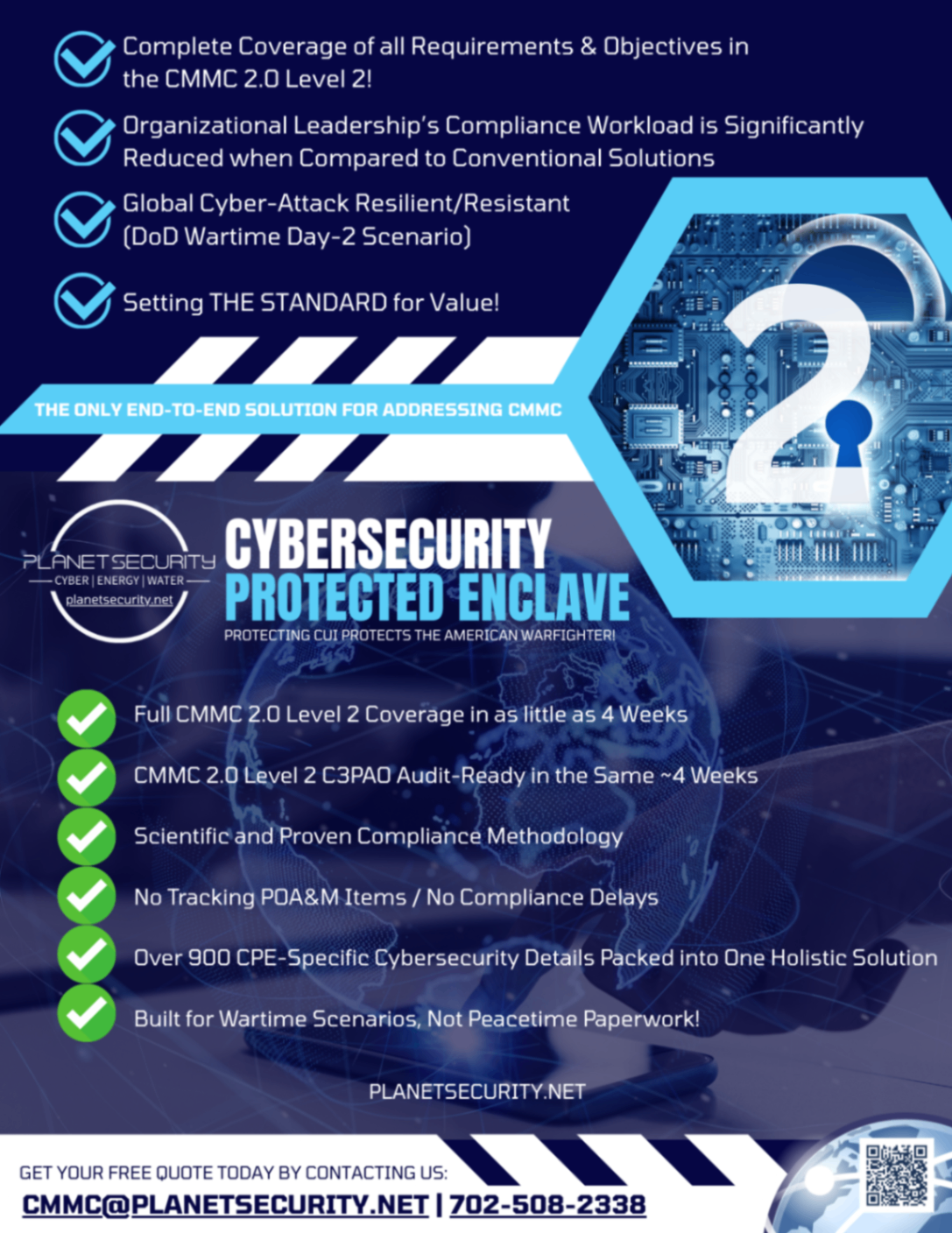
The Cybersecurity Protected Enclave (CPE Level 2) is built specifically to address every single requirement of CMMC 2.0 Level 2 with surgical precision.
What CPE Level 2 Delivers:
- 100% Coverage: Complete alignment with NIST SP 800-171 Rev. 2 and all 320 assessment objectives.
- Automated Audit-Ready Evidence: Continuous monitoring generates real-time proof for every control, eliminating guesswork during DIBCAC audits.
- World-Class Managed Operations: Ongoing maintenance, security hardening, and SIEM monitoring handled by elite cybersecurity experts.
- Wartime Readiness & Local Resilience: Superior performance and survivability compared to vulnerable cloud-only configurations.
Transparent Pricing and Flexible Deployment
We believe in absolute transparency and pragmatic execution. CPE Level 2 starts at $1,299/month for up to 20 users, providing an all-inclusive managed compliance and security infrastructure.
Furthermore, we offer tailored deployment timelines to fit your operational tempo: choosing an 8-week deployment instead of a standard 4-week rollout reduces your ongoing pricing by $100/month, allowing your team to pace implementation around critical contract milestones without sacrificing security rigor.
5. Frequently Asked Questions (FAQ)
Q: Are DIBCAC assessments mandatory for all defense contractors?
A: DIBCAC conducts targeted Medium and High-Confidence assessments for organizations handling critical CUI, prime contractors, and companies flagged during SPRS score reviews. Furthermore, passing a DIBCAC High assessment with zero open POA&Ms can be officially accepted as your CMMC Level 2 Final status.
Q: Can we use NIST SP 800-171 Rev. 3 for our current SPRS score?
A: No. The DoD assessment methodology and SPRS scoring framework strictly utilize NIST SP 800-171 Rev. 2. Submitting scores based on unapproved revisions exposes your organization to immediate audit rejection and False Claims Act scrutiny.
Q: How quickly can CPE Level 2 be deployed?
A: Our standard deployment takes just 4 weeks (with optional 8-week scheduling adjustments available to reduce monthly subscription costs by $100/month), rapidly replacing months of internal friction with a fully validated, audit-ready enclave.
Conclusion: Secure Your Contracts Today
The writing is on the wall: DIBCAC audits will not wait for your organization to catch up, and self-assessment paperwork will no longer shield you from liability. You need an unassailable security posture, automated evidence generation, and absolute compliance confidence.
We welcome a discussion on how we may assist in your CMMC success story!
planetsecurity.net 702.634.7233 [ QR CODE ]