If your company handles Controlled Unclassified Information (CUI), ransomware is not just an IT problem. It is a contract risk, operational risk, revenue risk, and national security risk.
A successful attack can encrypt engineering files, halt production, disrupt delivery schedules, expose technical data, and create immediate pressure to explain what happened to customers, partners, and the Department of Defense.
For defense suppliers working toward CMMC 2.0 Level 2, the answer cannot be another disconnected security product or a binder full of policies. You need an environment that is architected to protect CUI, continuously monitored, actively maintained, and ready to produce defensible evidence.
That is exactly where CPE Level 2 changes the conversation.
Ransomware Targets the Weakest Path to CUI
Ransomware operators do not need to defeat every control in your company. They need to find one practical path into the environment.
That path may be:
- A compromised employee credential
- A phishing attachment
- An exposed remote-access service
- An unpatched server or workstation
- A misconfigured firewall
- An unauthorized application
- A removable storage device
- A third-party connection
- Excessive user privileges
- An unmanaged backup
Once inside, attackers typically try to escalate privileges, move laterally, identify valuable data, disable security tools, encrypt systems, and exfiltrate files. CUI is especially attractive because it may contain technical information, specifications, manufacturing data, contract information, and other sensitive material connected to defense programs.
The CMMC Assessment Guide – Level 2 directly addresses these risks through requirements involving malicious-code protection, boundary protection, least privilege, audit logging, incident handling, vulnerability remediation, and monitoring of inbound and outbound communications.
Compliance is not separate from ransomware defense. Proper compliance architecture is ransomware defense.
CMMC 2.0 Level 2 Is 110 Requirements and 320 Objectives
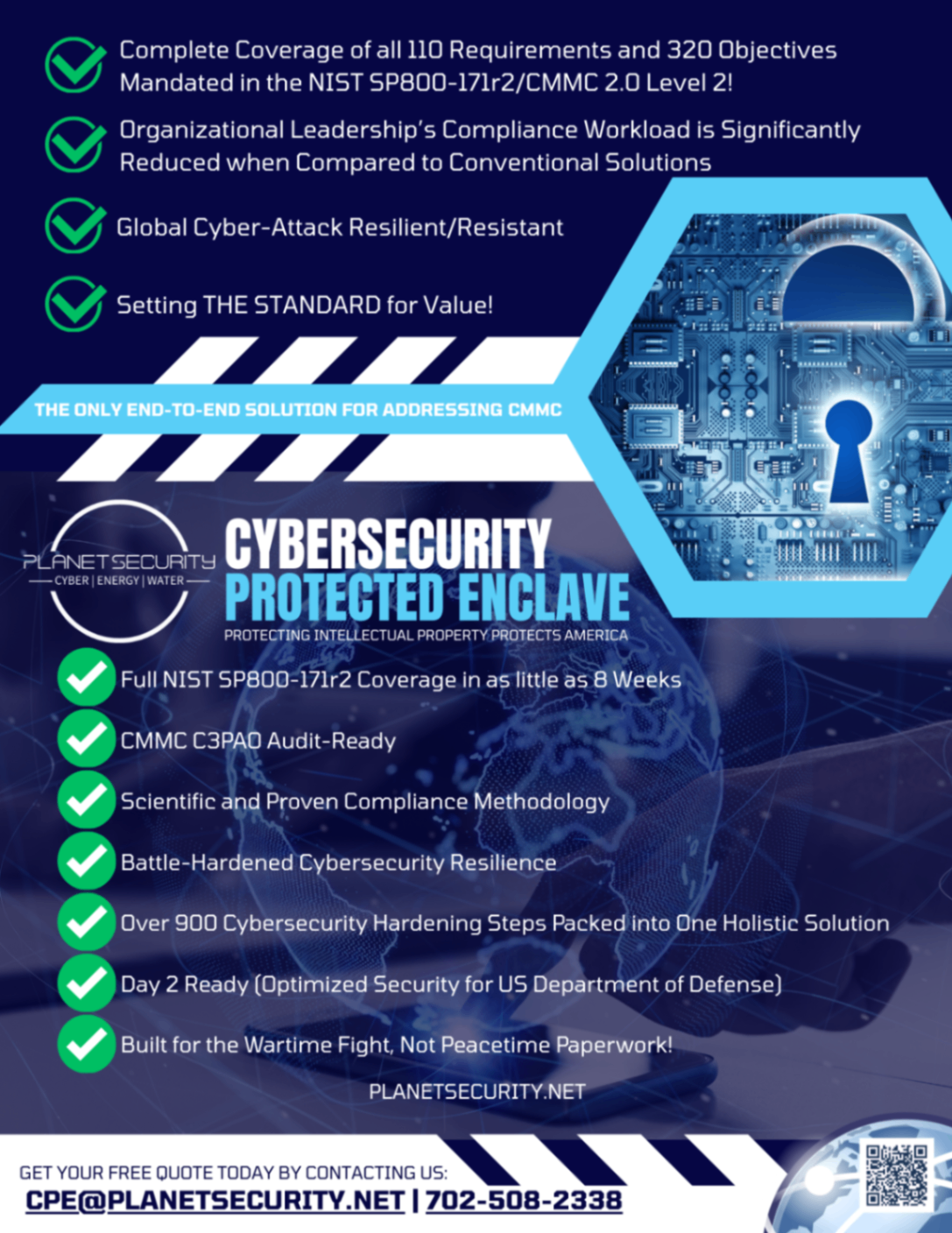
CMMC 2.0 Level 2 is not a basic checklist. It addresses 110 security requirements and 320 assessment objectives derived from NIST SP 800-171 Rev. 2.
Those objectives cover the complete operating environment, including:
- Access control : limiting who, what, and which devices can access CUI
- Awareness and training : reducing phishing, insider-threat, and human-error risk
- Audit and accountability : creating records that support investigation and response
- Configuration management : maintaining secure baselines and controlled changes
- Identification and authentication : enforcing MFA and trusted identities
- Incident response : preparing for detection, containment, recovery, and reporting
- Media protection : controlling portable storage, backups, and physical media
- Personnel security : screening users and managing access during transfers or terminations
- Physical protection : securing facilities, equipment, and alternate work sites
- Risk assessment : identifying and prioritizing vulnerabilities
- Security assessment : monitoring whether controls remain effective
- System and communications protection : encrypting and controlling data flows
- System and information integrity : detecting malicious code and unauthorized use
A traditional environment often spreads CUI across email, file shares, endpoints, cloud applications, remote devices, backups, and third-party systems. Every additional connection creates more scope, more evidence requirements, and more opportunities for ransomware to move.
A properly designed enclave takes a different approach: contain CUI inside a hardened boundary and make every connection deliberate, authorized, monitored, and logged.
Why Zero-Trust Enclave Design Changes the Ransomware Equation
CPE Level 2 uses a zero-trust approach built around the principle that no user, device, process, or connection receives automatic trust.
The architecture is designed to provide:
- CUI containment inside a dedicated protected environment
- Deny-by-default network communications
- Allow-by-exception access rules
- Security-centric network segmentation
- Multi-factor authentication
- Least-privilege access
- Controlled remote access through managed entry points
- Encrypted CUI in transit and at rest
- Separated user and system-management functionality
- Controlled removable media
- Protected, multi-stage backups
- Hardened operating systems and applications
- Documented configuration baselines
- Continuous technical monitoring
This matters because ransomware thrives on trust. If a compromised workstation can freely communicate with file servers, administrative systems, backups, and external services, the blast radius expands quickly.
A zero-trust enclave creates friction at every stage. A user must be authenticated. A device must be authorized. A connection must be permitted. A process must behave within defined parameters. Suspicious activity must generate evidence and trigger response.
The goal is not merely to detect ransomware after encryption begins. The goal is to make lateral movement, privilege abuse, unauthorized data access, and exfiltration exceptionally difficult in the first place.
Continuous Monitoring: Compliance That Operates Every Day
Periodic assessments are not enough to stop an active attack.
CMMC requires security controls to remain effective over time, and ransomware defense requires the same discipline. CPE Level 2 includes ongoing managed operations, maintenance, security monitoring, and reporting designed to keep the enclave aligned with its security objectives.
Monitoring focuses on signals such as:
- Unusual login attempts
- Privilege escalation
- Unexpected administrative activity
- Abnormal file-access behavior
- Unauthorized software execution
- Suspicious inbound communications
- Unusual outbound traffic
- Potential command-and-control connections
- Security-control failures
- Configuration drift
- Vulnerability exposure
- Backup and recovery status
The CMMC guide specifically calls for monitoring organizational systems, including inbound and outbound communications traffic, to detect attacks and indicators of potential attacks.
That is a major distinction between a compliance project and a security operating model. A compliance project may document what should happen. A managed enclave continuously checks whether it is actually happening.
AI Can Help Security Operations: But Generic AI Cannot Be Trusted With CUI
Many companies are experimenting with artificial intelligence for security analysis, workflow automation, and documentation. That can be useful: but generic public AI tools should not receive client CUI, proprietary technical data, credentials, system logs, or government information.
The risk is straightforward: you may not know where the data is stored, how it is retained, whether it is used for model training, who can access it, or how it is separated from other customers.
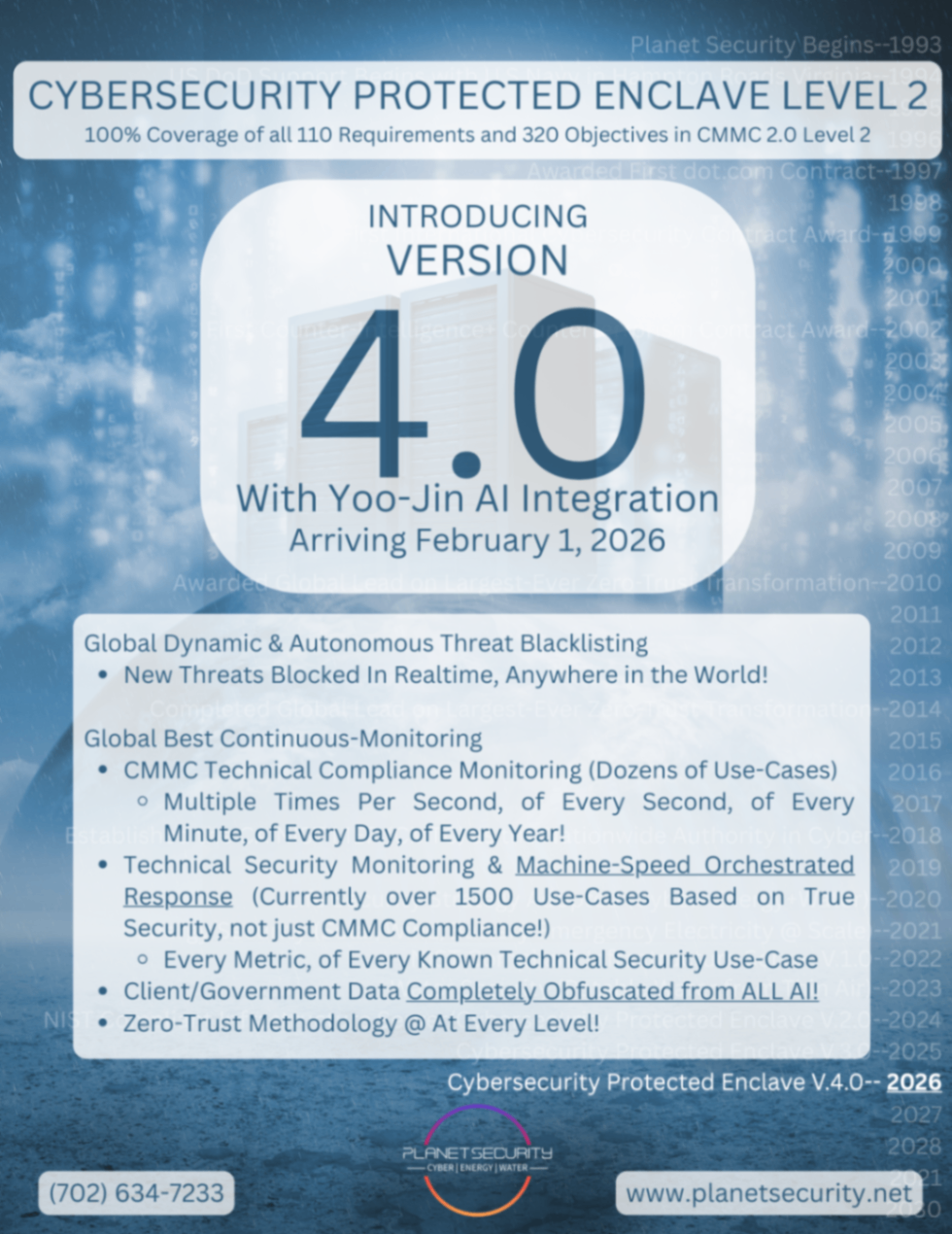
Planet Security takes a different approach through the use of AI-obfuscated data. AI-enabled workflows can support analysis and automation while reducing exposure of sensitive client and government information. The objective is to obtain operational value from AI without treating a public Big-Tech model as a trusted CUI repository.
There is no substitute for data minimization, controlled access, and purpose-built security boundaries.
Managed Operations Remove the “Set It and Forget It” Problem
A secure enclave is only effective if it remains secure.
That requires ongoing work, including:
- Security patching and maintenance
- Configuration review
- Vulnerability scanning and remediation
- Backup monitoring
- Security-awareness training
- Policy and procedure support
- Continuous compliance monitoring
- Incident-response readiness
- Audit evidence preparation
- vCISO guidance and reporting
- Hardware and infrastructure support
CPE Level 2 technical details describe an integrated model that combines infrastructure, security configuration, policies, procedures, training, monitoring, backup, and support.
For many small and midsize defense suppliers, this is the difference between a manageable compliance program and a multi-year internal burden.
Deployment and Commercial Scope
Organizations have different environments, user counts, and deployment needs. Where the standard program applies, $1,299/month supports up to 20 users and includes the managed enclave, required infrastructure and licensing, security maintenance, monitoring, backup, training, policy and procedure support, and compliance-focused operational assistance.
A standard deployment may be completed in approximately 4 weeks when conditions permit, while an 8-week deployment instead of 4 weeks reduces pricing by $100/month. Actual scope, timing, and qualification depend on the organization’s requirements and environment.
The important issue is not the monthly number. The important issue is what that investment replaces: fragmented tools, unmanaged risk, uncontrolled CUI sprawl, and the constant fear that a ransomware event will expose a gap nobody knew existed.
Frequently Asked Questions
Is CPE Level 2 only for companies that have already started a CMMC assessment?
No. CPE Level 2 is designed for defense suppliers preparing for CMMC 2.0 Level 2, including organizations that need to define their CUI boundary, establish secure infrastructure, remediate gaps, and maintain ongoing readiness.
Does an enclave eliminate all ransomware risk?
No responsible security professional can promise zero risk. However, CPE Level 2 is designed to contain CUI, reduce attack paths, limit lateral movement, enforce least privilege, monitor communications, and support rapid response. That creates a dramatically stronger security posture than a broadly distributed environment.
What does continuous monitoring mean in practical terms?
It means security controls, system activity, communications, vulnerabilities, configurations, and operational signals are reviewed on an ongoing basis: not only during an annual assessment. The resulting reports support both security decisions and CMMC evidence preparation.
Can employees use AI tools with CUI?
They should not use generic public AI tools with CUI or other sensitive client data. AI workflows must be governed, scoped, and protected. Planet Security emphasizes AI-obfuscated data to help reduce exposure while supporting AI-enabled security operations.
Does CPE Level 2 guarantee certification?
No solution can guarantee an organization’s final certification outcome. Certification depends on the defined assessment scope, organizational implementation, evidence, personnel, and the independent assessment process. CPE Level 2 is engineered to provide complete technical and operational coverage across the applicable requirements and objectives.
Protect Your CUI Before Ransomware Forces the Decision
Defense suppliers cannot treat CUI protection as paperwork completed before an assessment. Your enclave must be secure on an ordinary Tuesday, during a software update, after an employee leaves, when a remote user connects, and when an attacker is actively testing your defenses.
That requires a purpose-built environment, zero-trust design, continuous monitoring, managed operations, and a security team that understands both compliance and real-world attack behavior.
There is no substitute for protecting the information that supports the warfighter.
We welcome a discussion on how we may assist in your CMMC success story!
For additional guidance, review the DoD CMMC overview or contact Planet Security at 702.634.7233.
| planetsecurity.net | 702.634.7233 |  |
|---|