
A checklist can tell you what should exist. Audit evidence proves that it exists, operates correctly, and continues to work over time.
That distinction is decisive for organizations pursuing CMMC 2.0 Level 2. Defense contractors handling Controlled Unclassified Information (CUI) cannot rely on policies stored in a folder, screenshots from last year, or a spreadsheet filled with optimistic assumptions. Assessors examine whether security requirements are implemented correctly, operating as intended, and producing the desired outcome.
This is why Planet Security designed CPE Level 2 around complete coverage, continuous monitoring, defensible evidence, and operational execution: not paperwork alone.
CMMC Level 2 Is an Evidence Problem
CMMC 2.0 Level 2 addresses 110 security requirements and 320 assessment objectives based on NIST SP 800-171 Revision 2.
The numbers matter, but the deeper issue is what those requirements demand from your organization. You must be able to demonstrate:
- Who is authorized to access systems and CUI
- How access is controlled and reviewed
- Which systems, devices, and applications are in scope
- When security events, configurations, and access rights are reviewed
- What happens when a vulnerability or control failure is discovered
- Where audit records and supporting evidence are retained
- Why a control is effective for your specific environment
The official CMMC Assessment Guide – Level 2 emphasizes that assessors use examination, interviews, and testing. One policy statement cannot replace operational proof.
For example, a company may claim that privileged activity is logged. An assessor may then expect to see the configuration, the relevant logs, evidence of review, and proof that suspicious activity triggers a response. A “yes” in a spreadsheet is not enough.

What Strong Audit Evidence Looks Like
Effective evidence connects the requirement to the objective, the objective to the control, and the control to an observable result.
A defensible evidence program typically includes:
1. Final documentation
Assessors may examine:
- System Security Plans (SSPs)
- Policies and procedures
- Network and data-flow diagrams
- Configuration management plans
- Incident response plans
- Security awareness and role-based training records
- Risk assessments
- Business continuity and backup procedures
- Media protection and sanitization procedures
Drafts and informal working papers do not demonstrate an approved operating process. Documentation must accurately describe the environment being assessed.
2. Technical evidence
Technical evidence demonstrates that safeguards are configured and functioning. Examples include:
- Multifactor authentication settings
- Account and privilege reports
- Firewall and segmentation rules
- Encryption configurations
- Endpoint protection status
- Vulnerability scan reports
- Patch compliance results
- SIEM dashboards and alert histories
- Backup job results
- Audit-log retention settings
- Configuration baseline comparisons
3. Operational evidence
Operational evidence proves that people and systems perform required activities consistently:
- Access review records
- Change tickets and approvals
- Incident tickets and resolution notes
- Log review records
- Vulnerability remediation actions
- Security training completion records
- Media check-in and check-out logs
- Maintenance records
- Physical access records
- Security control assessment reports
The goal is not to accumulate random screenshots. The goal is traceability. Every artifact should have an owner, date, scope, control relationship, and clear explanation of what it proves.
Continuous Monitoring Prevents Compliance Decay
Security controls are not permanent simply because they were configured once.
Employees change roles. Devices are replaced. Applications are updated. Vulnerabilities are disclosed. Firewall rules evolve. New vendors connect to the environment. An account that was appropriate six months ago may now create unacceptable risk.
CMMC requirement CA.L2-3.12.3 requires organizations to monitor security controls on an ongoing basis to ensure their continued effectiveness.
In practical terms, continuous monitoring should include:
- Daily or near-real-time security event monitoring
- Configuration drift detection
- Vulnerability and patch-status tracking
- Account and privilege monitoring
- Endpoint and network telemetry
- Backup and recovery verification
- Security alert and advisory review
- Incident response tracking
- Periodic evidence reports
- Documented remediation and closure
Monitoring without action is merely observation. A dashboard that generates alerts but never produces assigned work, remediation, or documented decisions is not a mature control-management program.
CPE Level 2 integrates continuous technical monitoring with managed operations so security data becomes actionable evidence. Configuration changes, security events, vulnerability findings, and remediation activity can be connected to the requirements they support.

How CPE Level 2 Ends POA&M Tracking Chaos
Many organizations begin CMMC preparation with a gap assessment and quickly discover a sprawling Plan of Action and Milestones (POA&M) spreadsheet.
One line tracks missing MFA. Another tracks incomplete policies. Another tracks vulnerability scans. More lines track evidence that has not been collected, system owners who have not responded, and deadlines that move every week.
That approach creates predictable problems:
- No single source of truth
- Duplicate or conflicting remediation records
- Unclear ownership
- Missing objective-level evidence
- Stale milestones
- Inconsistent status reporting
- Repeated manual evidence collection
- Compliance work that never reaches closure
CPE Level 2 takes a different approach: build the assessed environment in a controlled, compliant state and operate it continuously.
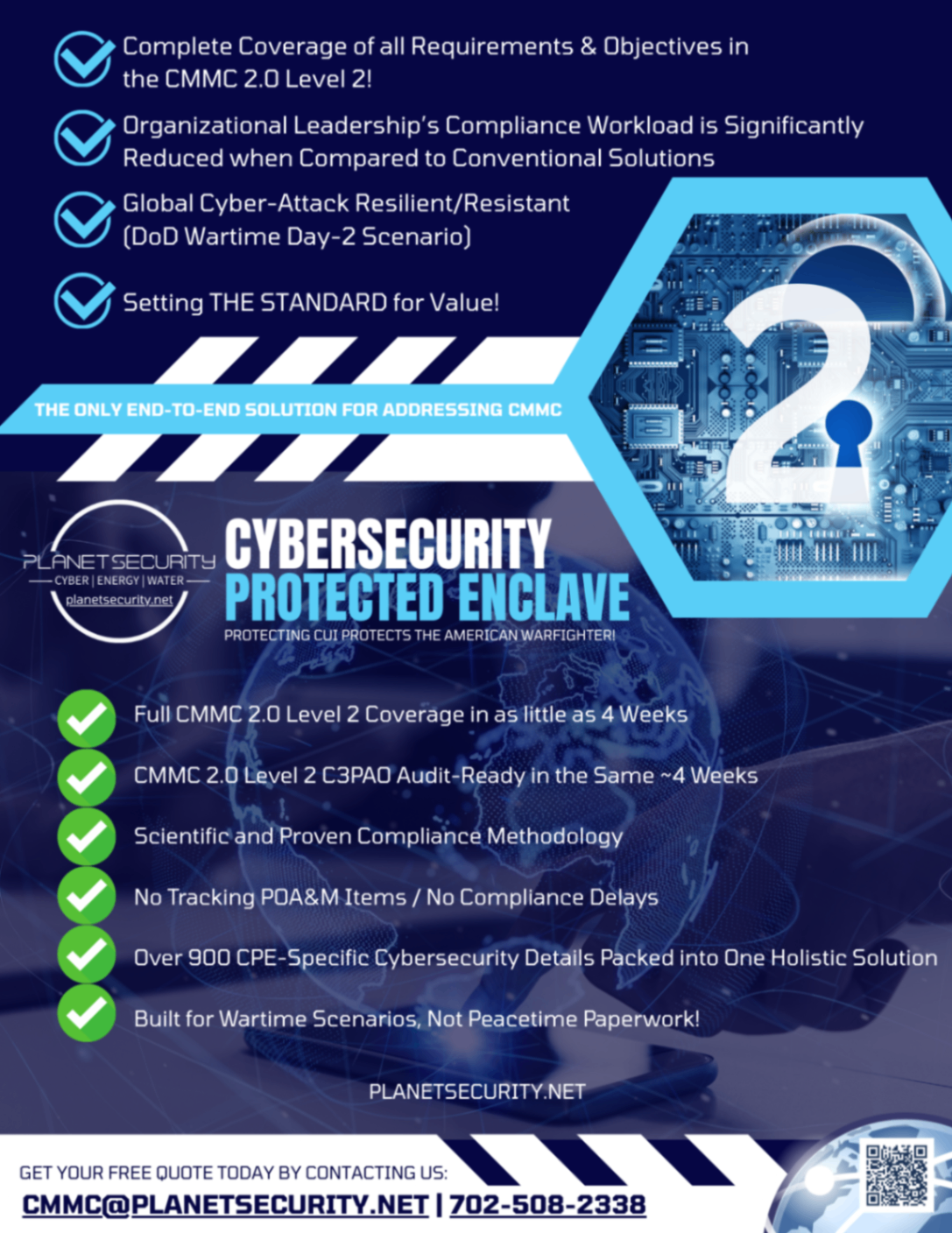
The solution provides 100% coverage of the 110 requirements and 320 objectives applicable to CMMC 2.0 Level 2. Instead of asking a small internal team to retrofit dozens of disconnected tools and procedures, Planet Security delivers an integrated enclave covering:
- Hardened infrastructure
- Security-focused configuration
- Network segmentation
- Identity and access controls
- Audit logging and accountability
- Encryption and backup protection
- Vulnerability management
- Incident response support
- Security policies and procedures
- Required security awareness training
- Ongoing maintenance and patching
- Continuous security and compliance monitoring
- Audit preparation and assessment support
The result is a dramatic reduction in manual POA&M tracking. Rather than managing a perpetual list of preventable gaps, your team operates within an environment engineered to maintain coverage and produce evidence as part of normal operations.
AI-Obfuscated Data: A Safer Model for AI-Enabled Workflows
Generic AI tools cannot be trusted with client data, intellectual property, financial information, personal information, or CUI. Sending sensitive content to a general-purpose Big-Tech platform can create unacceptable governance, confidentiality, and data-use risks.
Yoo-Jin AI is integrated into CPE Level 2 with a different architecture. Planet Security uses AI-obfuscated data so Yoo-Jin AI can support security and compliance workflows without receiving raw client data.
This privacy-first approach supports activities such as:
- Compliance-status analysis
- Security event correlation
- Automated workflow assistance
- Threat-intelligence processing
- Evidence organization
- Control monitoring
- Machine-speed response orchestration
AI should assist with protected workflows: not become another destination for sensitive information. Yoo-Jin AI is designed around that principle.
What Does CPE Level 2 Cost?
CPE Level 2 is $1,299/month for up to 20 users.
That monthly price includes the integrated enclave infrastructure, security configuration, managed operations, monitoring, maintenance, evidence support, security training, required policies and procedures, backup protections, and ongoing compliance-focused services.
Organizations selecting an 8-week deployment instead of the standard 4-week deployment receive a $100/month pricing reduction. The longer deployment schedule can provide additional planning flexibility while maintaining the same complete Level 2 coverage objective.
The central value is not the monthly price. It is the reduction in compliance uncertainty, operational burden, security exposure, and contract risk.
Frequently Asked Questions
Is a completed checklist enough for CMMC 2.0 Level 2?
No. Assessors evaluate evidence at the assessment-objective level. Your organization must demonstrate that requirements are implemented, operating as intended, and producing the required outcomes.
Does continuous monitoring replace formal assessments?
No. Continuous monitoring supports ongoing control effectiveness and risk management. It helps ensure that controls remain operational between formal assessments and provides current evidence for review.
Does CPE Level 2 guarantee certification?
No provider can replace the independent judgment of an authorized assessor. CPE Level 2 is engineered to provide 100% coverage of the 110 requirements and 320 objectives, establish audit-ready evidence, and maintain the environment through managed operations.
Why is a controlled enclave better than disconnected compliance tools?
Disconnected tools create integration gaps, inconsistent ownership, and evidence-management overhead. CPE Level 2 combines infrastructure, controls, policies, monitoring, maintenance, and evidence support into one managed operating model.
Beyond the Checklist
Defense contracts depend on trust. Customers, primes, and government stakeholders need confidence that CUI is protected today: not merely that a checklist was completed in the past.
Audit evidence, continuous monitoring, and complete control coverage are the foundation of that confidence.
With CPE Level 2, Planet Security delivers a pragmatic, execution-driven path to CMMC 2.0 Level 2 readiness and sustained security operations. There is simply no substitute for an environment that is built to cover the full scope, monitored continuously, and supported by experts who understand the realities of defense contracting.
We welcome a discussion on how we may assist in your CMMC success story!
Explore CPE Level 2 technical details or contact Planet Security at 702.634.7233.
| planetsecurity.net | 702.634.7233 | |
|---|