If you are a small defense contractor, you probably spend a decent amount of time staring at CMMC requirements and wondering if you’re actually going to pass an audit. I get it. The Department of Defense (DoD) isn't known for making things simple. But here is the cold, hard truth: the biggest reason most contractors fail or spend way too much money is poor scoping.
Scoping is the process of deciding which parts of your business actually need to meet those 110 CMMC requirements and 320 objectives. If your scope is too small, you fail the audit. If it’s too big, you’re throwing money into a black hole.
At Planet Security Inc., we see the same seven mistakes over and over again. If you want to stop the bleeding and get audit-ready without losing your mind, listen up.
1. Including Your Entire Corporate Network
This is the "Ocean-Boiling" approach, and it’s the fastest way to go bankrupt. Most contractors think, "Well, we have CUI, so I guess the whole office needs to be locked down." Wrong.
If your guest Wi-Fi, your receptionist’s computer, and your smart thermostat are all on the same network as your CUI, then every single one of those devices is in scope. That means you have to apply high-level security controls to things that don't even handle sensitive data.
The Fix: Use a "Protected Enclave" approach. By implementing our CPE Level 2, you wall off the CUI from the rest of your business. This shrinks your assessment scope, which directly translates to saving massive amounts of money and time during an audit.
2. Thinking "CUI" Is the Only Thing That Matters
A common mistake is thinking that if a device doesn't "touch" CUI, it’s out of scope. CMMC 2.0 Level 2 introduces the concept of Security Protection Assets (SPAs). These are assets that provide security functions to the CUI environment, like your firewall, your antivirus server, or your identity management system.
Even if your firewall doesn't store a single byte of CUI, it is 100% in scope because it protects the data. If you ignore these during your internal prep, you are in for a very rude awakening when the auditor shows up.
3. Trusting Generic AI with Your Compliance Data
In 2026, everyone is using AI. But if you are feeding your system security plans (SSPs) or sensitive contract details into a generic "Big Tech" AI tool to help write policies, you are likely leaking CUI into the public domain.
Generic AI tools cannot be trusted with client data. Period. At Planet Security Inc., we use a scientific compliance methodology that features AI-obfuscated data. We leverage the power of AI to speed up your implementation without ever exposing your sensitive info to the open web. It’s the only way to stay fast and stay secure.
4. Forgetting the "Human" Scope
Your scope isn't just hardware and software; it's people. If an employee has access to the room where CUI is stored, or if they have admin rights to a system that handles CUI, they are in scope.
Many small contractors forget to include their "part-time" IT guy or their external MSP in the scope. If they have the keys to the kingdom, the auditor is going to check their background, their training, and their access logs.
5. Poor Asset Inventory (The "I Think We Have 20 Computers" Problem)
You cannot protect what you don't know exists. Most contractors have a "shadow IT" problem, employees using personal Dropbox accounts, unmanaged USB drives, or personal laptops to "get work done."
If you can't produce a definitive, verified list of every asset that touches CUI, you have already failed the audit. Audit readiness requires a scientific approach to asset management.
6. DIY-ing Your Boundary Definitions
I see a lot of small shops trying to build their own "enclaves" using basic VLANs or consumer-grade hardware. Look, I admire the hustle, but there is no substitute for a professionally engineered enclave.
A proper boundary needs to handle 110 requirements, including FIPS-validated encryption and multi-factor authentication (MFA). If your "DIY" boundary has a single leak, the auditor will "bleed" the scope back out to your entire network. Suddenly, your $10k project becomes a $100k nightmare.
7. Waiting Until the Contract Is Signed to Start
The DoD isn't playing around anymore. CMMC is moving from "eventual" to "mandatory" right now. If you wait until you see a CMMC requirement in a Request for Proposal (RFP), you’ve already lost. It takes time to implement these controls correctly.
Most "traditional" security firms will tell you it takes 12 to 18 months to get CMMC-ready. We think that’s ridiculous.
How to Fix Your Scoping Nightmare: The CPE Level 2
The answer isn't to work harder; it's to work smarter. You need to shrink the target.
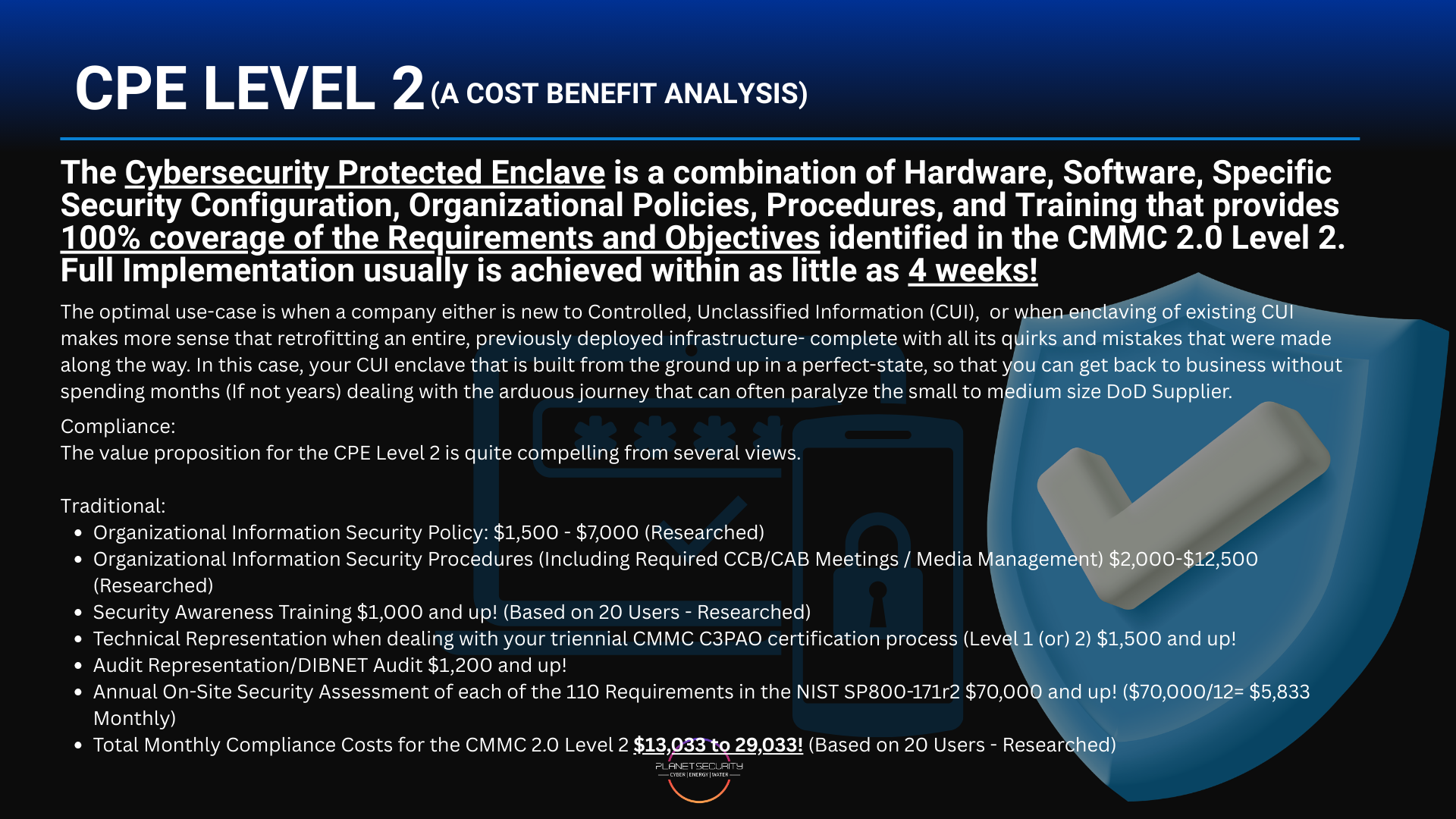
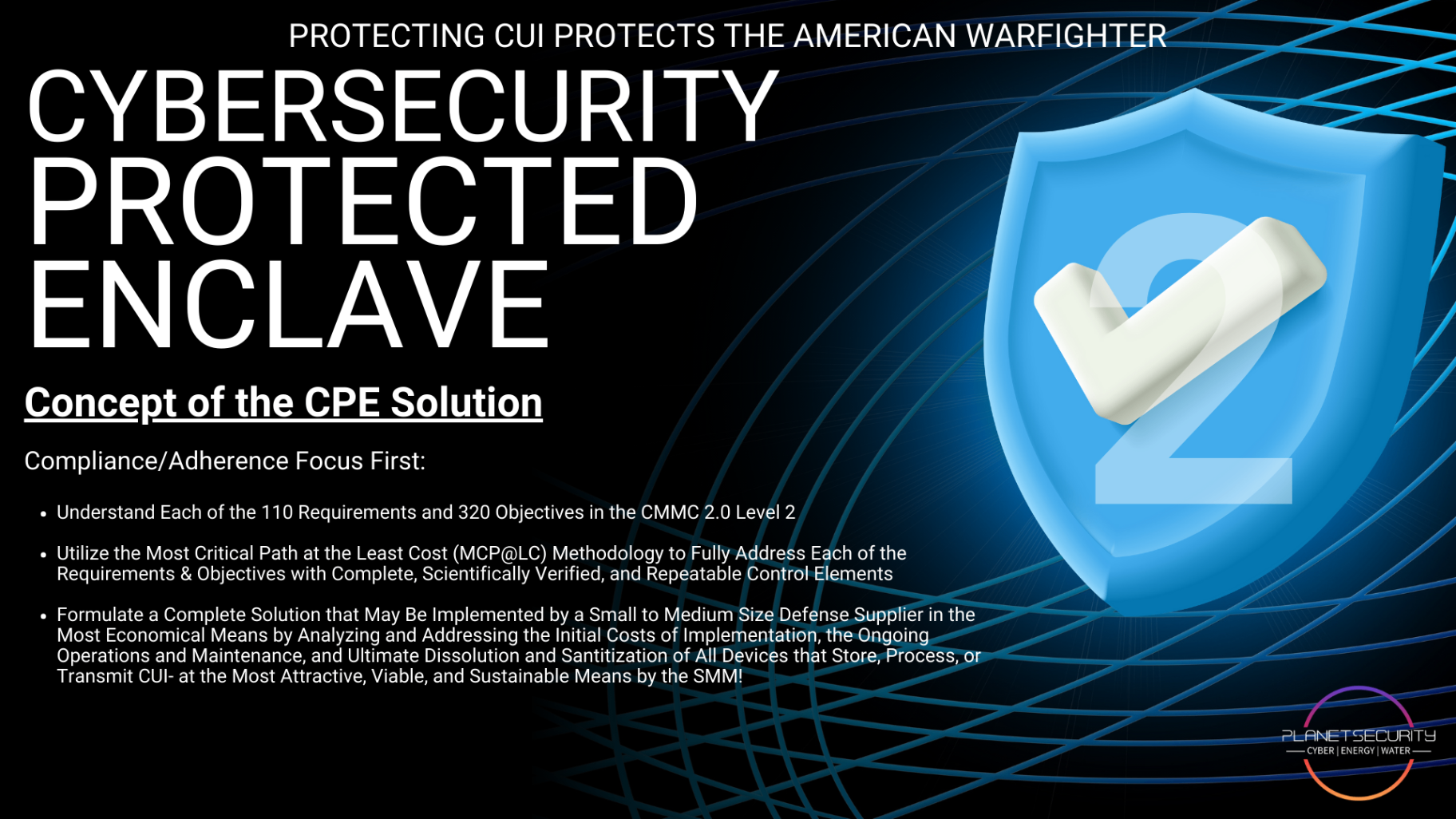
Our CPE Level 2 (Cybersecurity Protected Enclave) is a turnkey solution designed specifically for small-to-medium defense suppliers. Instead of trying to secure your entire messy office network, we drop in a pre-configured, 100% compliant environment where your CUI lives.
Why the Enclave Method Wins:
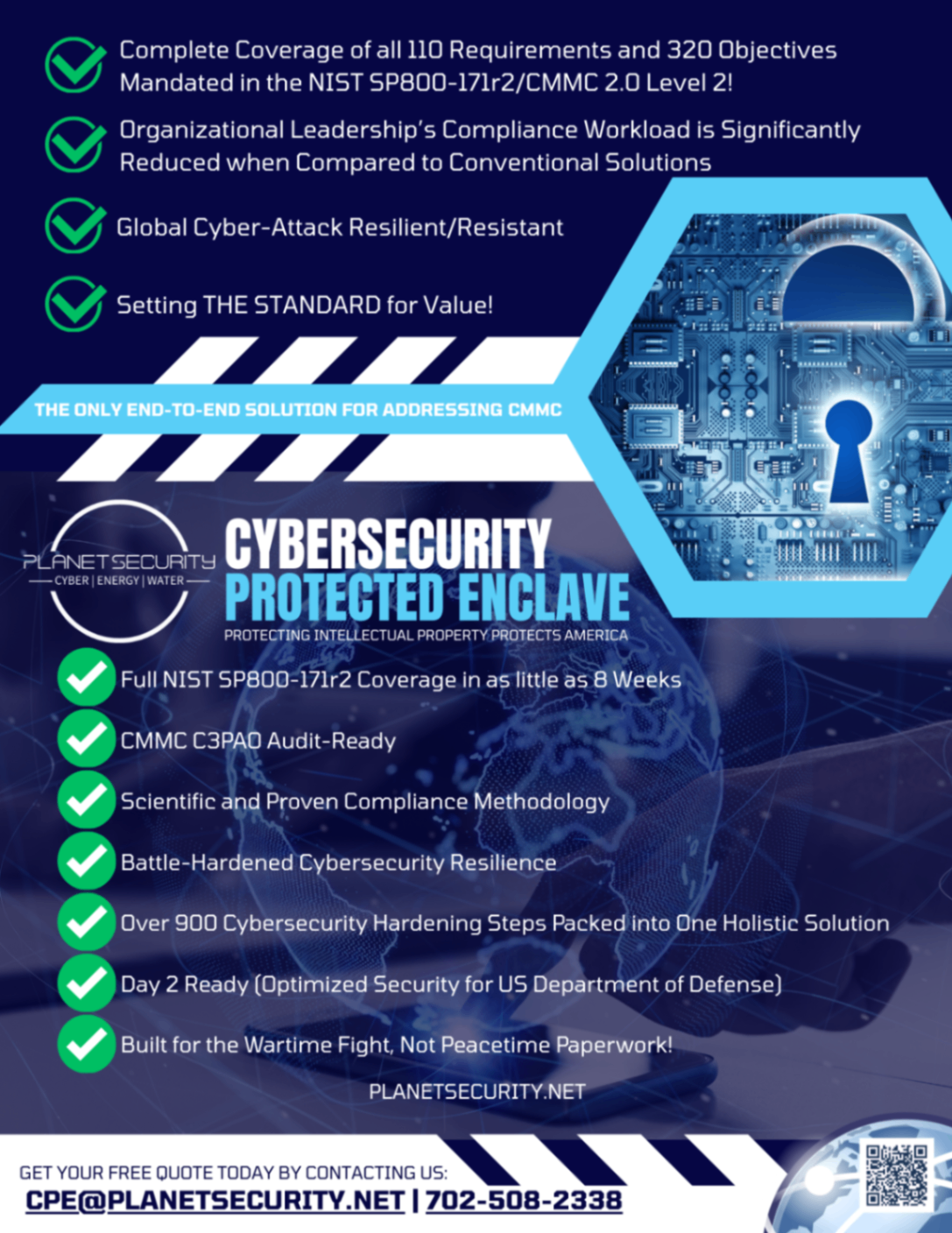
- Unparalleled Security Posture: We use over 900 hardening steps to ensure your data is safe from global cyber-attacks.
- Audit Ready in Weeks, Not Years: While others are still writing policies, our clients are often ready for assessment in as little as 4 weeks.
- Scientific Methodology: We don't guess. We use a proven, repeatable process that covers all 110 CMMC requirements and 320 objectives.
- Cost Predictability: No more "surprise" consulting fees.
Introducing: The "Planetary Option" for Small Offices
We know that small contractors are the backbone of the defense industrial base, and you don't have $250k sitting around for a compliance project. That’s why we created the Planetary Option.
For small offices, we offer a specialized deployment of CPE Level 2:
- $1,999/month (for up to 20 users).
- 8-week implementation timeline.
- Full CMMC 2.0 Level 2 coverage.
By choosing an 8-week deployment instead of our standard 4-week "Wartime Readiness" sprint, you save $100/month on your ongoing compliance costs. It’s the most cost-effective way to achieve 100% coverage of the CMMC mandates.
Frequently Asked Questions (FAQ)
Q: Does the $1,999/month include everything?
A: Yes. It includes the hardware, software, licensing, security patching, backup, vCISO services, and audit support. It is a complete compliance-in-a-box solution.
Q: Can I keep my current office network?
A: Absolutely. That’s the beauty of the CPE Level 2. Your "dirty" office network stays exactly as it is for things like browsing the news or printing lunch menus. Your CUI and "important stuff" stay inside the secure enclave. Your audit scope is restricted to the enclave.
Q: What if I have more than 20 users?
A: No problem. We have scalable solutions for any size, but our sweet spot is helping small contractors who are being squeezed by big-tech pricing.
Q: Is this just another MSP?
A: No. We are a Cybersecurity and IT Compliance firm. Most MSPs know how to make things work; we know how to make things compliant. There is a massive difference when the auditor starts asking for your Shared Responsibility Matrix.
Stop Stressing, Start Winning
Scoping shouldn't be a guessing game. Every day you spend with an "open" network is a day you are at risk of a data breach and an audit failure.
Planet Security Inc. is changing the entire industry by making high-level defense security accessible to the "little guys." We provide outstanding value leadership and a reduced compliance workload so you can get back to what you actually do: building things for the DoD.
There is simply not a more comprehensive offering on the market today. Don't let scoping mistakes sink your business.
Visit planetsecurity.net today to shrink your scope and your stress. Get started with your CPE Level 2 deployment and be ready for your audit before your competitors even know what hit them!